My name is Rachel Greszler. I am a senior research fellow in workforce and public finance at The Heritage Foundation, and a visiting fellow in workforce at the Economic Policy Innovation Center. The views I express in this testimony are my own and should not be construed as representing any official position of The Heritage Foundation or of the Economic Policy Innovation Center.
My testimony today focuses on three aspects of older Americans’ positive impact in today’s economy:
First, demographic shifts mean that older Americans are increasingly vital contributors to the American economy.
Second, cultural ails cry out for older generations to impart their wisdom, reasoning, and resilience to younger generations.
Third, policymakers can and should implement policy changes to make it easier for older Americans to remain engaged in meaningful activities.
Demographic Shifts Mean That Older Americans Are Increasingly Vital Contributors to the American Economy
The combination of declining fertility rates, the aging of the baby boomer population, and increased life expectancies means that older Americans are a rapidly growing share of the population. Beginning in 2034, there will be more seniors than children in America for the first time in U.S. history.
[1]
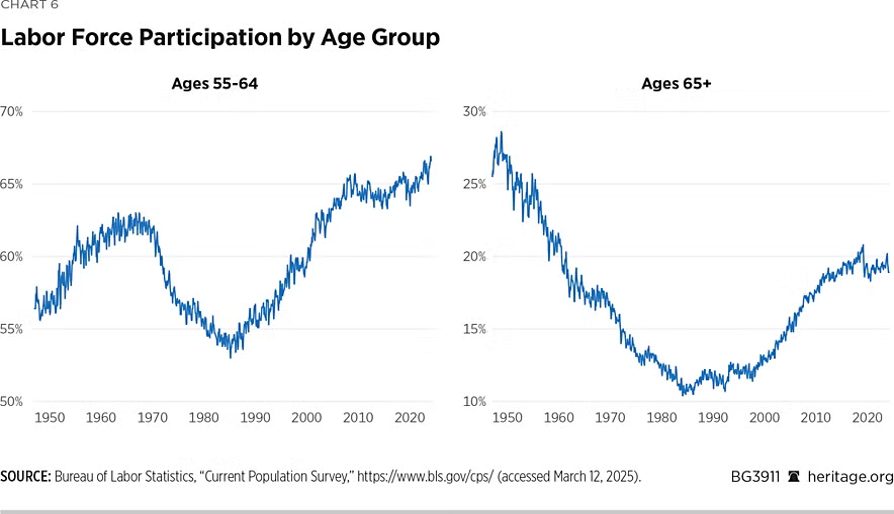
As the share of Americans ages 55 and older increased from 16 percent in 1950 to 25 percent in 2025, and is projected to reach 35 percent by 2060, the American economy needs more older Americans to remain productive. Fortunately, the trend is already headed in the right direction as older Americans’ labor force participation rate has increased significantly over the past 40 years, including a 10.9 percentage point increase among individuals ages 55 to 64, and a 7.0 percentage point increase among individuals ages 65 and older.
[2]
Improvements in health—including medical advancements—and less physically demanding jobs have helped to propel this rise in older Americans’ labor force participation
, and they provide the capacity for even further growth in older Americans’ labor force participation.
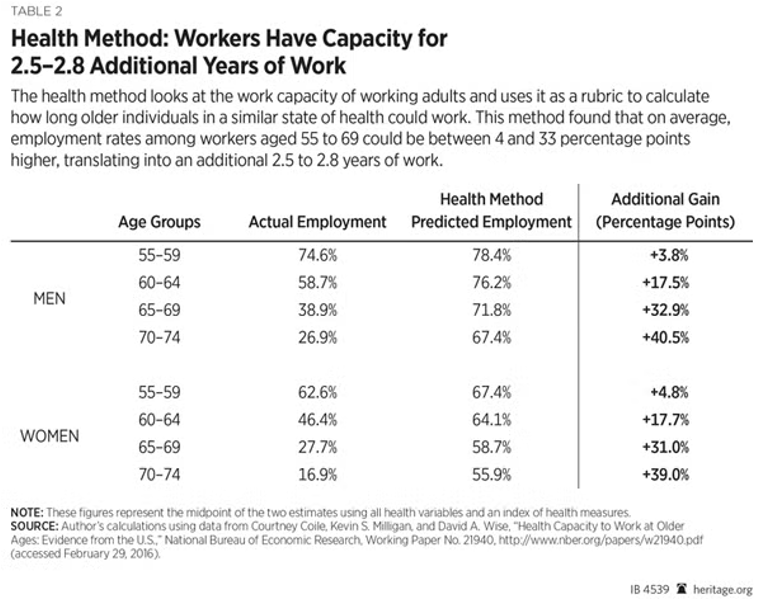
[3] In particular, an economic analysis that compared health and mortality data of Americans ages 55 to 69 in 1977 and 2010 estimated that older Americans in 2010 could have been working an additional 2.7 years to 4.2 years if they were to work in the same manner as their similarly situated counterparts from 1977.
[4] It is important to note that while there have been significant positive improvements in health, they are not universal across all older workers, and some, such as construction workers, and other hard-labor workers, still need to retire from those jobs before standard retirement ages.
Another positive change contributing to the rise in older Americans’ labor force participation has been the expansion of independent or freelance work. Rather than a full-stop retirement, many older workers have instead been gradually transitioning into retirement. Often times, that includes retiring from 9-to-5 jobs and shifting to contract-based work that affords older workers significant flexibility over when, where, and how many hours they work. According to the Freelance Forward 2023 report, “26% of Boomer professionals, and 38% of Silent Generation professionals” performed freelance work in 2023.
[5]
Cultural Ails Cry Out for Older Americans to Impart Their Wisdom, Experience, Judgement, and Resilience to Younger Generations
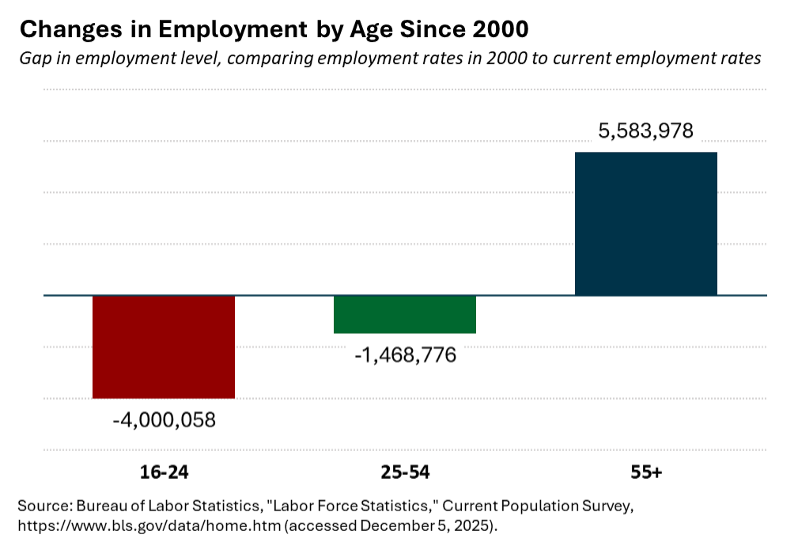
As employment has been rising among older Americans, it has fallen precipitously among younger Americans. Between 2000 and 2025, the employment rate of younger Americans (ages 16 to 24) fell by 10.2 percentage points, from 59.9 percent in September 2000 to 49.7 percent in September 2025.
This decline of just over 4 million younger workers is particularly regrettable because early employment imparts skills and experience, and teaches important life lessons like: showing up on time; demonstrating respect and kindness to co-workers and customers; staying on task even when it is difficult or boring; and disconnecting from screens and interacting face to face.
The onset of a screen-based childhood, and an increasingly screen-infused culture have proved particularly harmful to children and young adults, leading to a decline in personal characteristics that contribute to success in school, work, relationships, and overall well-being.
[6] For example, scholar Samuel J. Abrams said that, over the past two decades, society has been witnessing “the quiet unraveling of a trait that built civilization.”
[7] That trait is conscientiousness, and it is generally associated with tendencies to be careful, disciplined, persistent, and dependable. As Abrams noted,
Between 2014 and 2024, conscientiousness scores among Americans aged 16–39 dropped more sharply than any personality shift in recorded history. Younger cohorts report feeling 20 percent more distracted and careless than just a decade ago. They demonstrate less tenacity, make fewer commitments, and struggle to follow through on the ones they do make. Most alarming: the steepest declines occur during the transition from adolescence to early adulthood—precisely when character traits typically solidify for life.[8]
Perhaps more than ever, younger Americans need to spend more time engaged with and learning from older Americans. Older generations have long been the stewards of families, communities, and cultural memories—offering perspective, insight, and intergenerational connection that strengthens the fabric of society. As a generation that did not grow up with screens, and that understands the value of face-to-face connections, the importance of hard work, commitment, and respect, and which embodies resilience, today’s older Americans have so much to offer younger generations.
In the workplace, older Americans play an important role by sharing decades’ worth of wisdom and experience, passing on institutional knowledge and practices, and mentoring younger workers. Of particular importance today is older Americans’ ability to impart a strong work ethic, show how to work amicably and collaboratively with others, and demonstrate soft skills like punctuality, clear communication, and respect.
Outside of the formal workplace, older Americans’ volunteer work provides meaningful services that strengthen civil society. Whether it be volunteering in a church, serving on a non-profit board, cooking and delivering meals, tutoring at-risk youth, or serving as hospice companions, older Americans’ volunteer work improves the lives of others. Moreover, their engagement in volunteer work helps to pass down civic values, history, and ethical norms.
Older Americans are also the matriarchs and patriarchs of families. In addition to the wisdom, guidance, and sometime financial support that they provide, older Americans also spend significant time and energy caring for grandchildren. According to the National Poll on Healthy Aging, 20 percent of people with grandchildren under age 18 provide care for them at least once a week, and 8 percent provide daily or near-daily care.
[9] That same poll found that the benefits of grandparent care are mutually beneficial—enhancing both grandchildren’s and grandparents’ lives. Moreover, grandparents’ care can save families significant money, and the overwhelming majority of parents feel most comfortable with their children being cared for by family members.
[10]
Clement Troutman. I’d like to share a story about Clement Troutman, who is just one example of someone who is aging with purpose. Clement Troutman had a long and successful career serving in the Navy and then as a defense contractor. Instead of retiring early, Clement decided at age 60 to pursue his dream of owning his own business and he opened a Tropical Smoothie Café.
[11] Today, he owns one of the chain’s most successful stores—which he operates alongside his daughter.
When Clement passionately told me about his café and how he treats his team—he told me he does not have employees, but a team—the “dream team”—I wished I could work for Clement, or at least have my teenage son work for him. In addition to his passion of providing healthy food, Clement is passionate about helping people reach their potential. To that end, Clement sits down with each of his team members twice a year. Whether high schoolers working part-time to contribute at home or save for college, or single parents providing for their families, Clement wants to make sure he is doing all that he can to help them meet their goals.
Having just celebrated his 67th birthday this Monday, Clement is not stepping onto the sidelines. This past year, he opened a second Tropical Smoothie Café and a PJ’s Coffee Café. And he has plans for yet another store. As Clement expands his businesses while also serving in charitable organizations, I cannot help but smile at the thought of all the lives that Clement is positively impacting as he ages with purpose.
Policymakers Can and Should Make It Easier for Older Americans to Stay Engaged
While it should always be the choice of individuals how they spend their time and resources, particularly in older age and after decades of work, the federal government should not make it harder for older Americans to remain engaged in productive activities as they age. As income and health insurance are two of older Americans’ top concerns, policymakers should reduce excessive taxes on certain Social Security recipients and expand access to lower-cost, market-driven health insurance options.
Eliminating Social Security’s Retirement Earnings Test. Social Security’s Retirement Earnings Test is an outdated, little-known, and misunderstood relic of the original 1935 Social Security Act. When Social Security first began in the wake of the Great Depression, policymakers wanted to encourage older Americans to leave the labor force to free up jobs for younger workers. Consequently, the original version of Social Security’s Retirement Earnings Test was a prohibition on Social Security benefits for anyone who was still working.
[12]
The Retirement Earnings Test has been revised over time and, currently, it applies to Social Security recipients who are between the ages of 62 and 66, and who earn more than $23,400 per year. For those recipients, the Retirement Earnings Test takes away $1 in Social Security benefits for every $2 in earnings above $23,400 per year. Although retirees can later recoup some or all of the money taken out of their Social Security benefits by the Retirement Earnings Test, most people do not realize this, and the test is perceived as an additional 50 percent tax.
[13] This results in marginal tax rates as high as 84 percent, which, not surprisingly, suppresses the work and earnings of older Americans.
[14]
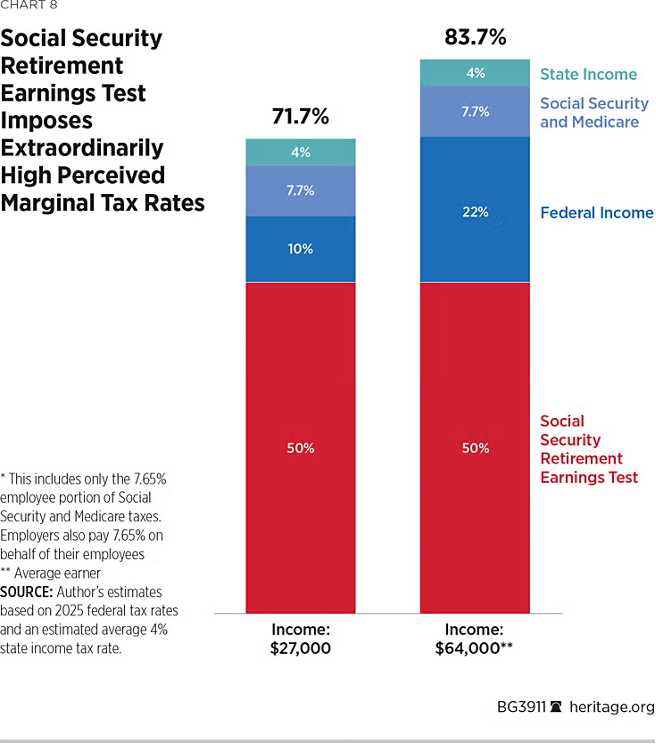
Many studies, including multiple ones conducted by the Social Security Administration, find that the Retirement Earnings Test significantly reduces older Americans’ work below what they would otherwise choose.
[15] While that was the intent of the original, Depression-era earnings test—to push older Americans out of the labor force—today’s economy would benefit from the continued work of older Americans.
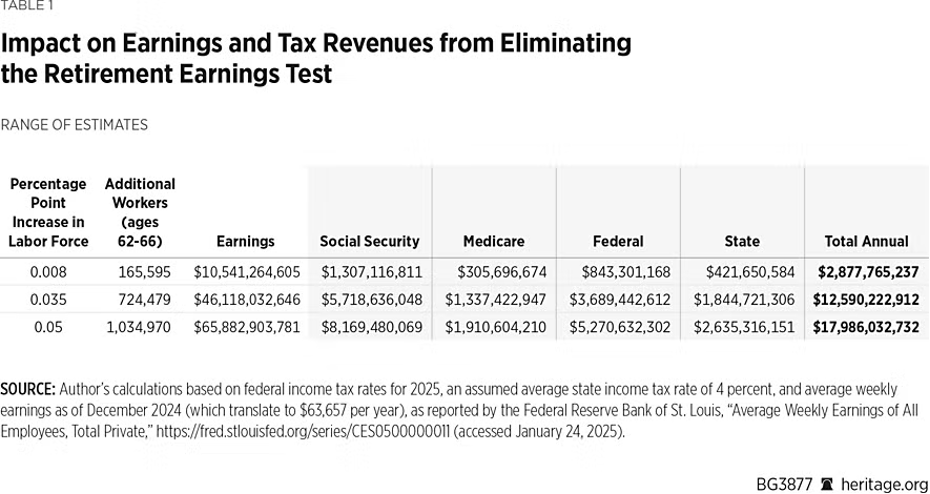
Based on evidence from past studies, I estimate that removing Social Security’s Retirement Earnings Test could increase the U.S. labor force by up to 1 million workers.
[16] The additional full-time and part-time work of older Americans would increase older Americans’ incomes, modestly reduce poverty among seniors, potentially improve physical and mental health, help to fill labor shortages, contribute to economic output, increase government revenues by up to $18 billion per year, and modestly improve the solvency of the Social Security and Medicare programs. Moreover, eliminating the Retirement Earnings Test would reduce administrative costs and complexities for the Social Security Administration, and eliminate all confusion and inquiries among seniors whose benefits are affected by the test.
[17]
All these positive results would stem from more Americans achieving their ideal levels of work in the absence of a government policy that actively discourages work. This win-win policy is evident in the fact that the last time that Congress addressed the Retirement Earnings Test, in 2000—eliminating the test for beneficiaries over Social Security’s normal retirement age—the proposal was fully bipartisan, with a vote of 422 to 0 in favor in the House, passed by unanimous consent in the Senate, and signed into law by President Bill Clinton. Since Social Security’s retirement age has been rising from 65 to 67, the Retirement Earnings Test now applies to and potentially suppresses the labor force participation of millions more seniors.
Expanding Health Insurance Options. Older Americans tend to have more health care needs and thus higher health care costs. Consequently, health insurance is especially important to them. Senator Rick Scott’s (R–FL) Health Freedom Accounts proposal would allow federal subsidies to go directly to individually owned health savings accounts (HSAs) (associated with the individual’s health insurance plan), instead of directly to insurance companies. In addition to the proven cost benefits of consumer-driven HSA health insurance plans, Health Freedom Accounts would allow individuals to build a health care nest egg to help to pay for future health care costs. Significantly, Health Freedom Accounts would not take away any existing options. They would simply offer a way for individuals to directly receive health insurance subsidies in HSAs instead of the subsidies going to insurers even if individuals have few or no health care expenses.
Reducing Regulations That Make It Harder to Work or Start a Business. In addition to the most significant factors of taxes and health insurance, a litany of government regulations function as additional taxes on work and entrepreneurship. To make it easier for all Americans, and particularly older Americans, to continue working in the ways that work for them, policymakers should consider the following bills that would remove existing regulatory barriers to work:
- The Modern Worker Empowerment Act[18] and the 21st Century Worker Act.[19] These bills would create a single, simple test of employee or independent contractor status, consistent across all federal law, and based on the level of control an individual has over his or her work. This would particularly help older Americans who want to transition from traditional 9-to-5 employment to flexible, contract-based employment.
- The Unlocking Benefits for Independent Workers Act.[20] This act would create a safe harbor for companies that do business with independent contractors to offer them benefits without triggering employee status. This could help older Americans to gain access to health insurance without having to remain in a traditional 9-to-5 job.
- The Independent Retirement Fairness Act.[21] This act would expand retirement savings options for independent workers and make it easier for them to save as they move across different jobs.[22]
- The Association Health Plans Act.[23] This act would allow independent workers and small businesses to pool together to negotiate collectively so that they can benefit from the lower costs of pooled health insurance.
- The Save Local Business Act.[24] This act would help to protect successful small-business entrepreneurship models—such as Clement Troutman’s multiple franchises—by defining joint employer status based on whether or not an entity exercises direct and immediate control over essential terms and conditions of employment.[25]
Summary
Older Americans are vital contributors to the economy. They confer invaluable wisdom and mentorship to younger generations, and their continued engagement benefits everyone. Demographic trends amplify the importance of older Americans’ contributions, and cultural trends cry out for their heightened influence. Consequently, it is more important than ever to remove unnecessary barriers that limit older Americans’ ability to stay engaged.
We have seen significant increases in labor force participation among older Americans in recent decades, thanks to improved health, longer life spans, and more flexible work options. But outdated policies—like the Social Security Retirement Earnings Test, overly burdensome licensing requirements, and restrictive definitions of employment—make it harder for older Americans who want to stay engaged to pursue the paths that are best for them.
Policymakers should repeal Social Security’s Retirement Earnings Test, protect flexible work, expand portable benefit opportunities, and preserve successful business models like franchising. These changes would allow older Americans to stay engaged in the ways that work for them, which would not only support seniors, but also strengthen families, workplaces, the economy, and the fabric of society.
[1] Jonathan Vespa, Lauren Medina, and David M. Armstrong, “Demographic Turning Points for the United States: Population Projections for 2020 to 2060,” U.S. Census Bureau, issued March 2018, revised February 2020,
https://www.census.gov/content/dam/Census/library/publications/2020/demo/p25-1144.pdf (accessed December 4, 2025).
[2] Bureau of Labor Statistics, “Labor Force Participation Rate by Age,” Current Population Survey,
https://www.bls.gov/data/home.htm (accessed December 5, 2025). For individuals ages 55 to 64, the labor force participation rate rose from 55.7 percent in September 1985 to 66.6 percent in September 2025. For ages 65+ the labor force participation rate rose from 12.5 percent in September 1985 to 19.5 percent in September 2025. Note that the decline in participation rates of individuals age 65+ that began in 2020 has been attributed to the steep rise in home prices. By significantly boosting the nest eggs of older homeowners, this increase in home values caused some homeowners to retire earlier than they had planned. See Jack Favilukis and Gen Li, “The Great Resignation Was Caused by the COVID-19 Housing Boom,” University of British Columbia Sauder School of Business, January 24, 2023, https://papers.ssrn.com/sol3/papers.cfm?abstract_id=4335860 (accessed March 1, 2023). The chart “Labor Force Participation by Age Group” is from Rachel Greszler, “America’s Retirees: Comfort or Crisis? Current Retirees Are Doing Better than Ever, but Threats Loom for Younger Generations,” Heritage Foundation
Backgrounder No. 3911, June 4, 2025,
https://www.heritage.org/sites/default/files/2025-06/BG3911.pdf.
[3] Rachel Greszler, “Rescuing Entitlements and Pensions: Study Shows Americans Can Work Longer,” Heritage Foundation
Issue Brief No. 4539, April 6, 2016, https://www.heritage.org/jobs-and-labor/report/rescuing-entitlements-and-pensions-study-shows-americans-can-work-longer.
[4] Courtney Coile, Kevin S. Milligan, and David A. Wise, “Health Capacity to Work at Older Ages: Evidence from the U.S.,” National Bureau of Economic Research
Working Paper No. 21940, January 2016,
http://www.nber.org/papers/w21940.pdf (accessed January 16, 2025).
[5] Upwork, “Freelance Forward 2023,” December 12, 2023, https://www.upwork.com/research/freelance-forward-2023-research-report (accessed March 24, 2025).
[6] USC Dornsife Center for Economic and Social Research, “Understanding America Study,”
https://uasdata.usc.edu/index.php (accessed September 15, 2025).
[7] Samuel J. Abrams, “The Quiet Crisis: Why Conscientiousness Matters More Than Ever,” American Enterprise Institute, August 11, 2025,
https://www.aei.org/society-and-culture/the-quiet-crisis-why-conscientiousness-matters-more-than-ever/ (accessed September 12, 2025).
[8] Ibid.
[9] Katie Bauer, “Grandparents Help Kids in Many Ways—But the Reverse May Be True Too, Poll Suggests,” National Poll on Healthy Aging, University of Michigan, November 12, 2024,
https://www.healthyagingpoll.org/reports-more/poll-extras/grandparents-help-grandkids-many-ways-reverse-may-be-true-too-poll?utm (accessed July 9, 2025).
[10] Wendy Wang and Jenet Erickson, “Homeward Bound: The Work–Family Reset in Post-COVID America,” Institute for Family Studies
Research Brief, August 2021, https://ifstudies.org/ifs-admin/resources/final-ifsparentsreport.pdf (accessed July 10, 2025).
[11] Joanna Fantozzi, “Nation’s Restaurant News: How a Veteran with Top Secret Security Clearance Became a Tropical Smoothie Café Franchisee,” International Franchise Association, February 20, 2025,
https://www.franchise.org/2025/02/how-a-veteran-with-top-secret-security-clearance-became-a-tropical-smoothie-cafe-franchisee/ (accessed July 10, 2025).
[12] Rachel Greszler, “Ending the Retirement Earnings Test: A Pro-Growth Proposal to Cut Social Security Taxes and Improve Program Solvency,” Heritage Foundation
Backgrounder No. 3877, March 3, 2025,
https://www.heritage.org/budget-and-spending/report/ending-the-retirement-earnings-test-pro-growth-proposal-cut-social.
[13] The retirement earnings test applies to anyone who collects Social Security benefits before reaching normal retirement age, which is 67 for anyone born in 1960 or later. The earnings test level, which is updated annually, is $23,400 for 2025. Although the earning test functions like a 50 percent tax, the amounts taken from workers’ Social Security checks are later added back in, by an upward revision to benefits once (or if) the individual reaches normal retirement age.
[14] The chart “Social Security Retirement Earnings Test Imposes Extraordinarily High Perceived Marginal Tax Rates” is from Greszler, “America’s Retirees: Comfort or Crisis? Current Retirees Are Doing Better than Ever, but Threats Loom for Younger Generations.”
[15] Anya Olsen and Kathleen Romig, “Modeling Behavioral Responses to Eliminating the Retirement Earnings Test,”
Social Security Bulletin, Vol. 73, No. 1 (2013), https://www.ssa.gov/policy/docs/ssb/v73n1/v73n1p39.pdf (accessed January 2, 2025); Steven J. Haider and David S. Loughran, “The Effect of the Social Security Earnings Test on Male Labor Supply: New Evidence from Survey and Administrative Data,”
Journal of Human Resources, Vol. 43, No. 1 (February 2008), pp. 57–87, https://www.researchgate.net/publication/24142180_The_Effect_of_the_Social_Security_Earnings_Test_on_Male_Labor_Supply_New_Evidence_from_Survey_and_Administrative_Data (accessed February 3, 2025); Leora Friedberg, “The Social Security Earnings Test and Labor Supply of Older Men,” in James M. Poterba, ed.,
Tax Policy and the Economy, Vol. 12 (Cambridge, MA: MIT Press, 1998), pp. 121–150, http://www.nber.org/chapters/c10915 (accessed February 3, 2025); Cordelia Reimers and Marjorie Honig, “Responses to Social Security by Men and Women: Myopic and Far-Sighted Behavior,”
Journal of Human Resources, Vol. 31, No. 2 (1996), pp. 359–382; Michael V. Leonesio, “The Effects of the Social Security Earnings Test on the Labor-Market Activity of Older Americans: A Review of the Evidence,”
Social Security Bulletin, Vol. 53, No. 5 (1990), pp. 2–21, http://www.socialsecurity.gov/policy/docs/ssb/v53n5/v53n5p2.pdf (accessed January 3, 2025); and Gary Burtless and Robert A. Moffitt, “The Joint Choice of Retirement Age and Postretirement Hours of Work,”
Journal of Labor Economics, Vol. 3, No. 2 (1985), pp. 209–236.
[16] Rachel Greszler, “Ending the Retirement Earnings Test: A Pro-Growth Proposal to Cut Social Security Taxes and Improve Program Solvency,” Heritage Foundation
Backgrounder No. 3877, March 3, 2025,
https://www.heritage.org/sites/default/files/2025-03/BG3877.pdf.
[17] The chart “Impact on Earnings and Tax Revenues from Eliminating the Retirement Earnings Test” is from ibid.
[18] S. 2228, Modern Worker Empowerment Act, 119th Congress, introduced July 7, 2025, https://www.help.senate.gov/imo/https://epr-creations.github.io/epic-media/doc/modern_worker_empowerment_actpdf.pdf (accessed July 11, 2025).
[19] S. 2159, 21st Century Worker Act, 118th Congress, introduced June 22, 2023,
https://www.govinfo.gov/content/pkg/BILLS-118s2159is/pdf/BILLS-118s2159is.pdf (accessed July 11, 2025).
[20] S. 2110, Unlocking Benefits for Independent Workers Act, 119th Congress, introduced July 7, 2025, https://www.help.senate.gov/imo/https://epr-creations.github.io/epic-media/doc/unlocking_benefits_for_independent_workers_act_text_1pdf.pdf (accessed July 11, 2025).
[21] S. 2217, Independent Retirement Fairness Act, 119th Congress,
https://www.help.senate.gov/imo/https://epr-creations.github.io/epic-media/doc/independent_retirement_fairness_act.pdf (accessed July 11, 2025).
[22] For example, the act includes a “suspension account,” which is a flexible savings account that allows independent workers to set aside funds to reserve for retirement and to later deposit into a pooled employer retirement plan or a simplified employee pension.
[23] S. 1847, Association Health Plans Act, introduced May 22, 2025, 119th Congress,
https://www.paul.senate.gov/wp-content/uploads/2025/05/KEN2533825-1.pdf (accessed July 11, 2025).
[24] S. 1261, Save Local Business Act, 118th Congress, introduced April 25, 2023,
https://www.congress.gov/bill/118th-congress/senate-bill/1261/text?utm (accessed July 10, 2025).
[25] If the Biden Administration’s Joint Employer rule, which remains unsettled after a judge in the Eastern District of Texas vacated it, were to be enforced, Clement and more than 790,000 other franchise business owners would face significant limits to their abilities to operate their businesses, and the franchise business model as we know it could cease to exist for future, would-be business owners. The Save Local Business Act would provide needed clarity and certainty.