

The Congressional Budget Office (CBO) recently released the final estimates for fiscal year 2023, which ended in September 2023. As I previously noted, CBO’s report should be an alarm bell for Congress – but so should the cost of Biden Administration’s various student loan cancellation plans.
Federal Credit Reform Act Governs Scorekeeping of Government Loan Programs
In general, the federal budget is accounted for on a cash basis, with transactions recorded when funds leave or enter the Treasury.
However, loan programs are scored under Federal Credit Reform Act (FCRA) accrual accounting rules. FCRA requires that the net present value of loans be recorded at the time a loan is made (or when a modification to the terms of the loan is made).
Net present value is the calculated value of all future expenses and receipts of the loan, discounted into current-value dollars. For example, if the future value of all of the expenses and receipts of a loan equals $1,000, then the net present value of that number would be $1,000 divided by the discount or interest rate. FCRA requires the discount rate for government loans to be assumed equal to the rates on Treasury securities (in contrast to Fair Value methodology that uses market rates for comparable loans, which the CBO believes is “a more comprehensive measure” of the taxpayer costs of loans).
Subsidized loans are recorded as positive outlays – meaning they are effectively counted as costing taxpayers –, while loans that turn a “profit” are negative spending, or an inflow. Student loans payments are an example of offsetting receipts, which represent funds received by the government that are counted as negative outlays that offset spending.
Student Loan Cancellation Increases Government Outlays, Supreme Court Striking It Down Reduces Costs
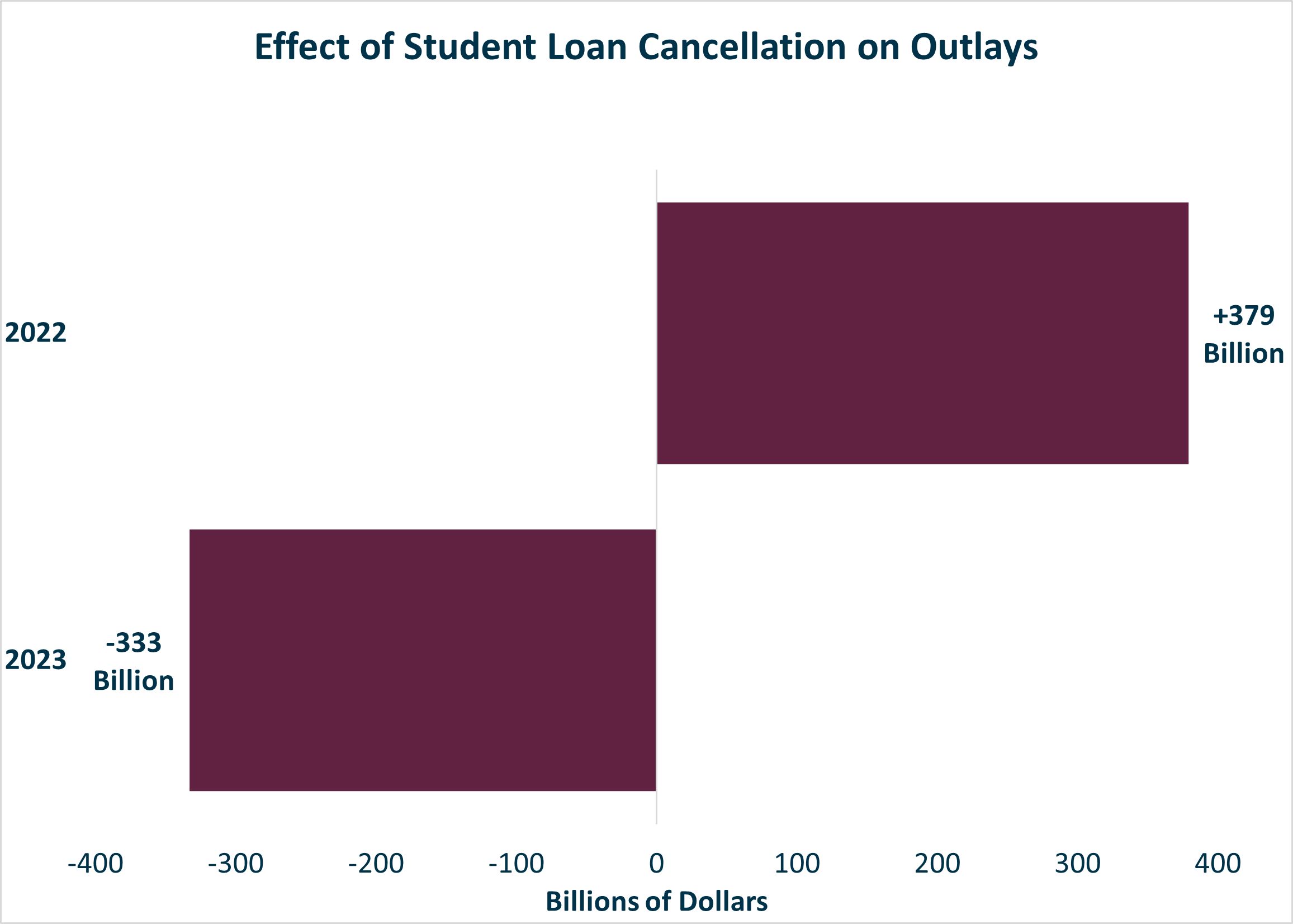
In September 2022, President Biden announced his student loan cancellation scheme, which would have forgiven up to $20,000 in U.S. Department of Education loans for certain individuals. Under FCRA rules, the taxpayer-financed subsidy costs of the Biden loan cancellation plan were booked as $379 billion in higher government spending in FY 2022.
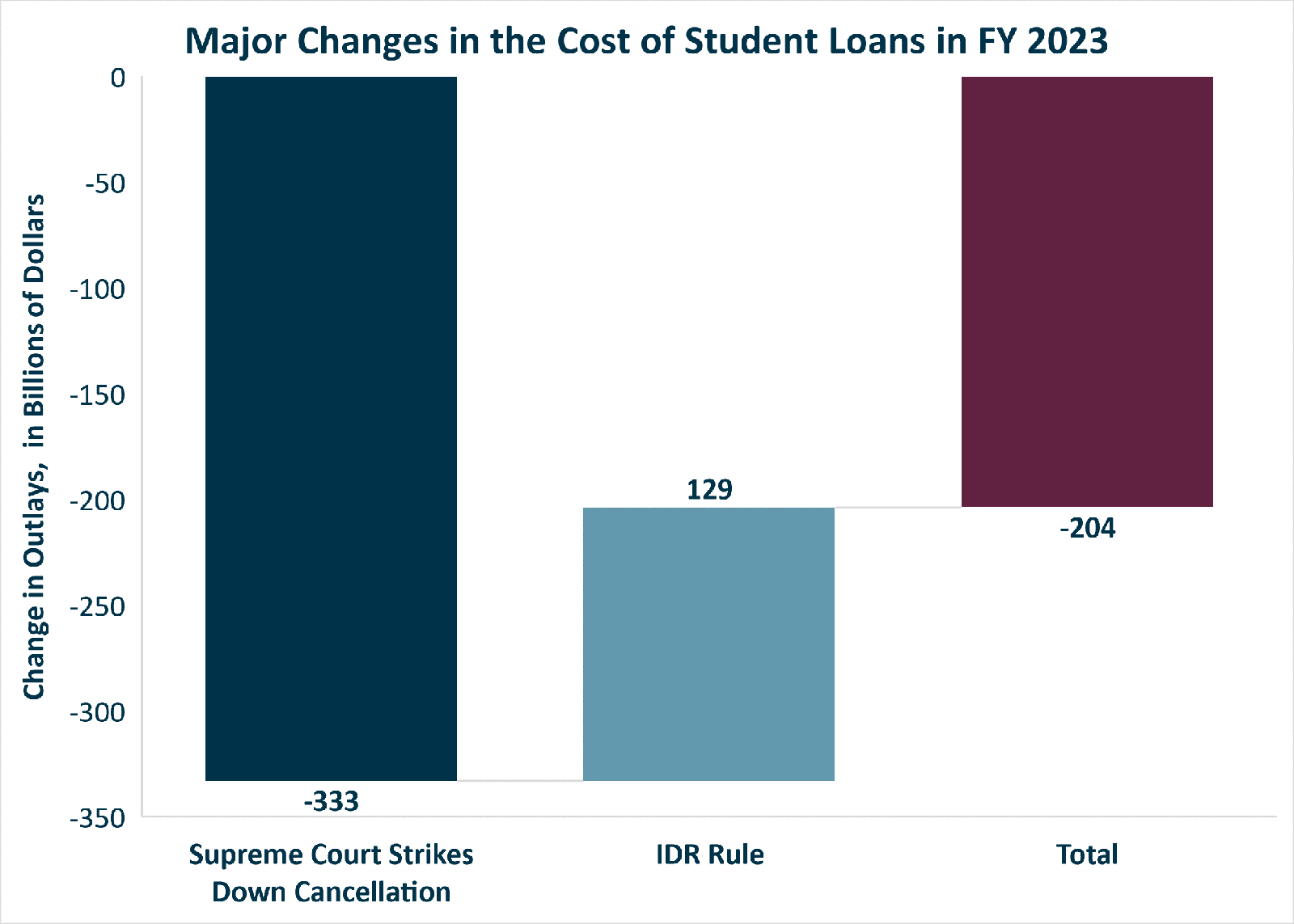
After the Supreme Court invalidated the plan, the $333 billion in lower outlays – attributable to borrowers paying the balances of loans rather than taxpayers – were accounted for in CBO’s August 2023 update.
The difference in the magnitudes of the FY 2022 and FY 2023 figures is due to interactions with the Biden Administration’s creation of a new Income Driven Repayment loan plan.
Without the Supreme Court’s Decision, FY 2023 Deficit Would Have Exceeded $2 Trillion
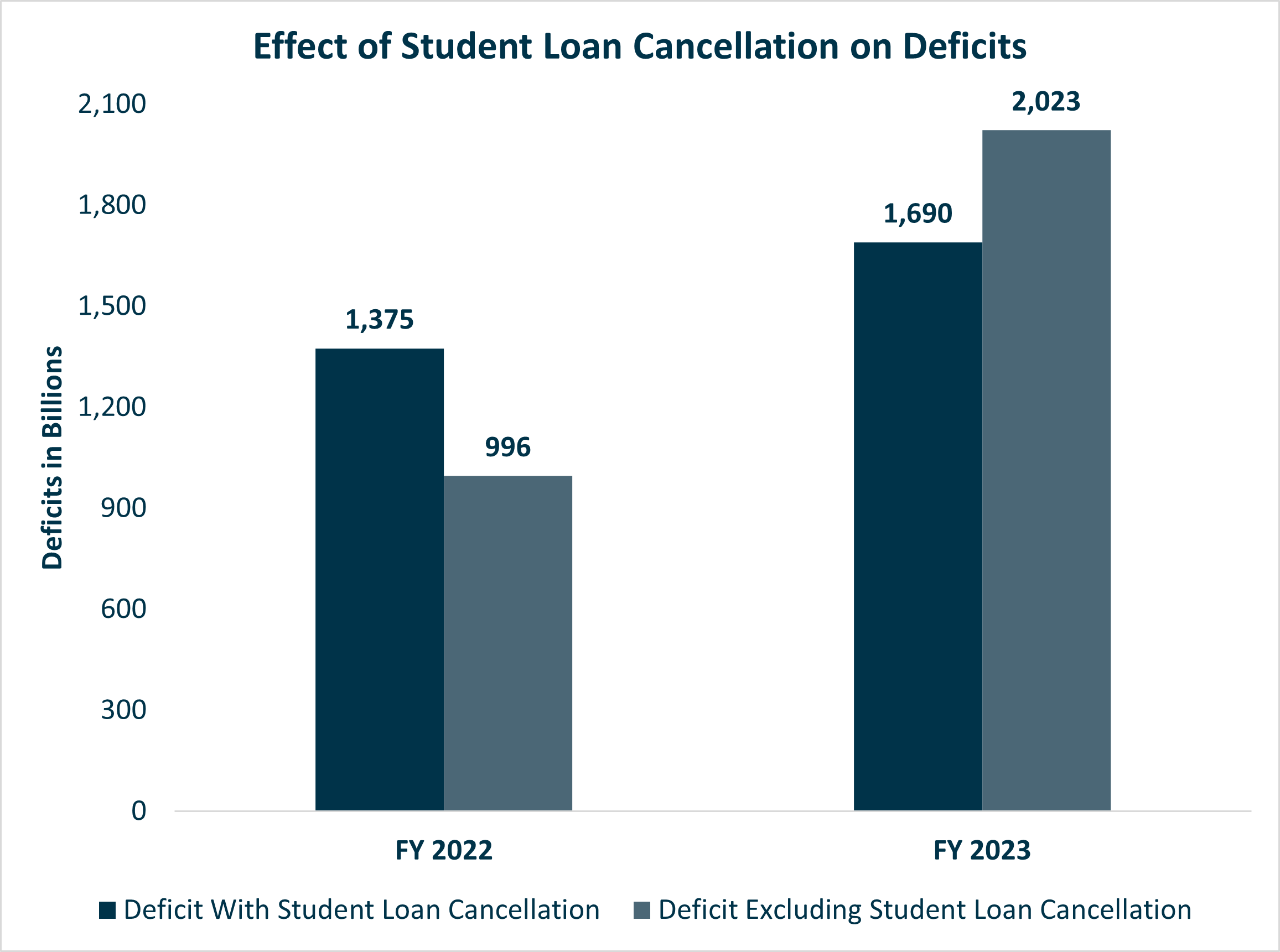
The Supreme Court’s decision invalidating Biden’s student loan cancellation plan made the FY 2023 deficit 16 percent lower than it otherwise would have been by reducing recorded outlays by $333 billion under the FCRA rules.
Absent the Supreme Court ruling, the FY 2023 deficit would have been $2.023 trillion.
Instead, with the Supreme Court’s decision, the FY 2023 deficit stands at $1.690 trillion.
Biden’s Income Driven Repayment Rule is Expensive
After the Supreme Court ruling invalidating the debt cancelation plan, the Biden Administration finalized a rule creating a new income-driven repayment (IDR) student loan plan, called Saving on a Valuable Education (SAVE).
CBO estimates this rule added $129.4 billion in costs in FY 2023 under FCRA rules.
According to CBO, interactions with the IDR plan is the primary reason that the outlay reduction from the FY 2023 Supreme Court ruling invalidating the student loan cancellation was smaller than the cost of the FY 2022 score of the student loan cancellation.