Federal Eligibility Rules for Food Stamps
An important principle is that welfare programs should only provide benefits to the truly needy. A commonsense way that the Food Stamp program is supposed to meet this standard is by limiting eligibility to only low-income households that do not have significant levels of liquid assets.
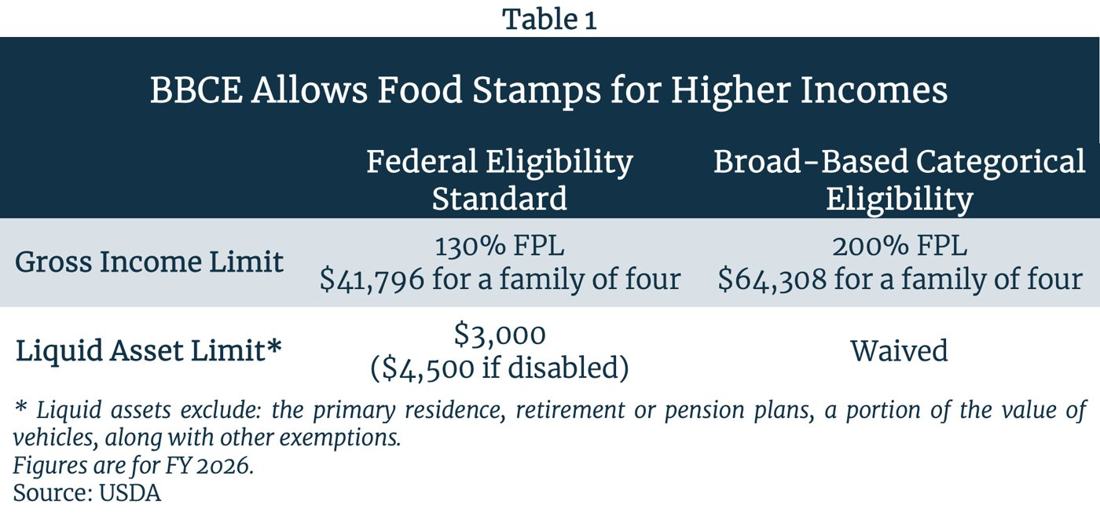
To be eligible for Food Stamps under the federal standards, the monthly gross income for a household without an elderly or disabled person must not exceed 130 percent of the federal poverty line (FPL). Welfare benefits from other programs generally do not count as income.
A household’s net income (gross income minus a standard deduction, a 20 percent deduction of earned income, and other deductions) must be no greater than 100 percent of the FPL.
[1]
In fiscal year (FY) 2026, the gross income annual limit for a family of four is the annualized equivalent to $41,796 while the net income limit is equivalent to $32,160.
[2]
Federal standards limit Food Stamp eligibility to households with no more than $3,000 in countable liquid assets in FY 2026, such as cash and bank accounts. Households with an elderly or disabled member may have up to $4,500 in countable assets. The asset limits are increased annually for inflation. These asset limits do not count the value of a home, retirement or pension plans, or a portion of the value of vehicles, along with other exemptions.
The purpose of limiting eligibility based on available liquid assets (with generous exemptions for housing, transportation, and retirement) is to ensure that households first take responsibility for their own basic needs before turning to the taxpayers for welfare assistance.
However, the statutory income and asset criteria for eligibility described above can be disregarded through “categorical eligibility.”
Categorical Eligibility
Categorical eligibility allows a person to automatically be eligible for a welfare program based on their receipt of another welfare program.
If the eligibility standards for different programs are aligned, the concept of categorical eligibility could, in theory, make sense as a way to simplify the application process for needy families and reduce states’ administrative burdens. However, because the eligibility requirements and purposes of the programs that confer categorical eligibility do not align with Food Stamps, this policy is problematic and deeply flawed in practice.
Categorical Eligibility for Food Stamps
Traditional categorical eligibility, sometimes called “pure public assistance,” is used to qualify a household for Food Stamps when all members of the household receive Supplemental Security Income (SSI), Temporary Assistance for Needy Families (TANF) cash assistance, or a state General Assistance (GA) cash benefit. Recipients of these cash welfare programs will usually have to satisfy an income or asset test, although states may set different rules than the federal Food Stamp standards. Traditional categorical eligibility operates similarly to the categorical eligibility that existed before the creation of TANF in 1996.
Alternatively, broad-based categorical eligibility (BBCE) allows households to be deemed eligible for Food Stamps by being provided a nominal TANF “benefit,” such as an informational pamphlet or access to an 800 number.
These nominal, non-cash TANF “benefits” were deemed permissible and encouraged by regulation and guidance from the Clinton and Obama Administrations. Under the BBCE regulations, states can completely waive the asset test, waive the net income test, and increase the gross income limit to 200 percent of the federal poverty level (from 130 percent of FPL).
[3]
Examples of How BBCE Works
The “benefits” that are used to confer BBCE are minimal. For example, California includes a “family planning” brochure as part of its standard informational packet whenever a person applies for Food Stamp benefits.
[4] West Virginia simply includes a statement on the Food Stamp application notifying applicants that they are “authorized to receive information and referral services about TANF-funded programs.”
[5] Minnesota includes a reference to a domestic violence information brochure and hotline on its Food Stamp and cash program combined application form.
[6] Because these notices and informational brochures are deemed to be TANF benefits, the household receiving them automatically qualifies for Food Stamps.
History of Categorical Eligibility for Food Stamps
The history of how categorical eligibility became a part of the Food Stamp program is useful for understanding why the policy no longer makes sense.
[7]
The modern Food Stamp program was established in the 1960s and 1970s. At that time, the predominant welfare program was the Aid to Families with Dependent Children (AFDC) program. Categorical eligibility for Food Stamps based on AFDC benefits was permitted by Congress for a short time in the 1970s.
The 1985 Farm Bill then established categorical eligibility for Food Stamps for all recipients of the AFDC and Supplemental Security Income (SSI) programs, meaning that AFDC and SSI recipient households only had to be screened for eligibility for those programs in order to also receive Food Stamp benefits. At the time, the asset and income requirements for Food Stamps, AFDC, and SSI were in general alignment.
However, AFDC was replaced with the new TANF program in the landmark 1996 welfare reform law. TANF differed from AFDC in significant ways. While AFDC was a cash entitlement, TANF provided a flat block grant to states with broad flexibility to determine eligibility and distribute different types of benefits.
TANF has four statutory goals:
- Provide assistance to needy families so that children can be cared for in their own homes or in the homes of relatives.
- End the dependence of needy parents on government benefits by promoting job preparation, work, and marriage.
- Prevent and reduce the incidence of out-of-wedlock pregnancies.
- Encourage the formation and maintenance of two-parent families.[8]
States meet the statutory goals by using TANF funds to provide basic assistance (cash payments), job training, childcare, pre-kindergarten, and a wide variety of other services.
[9]
Importantly, TANF does not require states to set strict income or asset tests. Instead, states are expected to prioritize the limited federal funding from the block grant (and state maintenance of effort funding) in order to most effectively meet the program goals. States are permitted to establish their own definitions of “needy” families.
Furthermore, TANF funds spent on activities to reduce out-of-wedlock pregnancies and encourage two-parent families (TANF’s third and fourth statutory purposes) are not required to be spent on “needy” families, meaning that states do not need to have any income criteria for certain activities. Those services could be provided to any residents in the state.
Despite these important differences, the 1996 welfare reform law did not alter categorical eligibility for Food Stamps with TANF or consider how to align the standards of the two vastly divergent programs.
The Clinton Administration’s U.S. Department of Agriculture (USDA) issued regulations in November 2000 to instruct states on how to implement categorical eligibility for Food Stamps.
[10]
First, the USDA “decided to confer categorical eligibility to all households authorized to receive TANF funded benefits and services designed to further TANF purposes one and two, which by statute must be targeted to ‘needy families.’” These TANF benefits could be cash assistance or non-cash benefits and services.
Second, the USDA provided that categorical eligibility would be conferred for households that receive non-cash TANF benefits or services provided for the purposes of reducing out-of-wedlock pregnancies and encouraging two-parent families (
i.e., the TANF purposes that are not necessarily for “needy” families), so long as those benefits are only provided to households with gross income at 200 percent of the FPL or lower.
The 200 percent FPL level was justified by citing “an analysis by HHS [the U.S. Department of Health and Human Services] which determined that for services with income eligibility criteria, such criteria tend to be set at 200 percent of the Federal poverty level or lower (although some States may have income eligibility criteria at higher levels).” Thus, the 200 percent of the FPL limit for categorical eligibility was invented via bureaucratic fiat rather than by law.
Note that neither of these definitions contains an asset test, unlike the federal Food Stamp eligibility standard.
The Obama Administration went a step further to expand categorical eligibility by promoting a concept known as broad-based categorical eligibility (BBCE) in a September 2009 guidance document.
[11]
BBCE allows states to provide a nominal “benefit” funded by the state’s TANF program as a reason to make a household categorically eligible for Food Stamps. The guidance from the Obama USDA stated that “we will use the term, ‘broad-based categorical eligibility’ to refer to the policy that makes most, if not all, households categorically eligible for SNAP because they receive a non-cash TANF/MOE funded benefit or service, such as an informational pamphlet or 800-number. Additional guidance issued in 2011 went even further, stating that a simple “notice of eligibility” for TANF non-cash benefits could confer BBCE.
[12]
USDA 2019 Proposed Rule
The first Trump Administration proposed a rule in 2019 to crack down on abuse of BBCE.
[13] However, the regulation was never finalized and was withdrawn by the Biden Administration.
The proposed rule would have required TANF benefits to be “ongoing” and “substantial” in order to confer categorical eligibility for Food Stamps. This would have prevented one-time, nominal “benefits” such as receiving a brochure, from qualifying a household for Food Stamps. “Ongoing” would have been defined as a benefit provided for at least six months. “Substantial” would have been defined as a benefit valued at least $50 per month. Non-cash benefits would also have been required to be for subsidized employment, work support, or childcare benefits.
Forthcoming Rule from Trump USDA
The USDA is currently developing a new regulation relating to reforming categorical eligibility.
[14] The potential proposed rule was included in the Trump Administration’s Regulatory Unified Agenda.
While details of the new regulation are not yet publicly available, the Unified Agenda states that the “proposal would change the regulations at 7 CFR 273.2(j)(2) pertaining to categorically eligible TANF households by limiting categorical eligibility to certain households that receive cash TANF or other substantial assistance from TANF. The proposed revisions would create a clearer and more consistent nationwide policy that ensures categorical eligibility is extended only to households that have sufficiently demonstrated eligibility by qualifying for ongoing and substantial benefits from TANF-funded programs designed to assist households and move them towards self-sufficiency.”
Millions Get Food Stamps Despite Not Meeting the Federal Eligibility Rules
Millions of individuals receive Food Stamps despite not meeting the federal eligibility rules. Although these individuals have income or assets above the limits, they can enroll in Food Stamps due to categorical eligibility.
When states use categorical eligibility, they do not have to collect or verify detailed information about the assets owned by Food Stamp applicants.
As a result, no one knows exactly how many people are getting Food Stamp benefits despite failing to meet the federal eligibility standards.
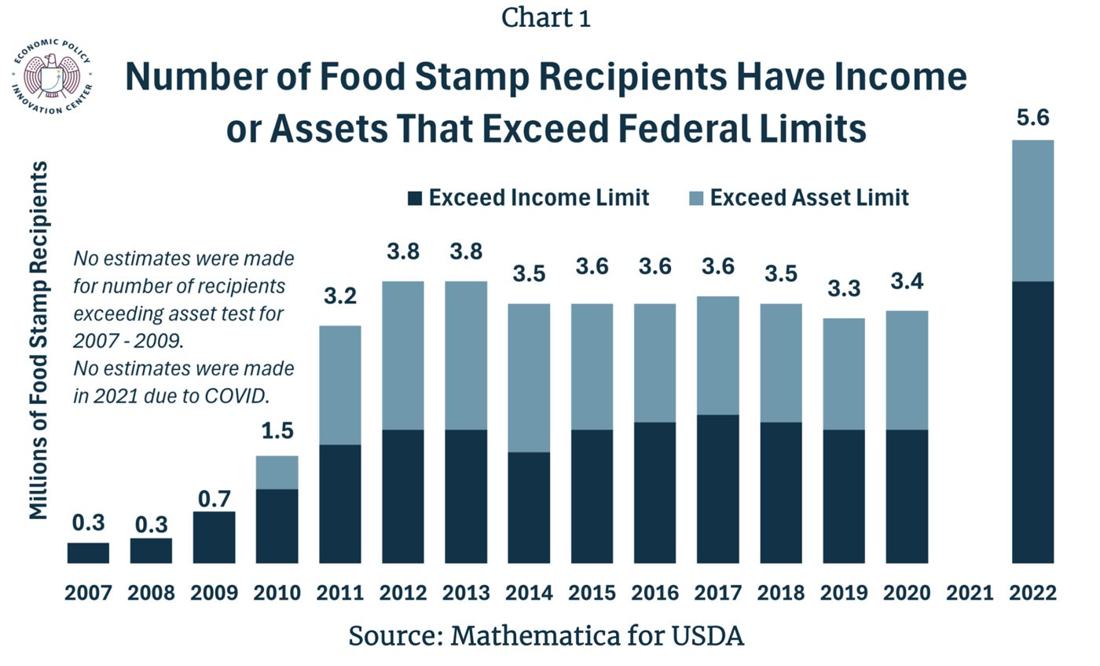
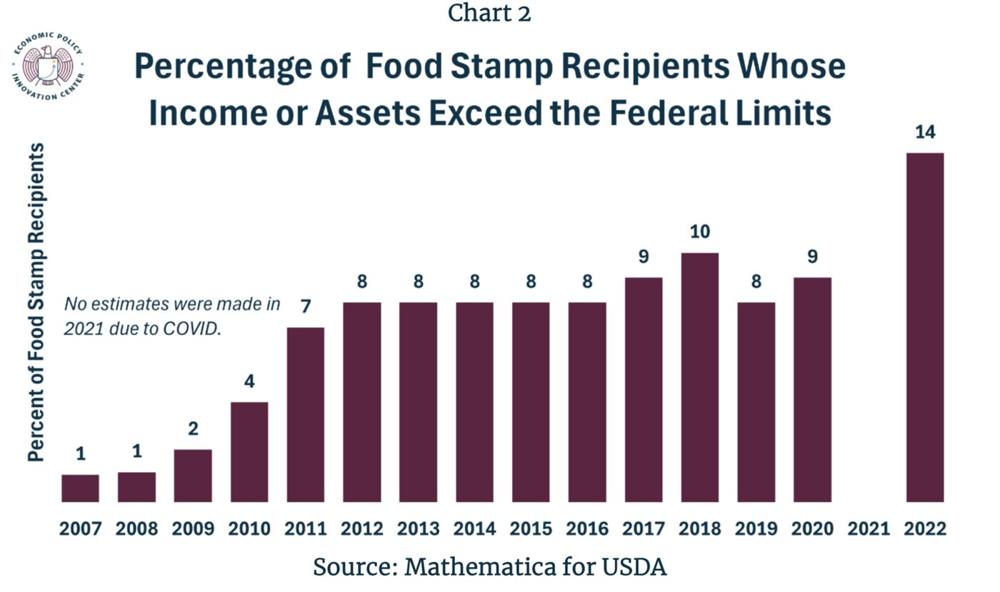
Mathematica estimated in a report for the USDA that 5.6 million individuals were made eligible by BBCE and received Food Stamps, but “did not meet the Federal SNAP income or resource rules” in FY 2022, equivalent to 14 percent of total enrollment. This includes “3.8 million individuals in households with incomes that exceeded the Federal SNAP income limits and an additional 1.9 million in income-eligible households that we estimated would fail the Federal SNAP resource test.”
[15]
The estimated number of Food Stamp recipients whose income or assets exceeded the federal limits grew from 276,748 in FY 2007 to 5.6 million in FY 2022 (Mathematica only began to estimate the number of recipients whose assets exceed the limit in 2010).
[16] Meanwhile Mathematica’s estimated percentage of Food Stamp recipients whose income or assets exceeded the federal limits has grown from 1 percent in FY 2007 to 14 percent in FY 2022.
The Foundation for Government Accountability (FGA) recently “estimated 5.9 million individuals are enrolled in food stamps through the broad-based categorical eligibility (BBCE) loophole despite not meeting federal eligibility requirements.” The FGA estimated that 20 percent of these BBCE enrollees hold more than $100,000 in assets.
[17]
Wealthy Millionaires Can Receive Food Stamps
Even millionaires can qualify for Food Stamps thanks to the categorical eligibility loophole.
[18]
In a well-known example, a retired millionaire in Minnesota qualified for food stamps – and it was not an error. Rob Undersander, a retired engineer, discovered that his state’s Food Stamp application ignored assets. He applied as an experiment to see if someone like him would qualify. Soon after, he was receiving hundreds of dollars in Food Stamps per month. He urged Minnesota to close this loophole in 2019, but the state legislature failed to act. Despite following the law, being truthful on his application forms, and even donating his benefits to charity, Congressional Democrats said Undersander “intentionally defrauded the federal government.”
[19]
It has also been reported that “well over 65,000 substantial lottery winners since 2019 continued collecting food stamps, even when they were over the federal income threshold for the program.”
[20]
Abuse of BBCE is Widespread
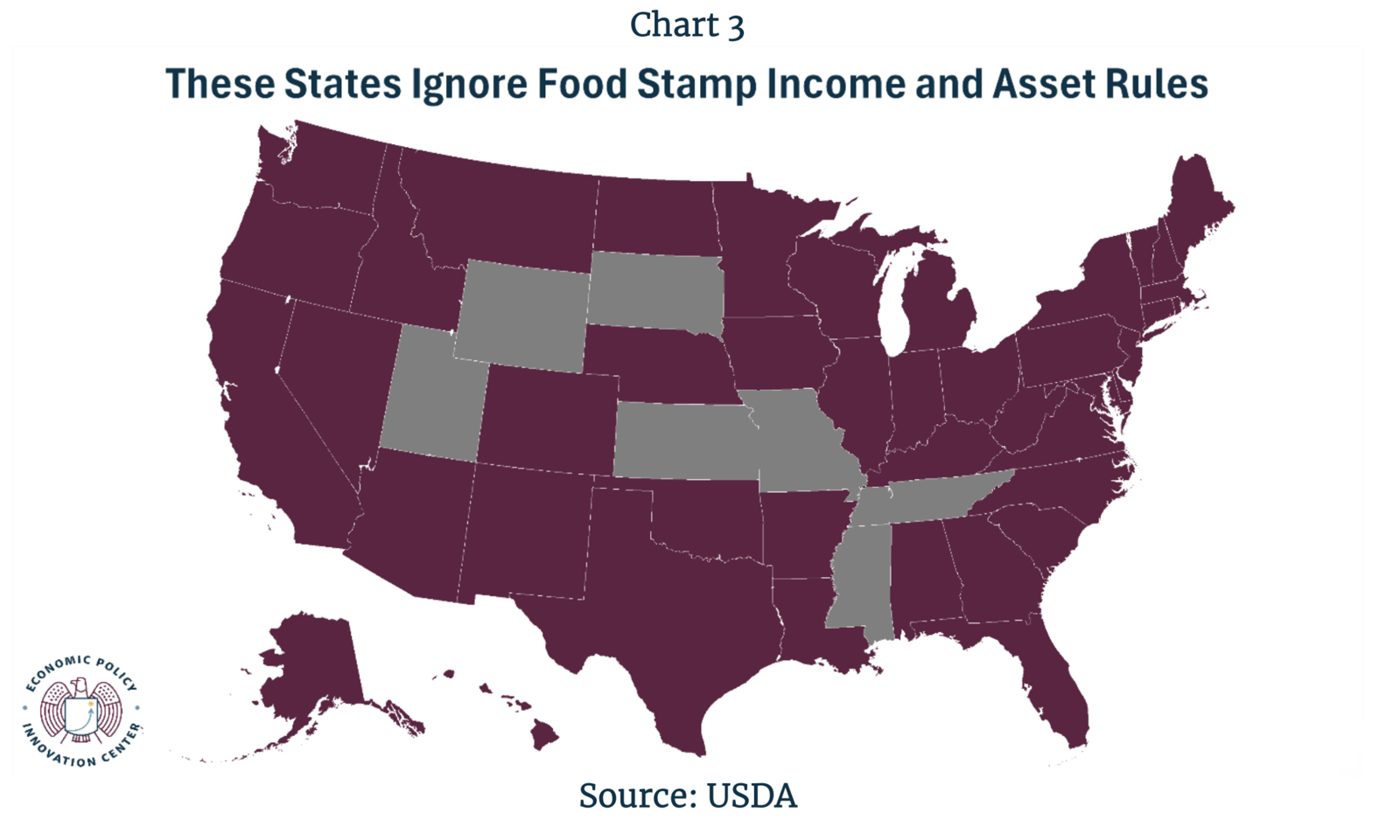
The use of BBCE is widespread: 44 states (including Washington, DC) do not follow the federal rules for Food Stamp eligibility. Many of these states allow benefits for households with a gross income of 200 percent of the federal poverty line (versus the 130 percent limit in the underlying law) and completely waive the asset limits.
Only seven states currently follow the federal eligibility standards for Food Stamps.
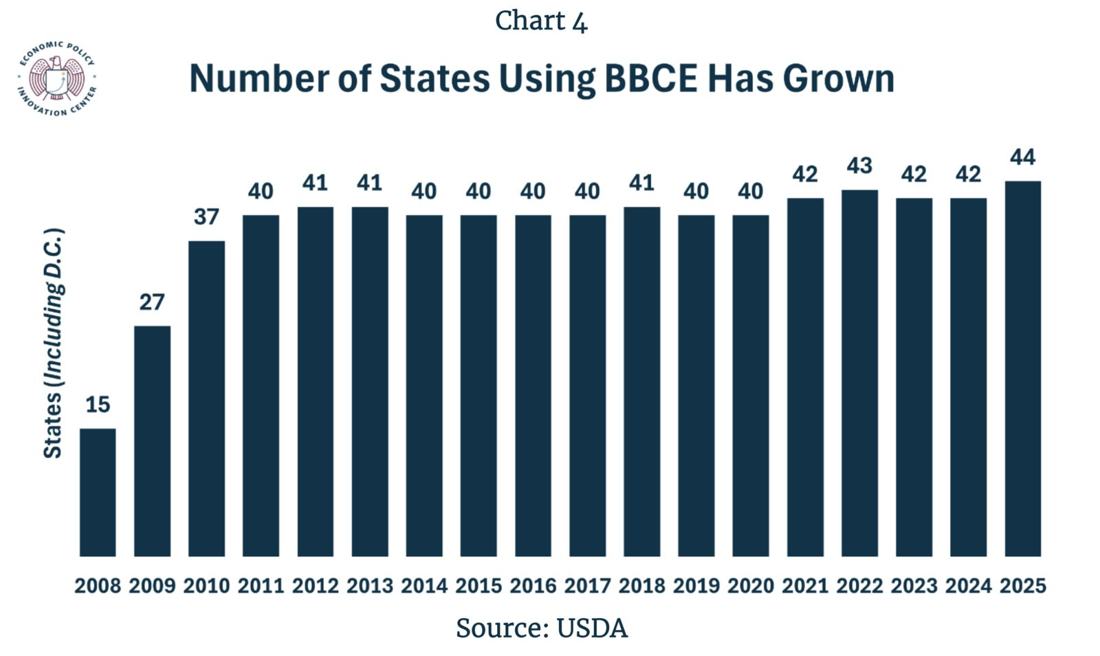
The use of BBCE has expanded over time. In FY 2008, 15 states had BBCE policies. After the Obama Administration guidance, the number of states rose to 27 in FY 2009 and to 40 by FY 2021.
Billions in Spending on Benefits for People Who Do Not Meet the Federal Eligibility Requirements
Ending categorical eligibility would produce significant savings for taxpayers by preserving welfare benefits for only those who meet the federal eligibility standards.
The FGA estimates that eliminating BBCE would save federal taxpayers $100 billion over the next decade, while state taxpayers would save another $10 billion (as the new state cost sharing requirement for states with high rates of improper payments takes effect).
[21]
The USDA estimated that its proposed rule in 2019 would have saved $9.4 billion over the five-year FY 2019-2023 period.
[22] An important factor distinguishing these two estimates is that they are scoring two different proposals: the FGA proposal is to eliminate BBCE while the USDA 2019 proposal was simply to curtail the abuse of BBCE.
It is also important to note that since reliable data does not exist for the actual number of individuals receiving Food Stamps due to categorical eligibility (because states do not have to verify assets), cost estimates from the Congressional Budget Office (CBO) could be subject to a range of uncertainty.
Food Stamp Enrollment and Spending Have Skyrocketed
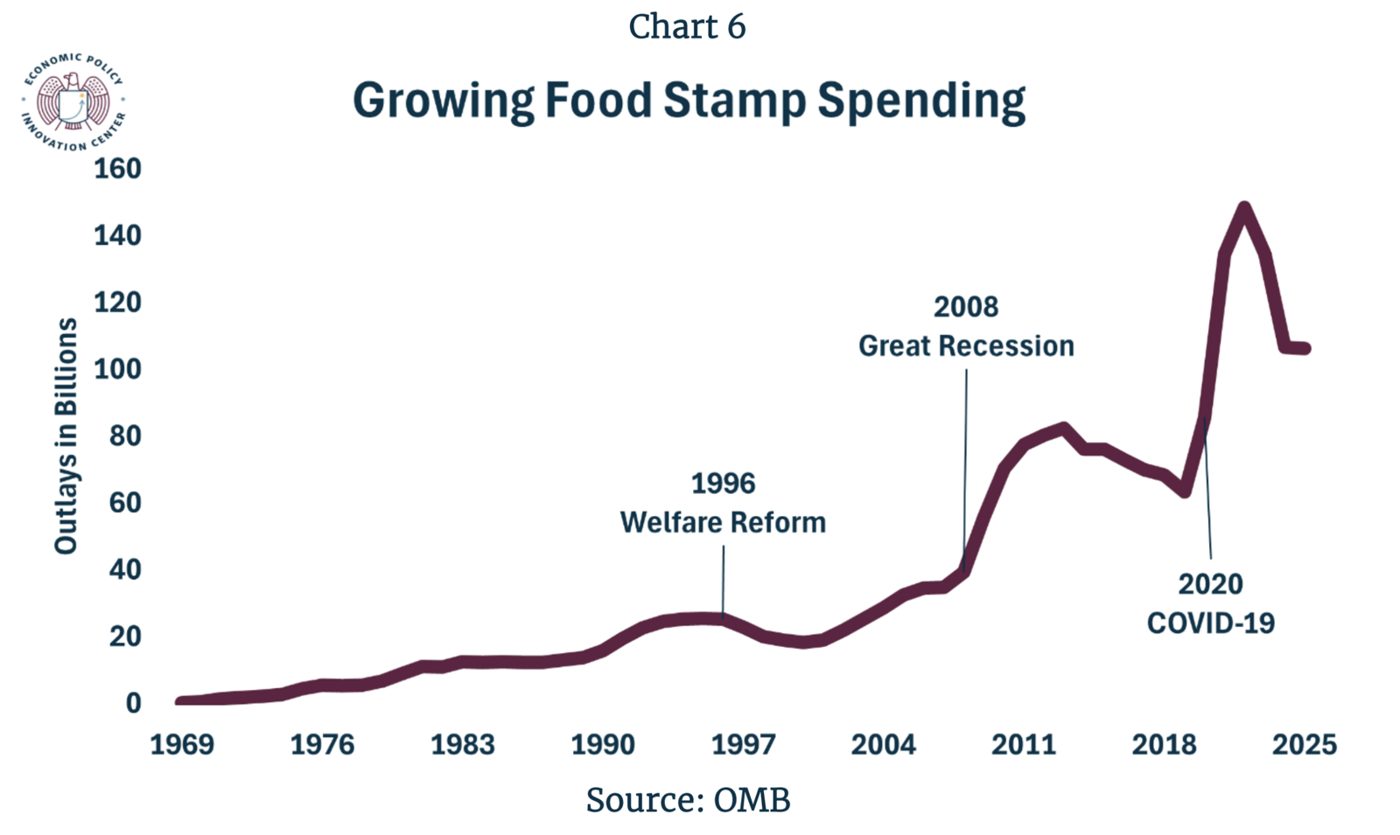
The number of Food Stamp recipients and taxpayer spending on the program have grown significantly in recent decades.
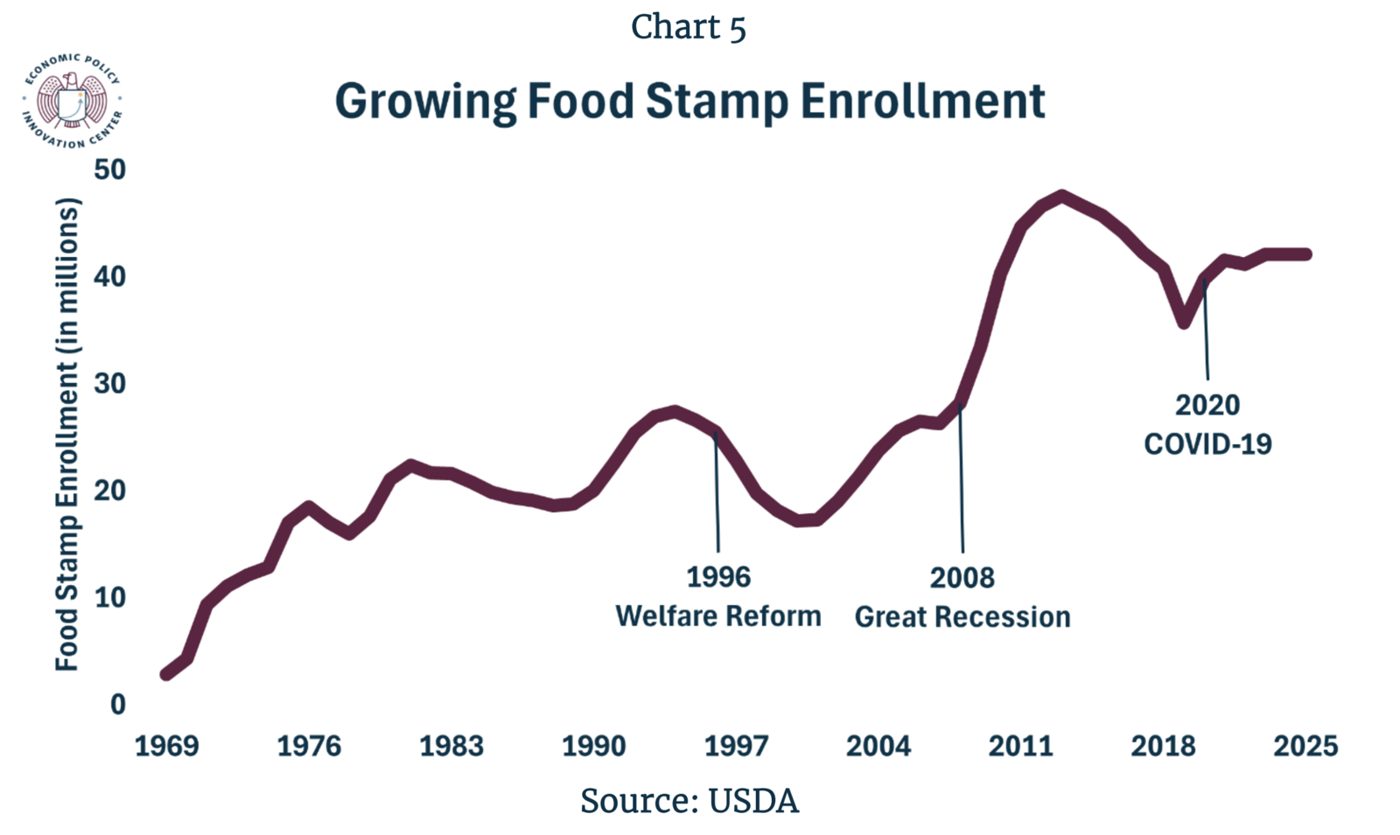
After welfare reform, Food Stamp enrollment fell from 26.5 million in FY 1996 to 17.3 million in FY 2001. However, the declines reversed and enrollment substantially increased over the next two decades due to the expansion of categorical eligibility, weakened work requirements, and benefit expansions. In FY 2025, 42.4 million individuals received Food Stamps.
Taxpayer funding for Food Stamps has grown even more significantly. After welfare reform, outlays fell from $25.4 billion in FY 1996 to $18.3 billion in FY 2000. Benefit levels increased drastically during the COVID-19 pandemic and after the Biden Administration unilaterally changed the benefit formula, outlays reached $148.5 billion in FY 2022. Outlays for FY 2025 totaled $106.3 billion.
How Categorical Eligibility Can be Used to Hide Improper Payments
The Food Stamp program makes billions of dollars in improper payments each year.
[23] The USDA reported more than $46.3 billion in improper payments between FY 2003 and FY 2023. The reported improper payment rate was 11.7 percent in 2023.
[24]Improper payments are likely significantly higher than the officially reported amounts.
Categorical eligibility makes it easier for states to report lower improper payment rates by avoiding enforcement of the federal Food Stamp eligibility rules. When states use categorical eligibility, they do not have to verify the assets owned by applicants. States have more flexibility in verifying gross income, as they can increase the maximum limit above the federal 130 percent of the FPL standard. States can also disregard the net income test. All of these lost check points create room for improper payments and fraud.
The USDA Office of Inspector General (OIG) found in a 2015 report that “States did not assess the eligibility of more than 15 million SNAP households in FY 2012 under the traditional SNAP eligibility requirements because of their Broad Based Categorical Eligibility (BBCE) status,” equivalent to two-thirds of households receiving Food Stamps that year. The OIG found that states “allowed BBCE SNAP recipients to continue receiving benefits after it became known that they were no longer eligible to participate in the program.” The OIG reported that households that receive Food Stamps because of BBCE do not have their eligibility assessed during the Quality Control (QC) process used to determine the error rate, concluding that “the policy inappropriately excluded ineligible BBCE cases from the SNAP error rate analysis during the QC process.” The report concluded that the USDA’s “QC procedures for BBCE significantly understated the SNAP error rate since BBCE recipients’ eligibility was not assessed during the QC reviews.”
[25]
States are incentivized to avoid reporting the true improper payment rate. Pressures to reduce reported improper payments have been amplified by the new state cost-sharing policy enacted in the One Big Beautiful Bill Act (OBBB), which is based on improper payment rates. Beginning in FY 2028, states with improper payment rates greater than 6 percent will be required to contribute between 5 and 15 percent of benefits costs (on a sliding scale based on the improper payment rate), but states with improper payments below 6 percent will not have to contribute any matching funds.
Creating the new Food Stamp cost-sharing requirement was an important reform that will promote fiscal federalism. However, an unintended consequence could be that states respond by attempting to game their reporting of waste, fraud, and abuse, or even by weakening their own standards for verifying data. Thus, the policy enacted under OBBB must be built upon to succeed.
Reforms to Preserve Benefits for the Truly Needy
Policymakers should focus on fixing the Food Stamp program to promote opportunity, focus benefits on the truly needy, and eliminate waste, fraud, and abuse.
Eliminate Categorical Eligibility to Ensure Eligibility Standards Are Met
Congress should eliminate categorical eligibility and protect welfare benefits for only the truly vulnerable. H.R. 416, the No Welfare for the Wealthy Act of 2025, would allow only households that meet the current income and asset standards to receive Food Stamp benefits.
[26] This legislation was introduced by Rep. Ben Cline (R-VA-06).
Reverse Regulatory Loopholes
The Administration should use its regulatory authority to crack down on abuses of BBCE and reverse the loopholes that have been opened by previous administrative actions.
Require States to Collect Data on Income and Assets for All Food Stamp Recipients
The Food Stamp quality control database does not identify categorically eligible households with assets above the Federal eligibility limit.
The USDA OIG has recommended that “BBCE recipients’ eligibility for SNAP benefits must be fully assessed during the QC review process and that any errors identified during the QC review be included in the error rate.”
[27] Until categorical eligibility is repealed, states should be required to collect, review, and report information about the income and assets of all Food Stamp recipients. This would allow policymakers at the federal and state levels to make better, more informed decisions.
Conclusion
Categorical eligibility allows states to circumvent the federal Food Stamp eligibility standards. As a result, millions of individuals receive Food Stamps even though their incomes and assets exceed the allowable limits set by the federal law. These benefits cost billions of dollars every year.
The weakened categorical eligibility policies weaken program integrity and allow states to hide the true rate of improper payments. To preserve benefits for the truly needy and to reduce waste, fraud and abuse in the Food Stamp program, lawmakers should ensure that only individuals who meet the federal eligibility standards receive welfare.
[1] The net income limit also applies to households with an elderly or disabled person.
[2] U.S. Department of Agriculture, “SNAP Eligibility,” September 30, 2025,
https://www.fns.usda.gov/snap/recipient/eligibility (accessed January 4, 2026).
[3] Net income is used to calculate Food Stam benefit levels, even if the state waives it was an eligibility cutoff.
[4] State of California Health and Human Services Agency, “Family Planning... Making the Commitment for a Healthy Future,”
https://www.cdss.ca.gov/cdssweb/entres/forms/English/PUB275Eng.pdf (accessed January 4, 2026).
[5] West Virginia Department of Health and Human Resources, “Supplemental Nutrition Assistance Program (SNAP) Application,”
https://dhhr.wv.gov/bcf/Services/familyassistance/Documents/DFA_SNAP_1%20%2007_11_19%20--%20approved.pdf (accessed January 4, 2026).
[6] Minnesota Department of Human Services, “Combined Application Form,”
https://www.dhs.state.mn.us/main/groups/county_access/documents/pub/dhs16_166607.pdf (accessed January 4, 2026).
[7] Angela Rachidi and Erik Randolph, “End Broad-Based Categorical Eligibility in SNAP and Address Benefit Cliffs,” American Enterprise Institute, September 23, 2025,
https://www.aei.org/research-products/report/end-broad-based-categorical-eligibility-in-snap-and-address-benefit-cliffs/ (accessed January 4, 2026).
[8] U.S. Department of Health and Human Services, “About TANF,” September 27, 2024,
https://acf.gov/ofa/programs/tanf/about (accessed January 4, 2026).
[9] U.S. Department of Health and Human Services, “TANF and MOE Spending and Transfers by Activity, FY 2023,” November 7, 2024,
https://acf.gov/ofa/data/tanf-and-moe-spending-and-transfers-activity-fy-2023 (accessed January 4, 2026).
[10] U.S. Department of Agriculture, Food and Nutrition Service, “Food Stamp Program: Noncitizen Eligibility, and Certification Provisions of Pub. L. 104–193, as Amended by Public Laws 104–208, 105–33 and 105–185,” Final rule, Federal Register 65, no. 225 (November 21, 2000): 70134–70212,
https://www.govinfo.gov/content/pkg/FR-2000-11-21/pdf/00-29355.pdf (accessed January 4, 2026).
[11] Jessica Shahin, “Improving Access to SNAP through Broad-Based Categorical Eligibility,” U.S. Department of Agriculture, September 30, 2009,
https://www.fns.usda.gov/snap/eligibility/BBCE-improving-access (accessed January 4, 2026).
[12] Lizbeth Silbermann, “Questions and Answers on Broad-Based Categorical Eligibility,” U.S. Department of Agriculture, January 31, 2011,
https://www.fns.usda.gov/snap/questions-and-answers-broad-based-categorical-eligibility (accessed January 4, 2026).
[13] U.S. Department of Agriculture, Food and Nutrition Service, “Revision of Categorical Eligibility in the Supplemental Nutrition Assistance Program (SNAP),” proposed rule, Federal Register 84, no. 142 (July 24, 2019): 35570–35581,
https://www.federalregister.gov/documents/2019/07/24/2019-15670/revision-of-categorical-eligibility-in-the-supplemental-nutrition-assistance-program-snap (accessed January 4, 2026).
[14] Office of Management and Budget, Office of Information and Regulatory Affairs, “Supplemental Nutrition Assistance Program: Reforming Categorical Eligibility (RIN 0584-AF10),” Unified Agenda of Federal Regulatory and Deregulatory Actions, Spring 2025,
https://www.reginfo.gov/public/do/eAgendaViewRule?pubId=202504&RIN=0584-AF10 (accessed January 4, 2026).
[15] Alma Vigil and Nima Rahimi, “Trends in USDA SNAP Participation Rates: FY 2020 and 2022,” Mathematica, submitted to the U.S. Department of Agriculture, October 2024,
https://www.fns.usda.gov/research/snap/national-participation-rates/fy20and22 (accessed January 4, 2026).
[16] U.S. Department of Agriculture, “Report Series - Estimates of National SNAP Participation Rates (Trends in SNAP Participation Rates),” April 21, 2025,
https://www.fns.usda.gov/research/snap/national-participation-rates (accessed January 4, 2026).
[17] Michael Greibrok, “Broad-Based Categorical Eligibility in Food Stamps is Fraud by Design and States Should Ban It,” Foundation for Government Accountability, December 12, 2025,
https://thefga.org/research/categorical-eligibility-in-food-stamps-is-fraud-by-design/(accessed January 4, 2026).
[18] Amelia Kuntzman, “Can Millionaires Really Receive Food Stamps?,” Economic Policy Innovation Center, April 29, 2025,
../../federal-budget/can-millionaires-really-receive-food-stamps/.
[19] Fred Lucas, “After Legally Receiving Food Stamps, This Millionaire Is Trying to Change the System,” Daily Signal, June 24, 2019,
https://www.dailysignal.com/2019/06/24/after-legally-receiving-food-stamps-this-millionaire-is-trying-to-change-the-system/ (accessed January 4, 2026).
[20] Brianna Herlihy, “65,000 stayed on food stamp rolls despite winning big in lottery, government data show,” Fox News, October 21, 2023,
https://www.foxnews.com/us/65000-stayed-food-stamp-rolls-despite-winning-big-lottery-government-data-show (accessed January 4, 2026).
[21] Michael Greibrok, “Broad-Based Categorical Eligibility in Food Stamps is Fraud by Design and States Should Ban It,” Foundation for Government Accountability, December 12, 2025,
https://thefga.org/research/categorical-eligibility-in-food-stamps-is-fraud-by-design/(accessed January 4, 2026).
[22] U.S. Department of Agriculture, Food and Nutrition Service, “Revision of Categorical Eligibility in the Supplemental Nutrition Assistance Program (SNAP),” proposed rule, Federal Register 84, no. 142 (July 24, 2019): 35570–35581,
https://www.federalregister.gov/documents/2019/07/24/2019-15670/revision-of-categorical-eligibility-in-the-supplemental-nutrition-assistance-program-snap (accessed January 4, 2026).
[23] Improper payments are government outlays that should not have been made or were made in the wrong amount. These improper payments often include fraud, abuse, and waste, but are not always indicative of illegal activity.
[24] PaymentAccuracy.gov, “Annual Improper Payments Datasets,” 2024 Dataset,
https://www.paymentaccuracy.gov/payment-accuracy-the-numbers/ (accessed January 4, 2026).
[25] U.S. Department of Agriculture Office of Inspector General, “FNS Quality Control Process for Snap Error Rate,” Report Number 27601-0002-41, September 23, 2015,
https://usdaoig.oversight.gov/reports/audit/fns-quality-control-process-snap-error-rate (accessed January 4, 2026).
[26] No Welfare for the Wealthy Act of 2025, H.R. 416, 119
th Congress, First Session.
[27] U.S. Department of Agriculture Office of Inspector General, “FNS Quality Control Process for Snap Error Rate,” Report Number 27601-0002-41, September 23, 2015,
https://usdaoig.oversight.gov/reports/audit/fns-quality-control-process-snap-error-rate (accessed January 4, 2026).