When Congress eventually turns its attention to full Fiscal Year (FY) 2026 appropriations, they will need to consider legislation drafted by the House and Senate Appropriations Committees.
For Commerce, Justice, and Science (CJS) appropriations, the
Senate markup would
spend $79.7 billion compared to the
House’s $76.8 billion. This is a difference of $2.9 billion, or 3.8%. Notably, there are larger gaps for some key accounts within the bills.
This post compares funding for selected accounts in the FY 2026 CJS appropriations bills proposed by the House and Senate alongside FY 2025 levels and the
President’s Budget.
Commerce Department
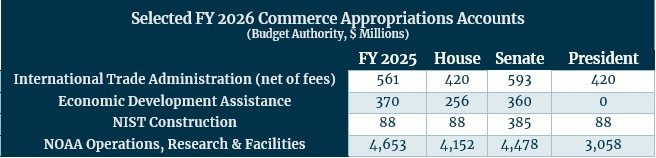
The International Trade Administration (ITA) addresses issues such as foreign investment in the U.S. and trade compliance. The savings in the President’s Budget focus on the Global Markets program, which promotes exports by small- and medium-sized businesses. The House bill matches the request but does not specify which aspects of the ITA should be pared back.
The Economic Development Administration oversees “development assistance” programs that provide handouts to selected projects in “distressed” areas. This is
local pork premised on
central planning ideology. The President’s Budget
calls for eliminating this spending based on “fiscal responsibility and to redefine the proper role of the Federal Government.”
The Construction account of the National Institute of Standards and Technology is held flat in the House bill and the President’s Budget. The Senate significantly increases this for the sake of
10 earmarks, including $105 million in requests from Sen. Mitch McConnell (R-KY).
Operations, Research and Facilities (ORF) funding for the National Oceanic and Atmospheric Administration (NOAA) receives a modest reduction in the House and Senate bills. Most NOAA savings in the President’s Budget come from
eliminating the Office of Oceanic and Atmospheric Research (OAR), including controversial climate research. Certain activities would be transferred to the National Ocean Service (NOS) and the National Weather Service (NWS). Meanwhile, the Senate proposes $657 million, and the House proposes $667 million for OAR. The President also proposes transferring certain fishing responsibilities to the Department of the Interior.
In preparation for the shutdown, each agency
evaluated staffing so that employees essential to protect life and property and keep necessary operations running would be retained while non-essential bureaucrats would be furloughed. The Department of Commerce
deemed 34,711 employees (81% of its workforce) as non-essential.
Justice Department & Related Agencies
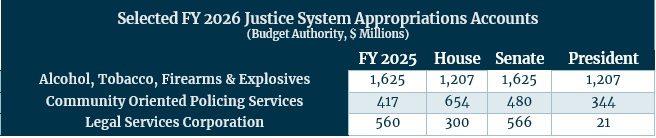
The U.S. Department of Justice’s Bureau of Alcohol, Tobacco, Firearms & Explosives (ATF) receives flat funding in the Senate and a roughly 25% reduction in the House bill and President’s Budget. The
President’s Budget request would reduce spending in several aspects of the bureau, predicated on activity prioritization.
The Community Oriented Policing Services (COPS) grant program is predicated on supporting local law enforcement. However,
analysis by the Heritage Foundation found that localities responded to the COPS funding by reducing their own spending. This is the case with an array of federal aid programs, which are ultimately an exercise in
welfare for state and local governments. The President’s Budget
seeks a reduction to COPS as part of streamlining Department of Justice grant programs. In contrast, the House and Senate increase funding for the sake of earmarks, demonstrating that even law enforcement spending can be pork.
The Department of Justice’s
shutdown plan deemed 12,840 employees (11% of the workforce) as non-essential.
The Legal Services Corporation (LSC) provides grants for legal aid for indigent clients. This is duplicative of state, local, and charitable funding and not a proper federal role. Further, the LSC’s authorization expired in 1980. The President’s Budget
requests eliminating the LSC. The House would significantly reduce funding, while the Senate would slightly increase it.
In addition to funding discrepancies, the House and Senate bills also have different policy provisions for the justice system.
Sec. 551 of the House bill prohibits funding of diversity, equity and inclusion (DEI) training, initiatives, offices, or designated employees. There is no similar provision in the Senate bill.
Sec. 224 of the Senate bill directs the Attorney General to preserve and compile records related to Jeffrey Epstein, and to produce a report to the Senate Appropriations Committee within 60 days of the bill’s enactment. The House bill does not address Jeffrey Epstein.
An area of agreement between the House and Senate bills is opposing the weaponization of government. Sec. 219 0f the House bill and Sec. 220 of the Senate bill prohibit investigations of parents based on disagreeing with officials at school board meetings. Sec. 220 of the House bill and Sec. 221 of the Senate bill prohibit investigating or prosecuting religious institutions based on their beliefs.
Appropriators should include additional provisions in the wake of revelations about Operation Arctic Frost, in which the Federal Bureau of Investigation (FBI) targeted hundreds of conservatives, including eight senators. Congress should require a report and briefings from the FBI about the investigation and establish guardrails to prevent a similar abuse of the justice system.
National Aeronautics and Space Administration
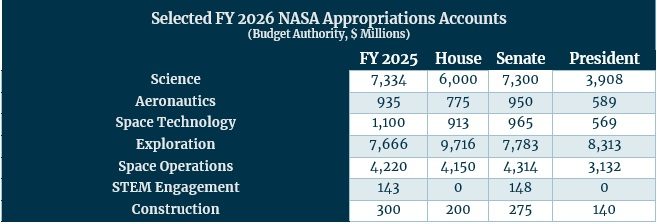
The House, Senate and
President’s Budget each have different priorities with respect to the National Aeronautics and Space Administration (NASA). The House and President’s Budget seek reductions to most accounts but an increase to Exploration, with the latter based on the
Moon to Mars project.
The Office of STEM Engagement is duplicative of activities elsewhere within NASA and other federal agencies and is rightly eliminated in the President’s Budget. The administration’s reductions to Science, Space Technology, and Space Operations are based on reductions to sub-accounts for research and development contracts.
NASA’s
shutdown plan deemed 15,094 employees (83% of the workforce) as non-essential.
National Science Foundation
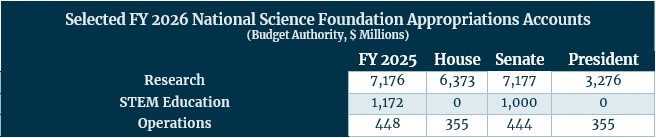
The primary activity of the National Science Foundation (NSF) is funding scientific research activity at universities. The
President’s request seeks substantial reductions, cutting most Research sub-accounts and eliminating the STEM Education department. The House agrees with the President directionally, while the Senate largely maintains the status quo.
Setting aside the
judiciousness of having the federal government at the forefront of research funding, the NSF is overdue for corrective budgetary action.
Federal research grants are coupled with excessive “
Indirect Cost” (overhead expense) payments that pad the budgets of university departments. While the Trump Administration has sought to limit these payments, this effort has been stymied by legal action. Congress can address this with legislation to bring such payments down to a more reasonable level. Unfortunately, Sec. 542 of the Senate bill prohibits any agency in the bill from adjusting these payments relative to FY 2024 levels .
The NSF’s internal culture tolerated funding grants explicitly designed to support
leftist ideology. In 2024, the Senate Commerce, Science, and Transportation Committee
released a report showing that taxpayers were on the hook for billions of dollars in ideological grants. Examples include $1.5 million to address “
anti-black racism” in engineering, $300,000 to promote the
unscientific “indigenous knowledge” fad in
geoscience, and $289,000 for an “affinity group” diversity effort among
ornithologists.
While the Trump Administration has taken
aggressive efforts to tackle such improper uses of tax dollars, the
ideological corruption of the NSF cannot be solved overnight. It makes little sense to provide the NSF with the same level of funding following years of abusing the public’s trust.
The NSF’s
shutdown plan deemed 1,087 employees (73% of the workforce) as non-essential.
Billions in Potential Savings
Some Appropriators complain about “tight” budgetary constraints. In reality,
$1.6 trillion of discretionary budget authority is more than enough to work with if legislators are willing to prioritize spending. The CJS package has many opportunities for savings, and the justifications laid out in the President’s Budget provide useful guidance.