



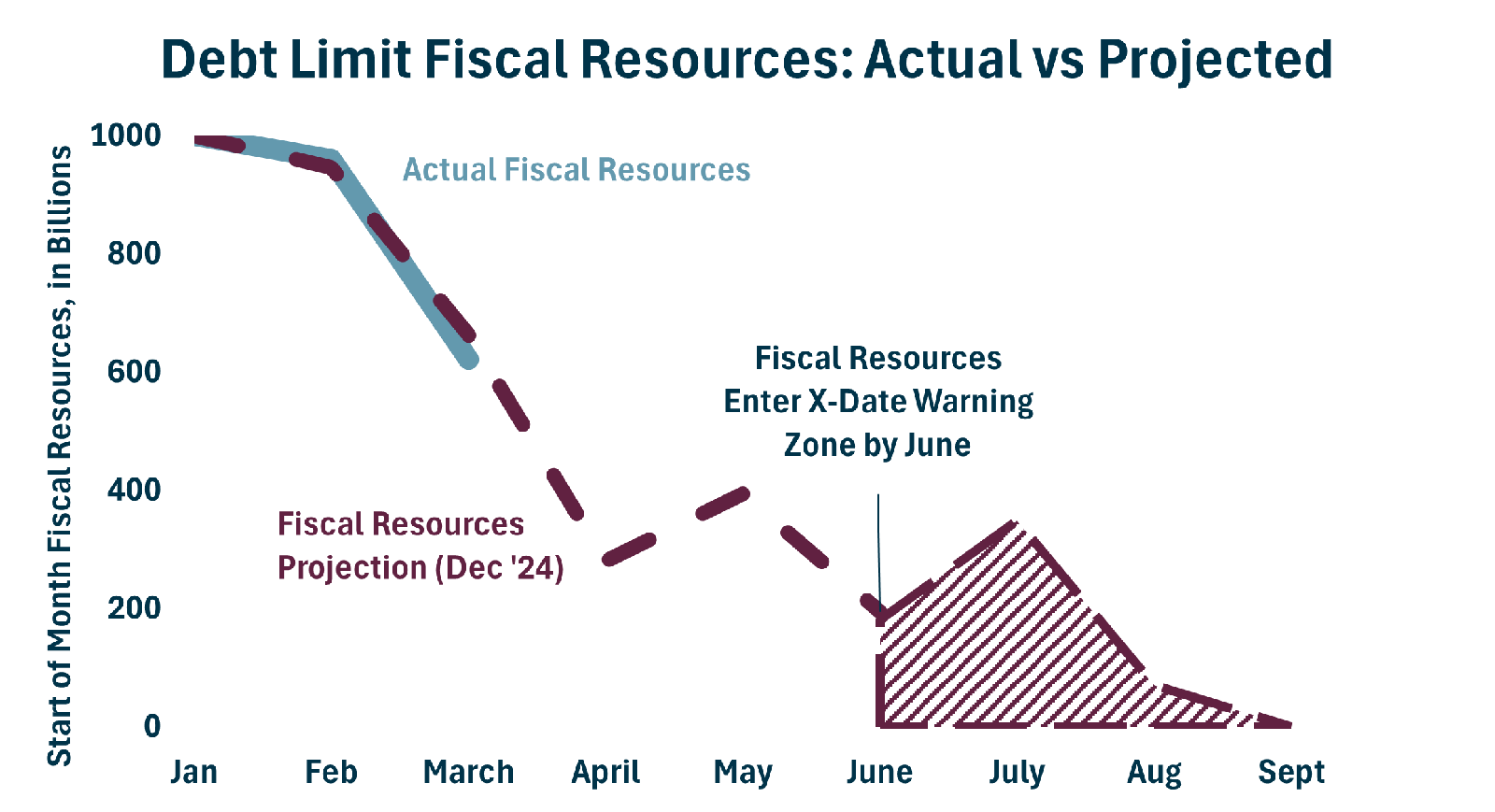
 As of March 19, 2025 (the latest date for which complete data are available), the Treasury reported $579 billion in total fiscal resources available, including $416 billion cash on hand plus $163 billion of extraordinary measures.
Additional Projections Show Debt Limit Increase Needed This Summer
This week, two other important projections of the X-Date were released, showing that the debt limit must be addressed this summer. The Congressional Budget Office (CBO) estimates that:“The government's ability to borrow using extraordinary measures will probably be exhausted in August or September 2025. The projected exhaustion date is uncertain because the timing and amount of revenue collections and outlays over the intervening months could differ from CBO's projections. “If the government's borrowing needs are significantly greater than CBO projects, the Treasury's resources could be exhausted in late May or sometime in June, before tax payments due in mid-June are received or before additional extraordinary measures become available on June 30. “Conversely, if borrowing needs fall short of the amounts in CBO's projections, the extraordinary measures will permit the Treasury to continue financing government activities longer than expected.”The Bipartisan Policy Center (BPC) “projects that the X Date will most likely fall between mid-July and early October.” Both BPC and CBO cite significant uncertainty over the X-Date. There are several different variables that influence the fiscal resources available and the Treasury’s borrowing requirements. The most important variable is the level of tax revenues during the April tax filing season, as well as the quarterly corporate tax payments that are due in mid-April and mid-June. One source of uncertainty for revenue collections is the tax filing extensions provided to disaster victims in California, Florida, Georgia, Alabama, South Carolina, North Carolina, Kentucky, Tennessee, and West Virginia. This relief could delay tens of billions of expected tax revenues.
Cycle of Monthly Deficits
The distribution of the budget deficit varies significantly throughout the fiscal year. The federal government typically has large budget deficits in February, March, May, July, and August. April usually has large surpluses as individuals pay income taxes due from the prior year and corporations pay quarterly taxes. In June, the additional quarterly tax payments are due and certain large extraordinary measures become available at the end of the month.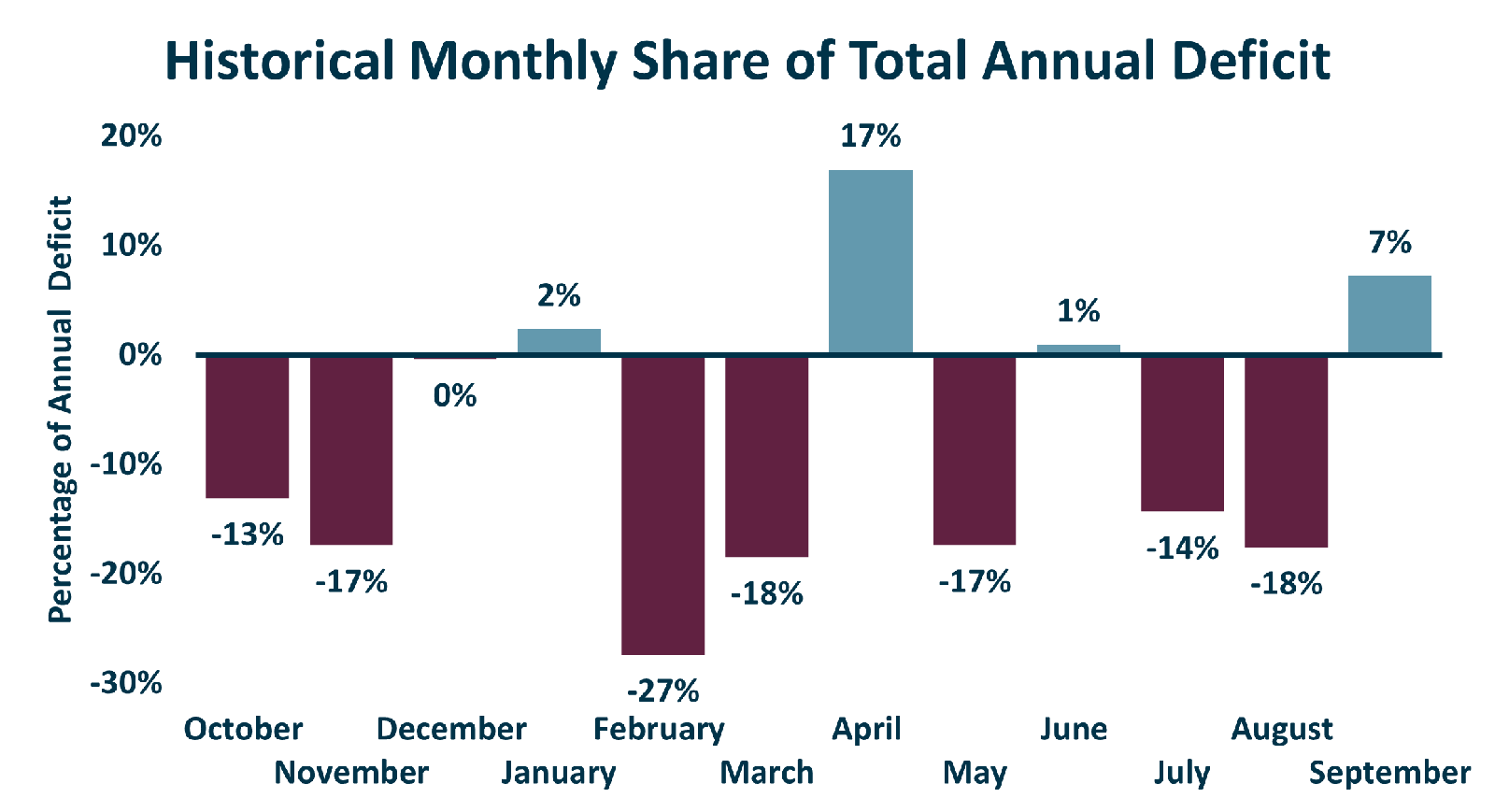 Source: Author calculation based on Treasury monthly reports from 2002 to 2024. The averaging method trims high and low values to exclude outliers.
Extraordinary Measures
Extraordinary measures are authorized by law to allow the Treasury to generate additional cash on hand to fund obligations when borrowing is at or near the debt limit. They do so by temporarily reducing certain types of debt so that the Treasury can issue additional debt held by the public, which provides the Treasury with access to cash to pay for spending obligations. The three main extraordinary measures include the:- Government Securities Investment Fund (G Fund).
- Exchange Stabilization Fund (ESF).
- Civil Service Retirement and Disability Fund (CSRDF) and Postal Service Retiree Health Benefits Fund (PSRHBF).
| Extraordinary Measures Available | ||
| Extraordinary Measure |
2023 Debt Limit |
2025 Debt Limit (Estimated) |
| G Fund | 295 | 299 |
| ESF | 17 | 20 |
| CSRDF and PSRHBF | 25 | 19 |
| Total Extraordinary Measures | 337 | 338 |
| Additional One Time CSRDF/PSRHBF - June 30 | 146 | 147 |
| Additional One Time CSRDF/PSRHBF - Sept. 30 | 48 | 53 |
| In Billions of Dollars. Note: an additional one-time CSRDF/PSRHBF extraordinary measure would also become available on December 31; Treasury did not report the amount that would have been available in 2023 or 2025. In 2017, the December one-time amount was reported to be $13 billion. Source: U.S. Department of the Treasury | ||