



What are Extraordinary Measures?
Extraordinary measures are authorized by law to allow the Treasury to generate additional cash on hand to fund obligations when borrowing is at or near the debt limit. They do so by temporarily reducing certain types of debt so that the Treasury can issue additional debt held by the public, which provides the Treasury access to cash to pay for spending obligations.What Extraordinary Measures Can the Treasury Use?
Here are the three main extraordinary measures used by the Treasury:- Government Securities Investment Fund (G Fund). The G Fund is the Government Securities Investment Fund of the Thrift Savings Plan (TSP) for federal retirees. Assets in the fund are invested in special-issue Treasury securities that count against the debt limit. When the debt limit is reached, the Treasury Secretary has the authority to suspend the daily reinvestment of assets in the fund. When the debt limit is raised, the fund is made whole, and retiree benefits are not affected.
- Exchange Stabilization Fund (ESF). The ESF is used to purchase and sell foreign currencies. Some assets of the fund are invested in special-issue Treasury securities that count against the debt limit. When the debt limit is reached, the Treasury Secretary has the authority to suspend the reinvestment of assets in the fund. There is no requirement or authority that the interest foregone for the ESF be restored when the debt limit is raised.
- Civil Service Retirement and Disability Fund (CSRDF) and Postal Service Retiree Health Benefits Fund (PSRHBF). The CSRDF and the PSRHBF provide benefits to retired and disabled federal and postal employees. The funds are invested in special-issue Treasury securities that count against the debt limit. During a “debt issuance suspension period,” the Treasury Secretary has the authority to suspend new investments in the funds and take early redemption of some investments. When the debt limit is raised, the funds are made whole, and retiree benefits are not affected.
How Do Extraordinary Measures in 2025 Compare to Previous Debt Limits?
The extraordinary measures estimated to be available in 2025 are very similar to those utilized by the Treasury in 2023. An estimated $336 billion of extraordinary measures are currently available. During the 2023 debt limit, $337 billion in extraordinary measures were used by Treasury.|
Extraordinary Measures Available |
||
|
Extraordinary Measure |
2023 Debt Limit |
2025 Debt Limit (Estimated) |
| G Fund |
295 |
298 |
| ESF |
17 |
20 |
| CSRDF and PSRHBF |
25 |
18 |
|
Total Extraordinary Measures |
337 |
336 |
| Additional One Time CSRDF/PSRHBF - June 30 |
146 |
147 |
|
Additional One Time CSRDF/PSRHBF - Sept. 30 |
48 |
53 |
| In Billions of Dollars. Note: an additional one-time CSRDF/PSRHBF extraordinary measure would also become available on December 31; Treasury did not report the amount that would have been available in 2023 or 2025. In 2017, the December one-time amount was reported to be $13 billion. Source: U.S. Department of the Treasury | ||
How Long Will the Extraordinary Measures Last?
EPIC projects that it is possible that the X-Date will be reached prior to June 16, 2025, and Congress will need to act earlier than many are expecting. At the latest, the debt limit will need to be increased before August 2025 when Congress typically recesses. The Treasury had about $677 billion cash on hand as of January 16, 2025, down from $722 billion on December 31, 2024. Combined with the estimated $336 billion of extraordinary measures, that means the Treasury has about $1 trillion in available fiscal resources (along with incoming revenues) to finance obligations until the X-Date is reached.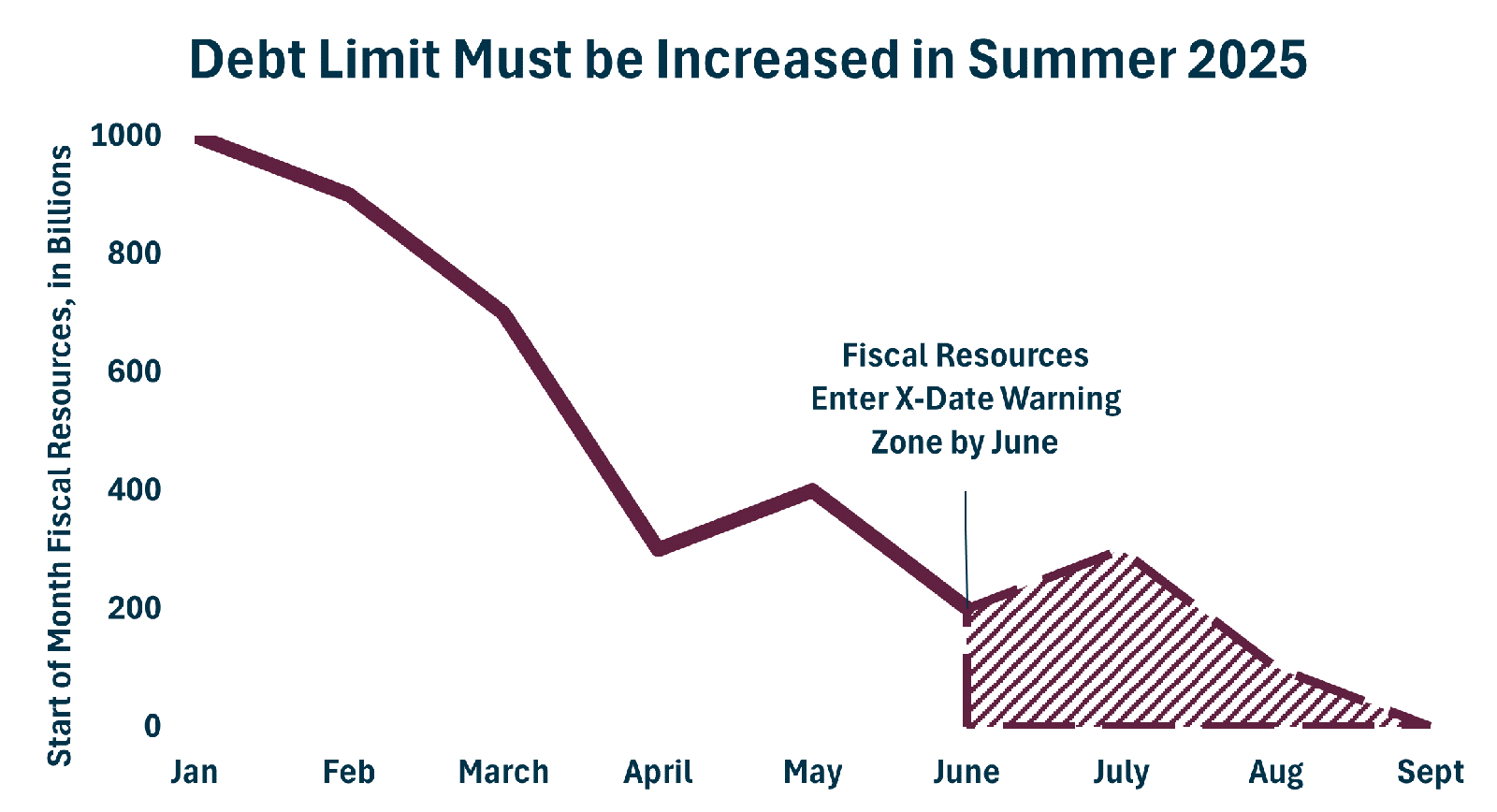 The fiscal situation going into the month of June will be key for determining the X-Date in 2025. May is traditionally a high deficit month. Then, at the beginning of June, large payments for Medicare and Social Security benefits are due. This means that available fiscal resources could run low by the early weeks of June, before the quarterly tax payments are received in the middle of the month and the June 30 one-time extraordinary measures become available.