The 2021 Infrastructure Investment and Jobs Act (IIJA) (also known as the Bipartisan Infrastructure Law) provided a major increase in federal infrastructure spending and was heralded as a “historic investment” in the nation’s infrastructure.
[1]
However, there is an important distinction between federal spending—the expenditure (or promised reimbursement) of cash—and actual capital investment in infrastructure,
i.e., the value of physical structures put into place.
The federal government owns a minimal amount of civilian infrastructure,
[2] so it has limited ability to invest directly in most transportation assets, including roads, bridges, transit systems, airports, and the like. It must instead provide (and pay for the programmatic administration of) grants to the state and local governments that own and can therefore invest in improving the infrastructure Americans depend on for their daily lives.
The IIJA’s Impact: Increased Spending, Declining Real Capital Investment
It is well documented that the IIJA considerably increased federal spending dedicated to transportation infrastructure.
[3] The $1.2-trillion bill included $550 billion for new programs, providing an annual budgetary increase ranging from 50 percent for the Federal Highway Administration to a 470 percent increase for the Federal Railroad Administration between FY 2019 (the final pre-pandemic year of the previous surface transportation authorization) and FY 2024.
Did this large increase in federal spending result in corresponding increases in real investment in the nation’s transportation infrastructure? An initial review of the latest federal data covering the first three years of the IIJA indicates it did not. Indeed, real inflation-adjusted investment appears to have declined following the passage of the IIJA.
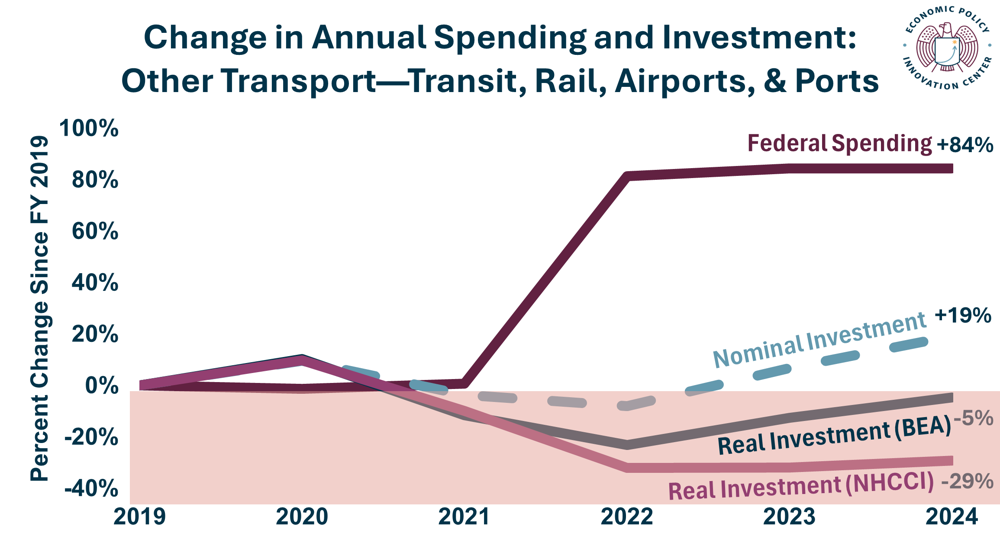
Between 2019 and 2024,
[4] an 84 percent increase in spending on non-highway transportation infrastructure (aviation, transit, rail, and port infrastructure) coincided with a -5 percent to -29 percent decrease in real investment over the same period, depending on whether one adjusts for inflation via the Bureau of Economic Analysis’s infrastructure-specific chained price indices or the Federal Highway Administration’s National Highway Constructure Cost Index (NHCCI).
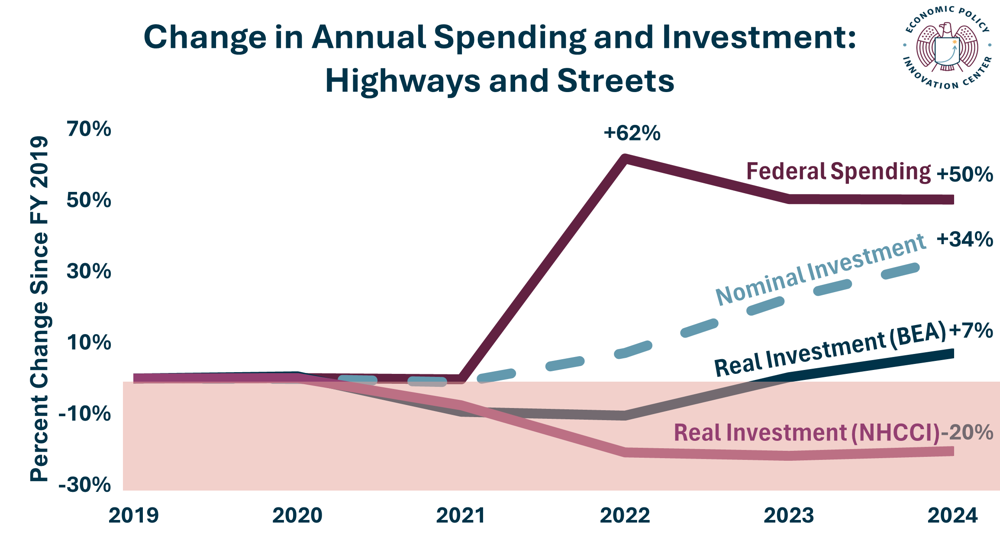
[5] Similarly, a 50 percent increase in highway spending led to, at best, a 7 percent investment increase and may have reduced investment by 20 percent.
To put it simply, federal data suggest there were more annual infrastructure improvements put in place
prior to IIJA’s 50-84 percent increase in federal transportation spending. In dollar terms, nominal federal spending levels as enumerated in the IIJA increased by nearly $56 billion annually, but total real investment likely
shrunk by as much as $33 billion. Notably, the federal spending figures in this analysis exclude billions in additional emergency resources allocated during the major COVID relief packages of CARES, CRRSA, and the American Rescue Plan Act, which provided additional billions for transportation operations, maintenance, and improvements.
It is important to adjust for inflation when considering capital investment because a dollar of investment does not buy the same amount of construction across years. Real investment figures allow one to compare the actual quantity of infrastructure put in place on an apples-to-apples basis, regardless of the price for a cubic yard of concrete or a ton of steel.
Potential Reasons IIJA Spending Increases Failed to Spur Investment
Regardless of the inflation index used to adjust for prices, a large increase in federal spending had not yet generated real capital investment three years into IIJA’s five-year run time. Why? While it is too early to prove the cause of this dynamic, there are likely several top factors at play:
- Long Federal Funding Lead Times: By the end of 2024, only 64 percent of the U.S. Department of Transportation’s (USDOT) available IIJA funding had been obligated (i.e., committed to a specific project) and less than one-third had actually been outlayed (i.e., spent).[6] This is likely due to two broad reasons:
- Administrative and Regulatory Hurdles: The IIJA created many new programs, including competitive discretionary grants. It took agencies time, often years, to establish an administrative framework and regulations for each of them. Additionally, the imposition of new rules on existing programs (and subsequent legal challenges to those rules) created additional hurdles and uncertainty for owners.[7]
- Federal Funding Mechanics: While it varies by program, state and local governments generally have four years just to obligate the transportation funds they are allocated—that is, assign the funds to a specific project via agreement with the granting agency. Owners are then not reimbursed for construction until actual expenses are incurred, meaning USDOT may not record real cash outlays for several years. And because projects can take years of development work before they are ready for construction, owners cannot immediately bring forward the number of projects they have ready for federal obligation. They must dedicate additional capacity to bring projects through planning, environmental review, design, and procurement, which likewise takes considerable time and resources.
- Inflation: As the data show, IIJA coincided with a large increase in inflation for transportation projects that reduced purchasing power and therefore the value of investment put in place. The IIJA likely spurred inflation in two ways. Specific to the infrastructure sector, the dramatic increase in available funding increased demand among infrastructure owners to advance projects while the supply of construction services and materials remained fixed. Construction workers require training and new production plants to increase output for concrete, steel, asphalt, and other necessary components cannot be built overnight. As such, demand outstripped available supply, leading to higher prices. Secondly, the spending increases in IIJA were not offset by cuts to other spending programs and instead led to a significant increase in the federal deficit, creating inflationary pressure at a macroeconomic level.
- Intergovernmental Dynamics: Federal funding has historically represented a minority of national transportation funding—approximately a quarter—with the majority coming from state and local sources. State and local governments therefore have control over the bulk of infrastructure funding streams and may respond perversely to an increase in newly available money from the federal government. There are at least two responses that are rational from the state and local owner’s perspective but may have reduced or delayed overall investment:
- Substitution Effect: Instead of supplementing their own investment, owners may have substituted new federal funding for their own funds and shifted them from transportation to non-infrastructure uses. Indeed, following the large one-time transportation spending increase in the 2009 stimulus package, a Federal Reserve study found that many states—those representing 40 percent of Americans—reduced their overall highway spending after they received additional funding under the American Recovery and Reinvestment Act.[8]
- Coupon Effect: Additionally, the prospect of receiving funding in the near future could lead sponsors to delay investing their own funds in a project so they can apply for and ultimately receive a federal grant that would buy down the cost to the owner This leads not only to the delay of investments but also associated cost increases as inflation accrues during the project delay.[9] It also encourages additional reliance on federal programs for project selection and funding, potentially subjugating state and local priorities to those that are eligible for federal funding, even if the latter group of projects may not necessarily provide as much value to the owners.
- Overhead and Waste: As discussed, the creation of many new programs required the establishment of new administrative functions, which require resources. For example, staffing levels at USDOT increased by more than 2,500 full-time equivalent positions between 2019 and 2024.[10] Similarly, it is likely that many state and local governments either expanded or refocused staff and consultant resources on federal funding pursuits and administrative activities, potentially at the expense of project development and delivery functions. Furthermore, the vast availability of funding and preferences for causes unrelated to hard construction activities may have resulted in capture by interest groups at the expense of investment.[11]
- Measurement Issues: In calculating capital investment, BEA may not account for investment in equipment outside of fixed structure, such as transit buses and rolling stock, or spending on non-construction services needed to advance projects (e.g., planning, environmental, engineering).
Conclusion
Three years after enactment of the IIJA, data suggest that federal spending increases have not spurred corresponding investments in real infrastructure improvements and in fact may have led to an overall reduction in investment. Policymakers at the federal, state, and local levels should carefully track infrastructure investment outcomes and bear in mind the experience with the IIJA when crafting subsequent infrastructure spending legislation, including considering a more rationalized, flexible spending approach.
[1] Senate Committee on Commerce, Science, and Transportation, “Historic Investments to Rebuild America’s Transportation Infrastructure, Spur Economic Growth are On the Way as IIJA Heads to President’s Desk,” November 6, 2021,
https://www.commerce.senate.gov/2021/11/historic-investments-to-rebuild-america-s-transportation-infrastructure-spur-economic-growth-are-on-the-way-as-iija-heads-to-president-s-desk (accessed April 27, 2026).
[2] See, e.g., Chris Edwards, “Who owns U.S. Infrastructure?,” Cato Institute, June 1, 2017,
https://www.cato.org/tax-budget-bulletin/who-owns-us-infrastructure (accessed April 27, 2026).
[3] Spending advanced in the IIJA consists primarily of authorized contract authority (subject to obligation limitations) and appropriations. This analysis relies on actual figures for budgetary resources detailed in US Department of Transportation’s annual Budget Highlights document. U.S. Department of Transportation, Budget Highlights, https://www.transportation.gov/mission/budget/dot-budget-and-performance-documents#BudgetHighlights
[4] 2024 is the latest year for which complete data are available.
[5] These two indices both measure price changes specifically associated with infrastructure construction but via different methodologies. The Bureau of Economic Analysis uses a chained-type price index derived from the Producers Price Index, which is drawn from a survey of producer inputs, while the Federal Highway Administration’s National Highway Construction Cost Index uses the prices used in actual bids made on federal-aid highway projects. Because the inputs in highway projects such as contractor labor, asphalt, concrete, steel, aggregates, etc., are similar to those used in the construction of other infrastructure, the index applies well to these other modes. For a recent survey of infrastructure construction cost indices, see: Grace Truslow, “Rising Construction Costs: Analyzing the Contributors to Cost Escalations and the Impact on Federal Transportation Infrastructure Investments,” Eno Center for Transportation, August 2025,
https://enotrans.org/wp-content/uploads/2025/08/Rising-Construction-Costs-White-Paper_Final.pdf (accessed April 27, 2026).
[6] U.S. Department of Transportation, Infrastructure Investment and Jobs Act (IIJA) Financial Summary as of December 15, 2024,
https://web.archive.org/web/20250204232318/https://www.transportation.gov/sites/dot.gov/files/2025-01/IIJA%20Draft%20SOF%20Report_12-15-24%20%28IIJA%20Only%29%20Combined.pdf (accessed April 27, 2026).
[7] See, for example, Federal Highway Administration, “Memorandum: Policy on Using Bipartisan Infrastructure Law Resources to Build a Better America,” December 16, 2021,
https://web.archive.org/web/20220205004507/https://www.fhwa.dot.gov/bipartisan-infrastructure-law/docs/building_a_better_america-policy_framework.pdf (accessed April 27, 2026).
[8] Bill Dupor, “Why the 2009 Recovery Act Didn’t Improve the Nation’s Highways,” Federal Reserve Bank of St. Louis, September, 22, 2017,
https://fraser.stlouisfed.org/title/economic-synopses-6715/2009-recovery-act-didnt-improve-nations-highways-624502?deep=true (accessed April 27, 2026).
[9] DJ Gribbin, Testimony on Paving the Way for Funding and Financing Infrastructure Investments, January 29, 2020,
https://www.congress.gov/116/meeting/house/110410/witnesses/HHRG-116-WM00-Wstate-GribbinD-20200129.pdf (accessed April 27, 2026).
[10] U.S. Department of Transportation, Budget Highlights,
https://www.transportation.gov/mission/budget/dot-budget-and-performance-documents (accessed April 27, 2026).
[11] See, for example, Sarah Wagoner, “IIJA Funds Wasteful Community Charging Infrastructure,” February 18, 2026,
../../federal-budget/iija-funds-wasteful-community-charging-infrastructure/.