When Congress cancels federal budget authority (BA) which has not yet been used for spending (outlays, or OT), it is called a rescission. There are several different ways for legislators to enact a rescission. One of these involves an expedited process for rescissions requested by a President and then voted on by Congress. However, rescissions most often take place in appropriations legislation.
Policymakers should understand the pitfalls associated with the use of rescissions in appropriations bills. Such rescissions not only fail to provide deficit reduction, but in fact often lead to additional deficit spending. Tighter budget rules and greater transparency would rein in gimmicky rescissions with fake savings.
Rescissions Enable Appropriations Growth
If an appropriations bill cancels previously enacted BA with a rescission, the Congressional Budget Office (CBO)
counts the rescission as a reduction in BA. This creates space for additional BA within the appropriation bill’s
budget allocation. Since appropriators tend to spend the maximum amount possible, it can be assumed that every dollar of BA “saved” by rescissions will be repurposed into BA for other accounts in the appropriations bill.
This has more than just a short-term effect. The CBO “
baseline” for appropriated accounts reflects what Congress enacted in the most recent fiscal year (FY), along with an assumption of annual growth for inflation. When a rescission enables a BA increase elsewhere in the appropriations bill, the new spending becomes part of the baseline.
In turn, special interests that benefit from this higher spending will defend the increases in subsequent spending cycles, making it less likely that future appropriations bills will revert to the original level. Thus, a gimmick rescission from a single year can create lasting increases elsewhere.
Real Rescissions vs Gimmick Rescissions
Ideally, rescinded BA will lead to a comparable amount of reduced OT. For example, the
second FY 2024 appropriations package included $20.2 billion of rescissions to Internal Revenue Service (IRS) enforcement spending originally passed in
2022. These funds were made available through FY 2031, meaning that in isolation the rescission represented a genuine spending cut. Below is one of the two IRS rescissions.

However, these savings were offset by new spending elsewhere in the bill.
Rescinding “excess” prior-year BA in the appropriations process will often have little to no effect on OT, which is ultimately what drives the size of federal deficits. While federal agencies usually spend the vast majority of their appropriations, there are times when a portion of a given account’s BA remains unspent. If Congress overestimates how much a bureau needs to complete its assigned duties during the year, there will be “excess” BA that does not lead to OT.
However, a rescission’s value for appropriators is based solely on the new BA they can create. Rescinding “excess” BA enables the creation of new BA that will lead to a comparable amount of OT, meaning that the rescission causes a net increase in OT. Such rescissions are a budget gimmick that does not reduce the deficit.
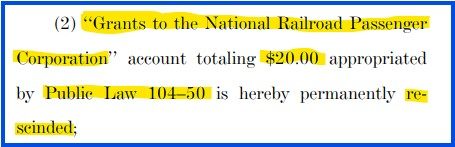
An example of this can be found in the Senate’s FY 2026 Transportation, Housing and Urban Development
bill, which contains a $20 rescission to Amtrak funding from
FY 1996. This long-dormant BA will not lead to $20 of OT and rescinding it would not represent $20 of real savings.
 Dozens of larger rescissions
 scattered across House and Senate FY 2026 appropriations bills would increase spending by billions of dollars.
Reforms to Prevent Gimmick Rescissions
There are several ways for Congress to prevent appropriators from abusing rescissions:
- Adjusting budgetary rules to link offsets to changes in OT as well as BA.
- Regularly passing rescissions of unnecessary BA outside of the appropriations process, so that the savings result in deficit reduction.
- Ending the loophole on publishing full account-level CBO analysis of appropriations bills, which was established in section 402 0f the Budget Act of 1974. This would allow legislative offices and outside analysts to see whether a given rescission represents genuine savings or is merely a gimmick.
Stopping the use of rescissions as a budget gimmick would not be sufficient to eliminate the federal government’s unsustainable deficits. However, it would represent a measure of fiscal responsibility that has been sorely lacking for quite some time.