Rescissions Reduce Budget Authority
Budget authority that was provided by a previously enacted appropriations bill and has not yet been obligated by an agency can be canceled by a new law passed by Congress, preventing the funds from being spent. This cancellation of budget authority is called a rescission.
Rescissions can be initiated by either the President or by Congress.
The Impoundment Control Act creates an expedited rescission process that is initiated by the President. Presidentially-initiated rescissions are considered by Congress under a fast-track legislative process that bypasses the Senate filibuster.
[1]
Alternatively, Congress can initiate and pass rescissions just like any other legislation. Rescissions of previously enacted budget authority are often included in annual appropriations bills.
Congressionally-initiated rescissions are common. Between fiscal years (FY) 2000 and 2020, Congress initiated and enacted 2,019 rescissions, an average of 96 per year, according to data compiled by the Government Accountability Office (GAO).
[2] Presidentially-initiated rescissions have been rare in recent decades, although President Donald J. Trump has shown a renewed interest in using this authority. No Presidentially-initiated rescissions were accepted from FY 2000 until FY 2025. After President Trump proposed 21 rescissions of funding for foreign aid and the Corporation for Public Broadcasting, Congress passed H.R. 4, the Rescissions Act of 2025, which was signed into law on July 24, 2025.
[3]
Standalone Rescissions and Rescissions in Appropriations Bills Can Be Used for Different Ends
Standalone rescission bills, including Presidentially-initiated rescissions, reduce the deficit. For example, the Rescissions Act of 2025 reduced outlays by $9 billion.
[4]
However, rescissions included in appropriations bills could be used to
increase net outlays. Under the scoring rules, rescissions of previously enacted budget authority can be used as an offset for higher spending elsewhere in an appropriations bill.
[5] When rescissions are included in an appropriations bill, it is often a budgetary gimmick used to hide spending increases.
[6]
In many cases, the rescinded budget authority is old and not needed, while the new budget authority is more likely to be fully obligated. This means that the rescinded funds would not actually have been spent, but the new spending offset by the rescission will be spent. Effectively, the offset only exists on paper in these instances.
Furthermore, when a rescission is in an appropriations bill, it means the spending cut is “used up” and cannot be enacted as a standalone measure to reduce the deficit. This is particularly impactful when the budget authority likely would have been outlayed if not for the rescission.
Rescissions in the FY 2026 Appropriations Bills
FY 2026 has already begun, but the annual appropriations process is only partially completed. The House has marked up all 12 of its bills, while the Senate has only marked up eight bills. Congress has already enacted the FY 2026 Agriculture, Legislative Branch, and Military Construction-Veterans Affairs appropriations bills as part of a three-bill minibus in November.
[7] That leaves nine other regular appropriations bills that have yet to be enacted. These agencies are operating under a continuing resolution through January 30, 2026.
Many rescissions are included in the FY 2026 appropriations bills. More than 100 rescissions have been proposed, totaling more than $62.5 billion across 11 appropriations bills. Only one of the regular appropriations bills (Legislative Branch) did not include any rescissions proposed by either chamber. A table listing rescissions proposed by appropriations bill is included in Appendix A.
Already Enacted Rescissions
The Ag, Leg Branch, and MilCon-VA minibus that was signed into law included seven rescissions totaling $16.999 billion.
Table 1
| FY 20206 Enacted Rescissions |
| Rescissions Enacted |
Rescission Amount |
| 7 |
$16,999,000,000 |
| Source: House and Senate Appropriations Committees. |
The largest enacted rescission was $15.889 billion from Veterans Health Administration — Medical Services funding, which was advanced appropriated for FY 2026 by the FY 2025 full-year continuing resolution. A table listing the enacted rescissions in the minibus is included in Appendix B.
Rescissions Agreed to by Both Chambers
In the bills marked up by the House and Senate Appropriations Committees not yet enacted, both chambers agree upon 102 rescissions totaling at least $38.2 billion. This includes $709 million in rescissions in the Commerce, Justice, and Science, Energy and Water, and Interior minibus,
[8] $2.2 billion in the Financial Services and General Government and National Security, Department of State, and Related Programs minibus,
[9] $35.1 billion in the Defense, Labor, Health and Human Services, and Education, and Transportation and Housing and Urban Development minibus,
[10] and $202 million in the Department of Homeland Security bill.
[11]
Table 2
| FY 2026 Rescissions Agreed to by Both Chambers |
| Rescissions Proposed |
Rescission Amount |
| 102 |
$38,221,580,514 |
| Source: House and Senate Appropriations Committees. |
The largest of these recissions is a $12.3 billion reduction in the Children’s Health Insurance Program (CHIP) Child Enrollment Contingency Fund (this is a recurring rescission commonly called the “CHIP CHIMP”).
[12] A table listing the rescissions agreed to by both chambers is included in Appendix C.
Rescissions Initially Proposed by But Not in Final Bill
A total of 24 additional rescissions have been proposed by either the House or Senate, but were not included in the final conferenced bill. These rescissions total $7.3 billion.
Table 3
| FY 2026 Rescissions Proposed by One Chamber |
| Chamber |
Rescissions Proposed |
Rescission Amount |
| House |
18 |
$6,676,150,000 |
| Senate |
8 |
$661,659,000 |
| Total |
24* |
$7,337,809,000 |
| Source: House and Senate Appropriations Committees.
* Includes two overlapping rescissions between the House and Senate. |
A table listing the rescissions proposed but not in the final bill is included in Appendix D.
Rescissions Are a Powerful Tool to Cut Waste
The rescission process is a powerful way to eliminate waste, fraud, and abuse by cancelling unneeded funds. The President and Congress should use rescissions to enact needed spending cuts.
However, rescissions should be used to reduce the deficit, not hide new wasteful spending. When rescissions are included in appropriations bills, the scoring rules allow them to offset higher spending elsewhere in the bill. Standalone rescission bills, on the other hand, reduce the deficit. Thus, it would be best to consider rescissions of unneeded budget authority on a standalone basis in most cases.
The Appropriations Committees Should Identify Rescission Opportunities
The Appropriations Committees should be charged with identifying opportunities to rescind waste, fraud, and abuse.
The members of the House and Senate Appropriations Committees follow the budget accounts within their jurisdictions very closely throughout the fiscal year. They work directly with agency budget officers and the Office of Management and Budget (OMB) to monitor the status of enacted appropriations and provide oversight.
When funds are no longer needed, the Appropriations Committees often propose that budget authority be rescinded. This work can be incredibly detail-oriented. For example, one rescission in the Senate’s FY 2026 Transportation, Housing, and Urban Development Appropriations Bill is for just $1.74.
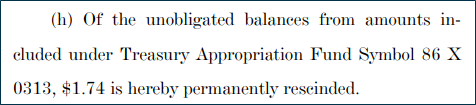
Source: S. 2465, Transportation, Housing and Urban Development, and Related Agencies Appropriations Act, 226 (119th Congress)
The Appropriations Committees have recently identified more than 100 potential rescissions totaling $56.4 billion. Unfortunately, instead of introducing standalone rescission proposals to permanently cut waste, the rescissions have been used to increase other spending in the FY 2026 appropriations bills.
The President Should Lead on Rescissions by Using Impoundment Control Act Powers
The Impoundment Control Act (ICA) created an extremely powerful procedure that allows rescissions proposed by the President to be enacted on a fast-track process that bypasses the Senate filibuster. The President should take advantage of this process to cut wasteful spending. President Trump and his Administration deserve credit for revitalizing the rescission power.
In fact, the President is required by law to use the ICA process. The law provides that:
“Whenever the President determines that all or part of any budget authority will not be required to carry out the full objectives or scope of programs for which it is provided or that such budget authority should be rescinded for fiscal policy or other reasons (including the determination of authorized projects or activities for which budget authority has been provided), or whenever all or part of budget authority provided for only one fiscal year is to be reserved from obligation for such fiscal year,” the President shall submit a rescission proposal to Congress.
[13]
This requirement means that the Executive Branch should have a process in place to continuously review unspent budget authority. Any funds that are determined to be wasteful, harmful, or not needed should be officially proposed for rescission. One indicator that funds could be rescinded is when the Congressional spending committees themselves propose cutting those funds.
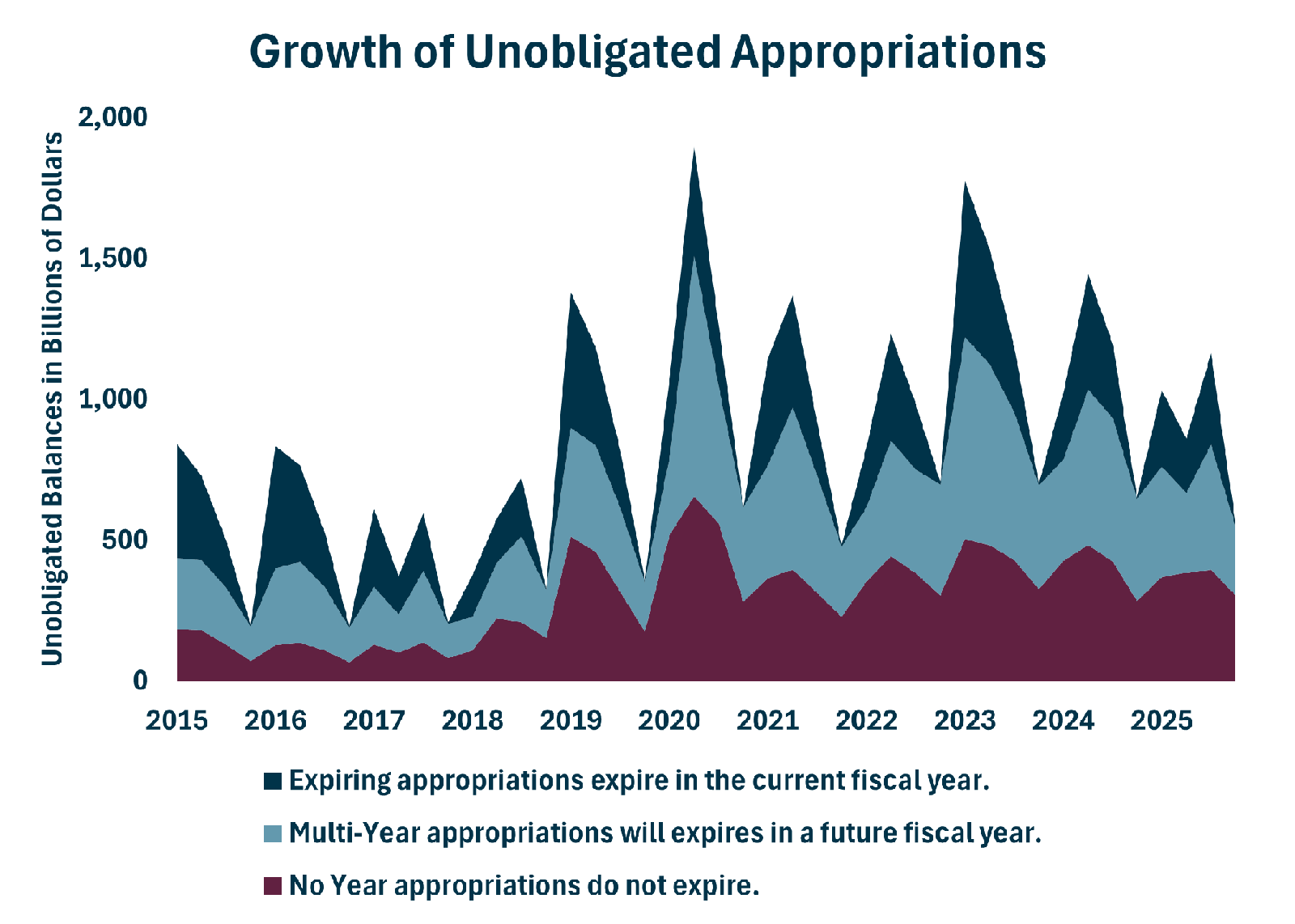
At the end of FY 2025, federal agencies had $560 billion in unobligated balances of discretionary budget authority that could be rescinded.
[14]
Table 4
| Unobligated Appropriations
as of September 2025 |
| No-Year |
Multi-Year |
Expiring |
Total |
| $305 B |
$242 B |
$13 B |
$560 B |
| In billions of dollars.
Source: Office of Management and Budget. |
Over the last decade, balances of unobligated budget authority have grown significantly. At the end of FY 2015, $199 billion in unobligated balances remained. In contrast, $560 billion in unobligated budget authority was available at the end of FY 2025. This is an increase of 181.4 percent.
Chart 1
Source: OMB
Rescissions Are One Tool to Control Spending
The national debt is now roughly equivalent to the size of the economy and stands at its highest level since World War II. The fiscal state of our nation is deteriorating, and unsustainable spending is the underlying problem. The government is rapidly depleting its fiscal space, risking a fiscal crisis if a debt spiral occurs.
Congress and the President should use every tool at their disposal to get spending under control. Rescissions are just one option to enact spending cuts. It is important that legislators enact rescissions in the most effective way possible. Rescissions should be passed as standalone legislation rather than being tucked into appropriations bills to hide higher spending.
This report was originally published on December 2, 2025, and updated on January 9, January 11, and January 21, 2026.
Appendix A: FY 2026 Rescissions by Bill
Table 5
| FY 2026 Rescissions by Bill |
| Bill |
House |
Senate |
Final |
| Agriculture |
$378,000,000 |
$450,000,000 |
$500,000,000 |
| CJS |
$697,299,000 |
$305,000,000 |
$709,200,000 |
| Defense |
$0 |
$3,157,302,000 |
$5,708,887,000 |
| Energy & Water |
$9,422,000 |
$39,000,000 |
$0 |
| FSGG |
$12,000,000 |
$262,000,000 |
$303,000,000 |
| Homeland |
$0 |
$194,800,000 |
$202,232,799 |
| Interior |
$0 |
$91,000,000 |
$0 |
| L-HHS-ED |
$18,159,707,000 |
$26,456,000,000 |
$28,218,000,000 |
| Leg Branch |
$0 |
$0 |
$0 |
| MilCon-VA |
$0 |
$0 |
$16,499,000,000 |
| State |
$3,552,697,000 |
$0 |
$1,936,531,000 |
| T-HUD |
$1,103,000,000 |
$221,759,088 |
$1,143,729,715 |
| Total |
$23,912,125,000 |
$31,176,861,088 |
$55,220,580,514 |
| Source: House and Senate Appropriations Committees. |
Appendix B: FY 2026 Already Enacted Rescissions
Table 6
| FY 2026 Enacted Rescissions |
| Bill |
Agency |
Account |
Rescission |
| Ag |
Agriculture |
Natural Resources Conservation Service—Conservation Operations |
$30,000,000 |
| Ag |
Agriculture |
National Institute of Food and Agriculture—Research and Education Activities |
$22,000,000 |
| Ag |
Agriculture |
Distance Learning, Telemedicine, and Broadband Program |
$20,000,000 |
| Ag |
Agriculture |
Working Capital Fund |
$78,000,000 |
| Ag |
Treasury |
Treasury Forfeiture Fund
(CHIMP) |
$350,000,000 |
| MilCon-VA |
Veterans Affairs |
Veterans Health Administration — Medical Services
(FY 2026 advanced appropriation) |
$15,889,000,000 |
| MilCon-VA |
Veterans Affairs |
Medical Support and Compliance
(FY 2026 advanced appropriation) |
$610,000,000 |
| Total |
|
|
$16,999,000,000 |
| Source: House and Senate Appropriations Committees. |
Appendix C: FY 2026 Rescissions Agreed to by Both Chambers
Table 7
| FY 2026 Rescissions Agreed to by Both Chambers |
| Bill |
Agency |
Account |
Rescission |
| CJS |
Commerce |
Census Working Capital Fund |
$15,000,000 |
| CJS |
Commerce |
Economic Development Assistance Programs |
$60,000,000 |
| CJS |
Justice |
Office on Violence Against Women—Violence Against Women Prevention and Prosecution Programs |
$36,000,000 |
| CJS |
Justice |
Office of Justice Programs |
$250,000,000 |
| CJS |
Justice |
Community Oriented Policing Services |
$25,000,000 |
| CJS |
Justice |
Working Capital Fund |
$210,000,000 |
| CJS |
Justice |
Assets Forfeiture Fund (CHIMP) |
$113,200,000 |
| DOD |
Defense |
Cooperative Threat Reduction Account |
$33,936,000 |
| DOD |
Defense |
Other Procurement, Army |
$15,000,000 |
| DOD |
Defense |
Weapons Procurement, Navy |
$2,943,000 |
| DOD |
Defense |
Aircraft Procurement, Air Force |
$25,397,000 |
| DOD |
Defense |
Missile Procurement, Air Force |
$41,189,000 |
| DOD |
Defense |
Procurement, Space Force |
$107,100,000 |
| DOD |
Defense |
Defense Health Program |
$10,473,000 |
| DOD |
Defense |
Counter-Islamic State of Iraq and Syria Train and Equip Fund |
$50,000,000 |
| DOD |
Defense |
Procurement of Weapons and Tracked Combat Vehicles, Army |
$452,647,000 |
| DOD |
Defense |
Other Procurement, Army |
$119,887,000 |
| DOD |
Defense |
Aircraft Procurement, Navy |
$155,711,000 |
| DOD |
Defense |
Weapons Procurement, Navy |
$200,272,000 |
| DOD |
Defense |
Aircraft Procurement, Air Force |
$193,555,000 |
| DOD |
Defense |
Other Procurement, Air Force |
$186,638,000 |
| DOD |
Defense |
Procurement, Space Force |
$339,196,000 |
| DOD |
Defense |
Procurement, Defense-Wide |
$11,807,000 |
| DOD |
Defense |
Research, Development, Test and Evaluation, Army |
$178,735,000 |
| DOD |
Defense |
Research, Development, Test and Evaluation, Navy |
$82,461,000 |
| DOD |
Defense |
Research, Development, Test and Evaluation, Air Force |
$329,435,000 |
| DOD |
Defense |
Research, Development, Test and Evaluation, Space Force |
$370,149,000 |
| DOD |
Defense |
Shipbuilding and Conversion, Navy: FFG–Frigate 2020/2031 |
$240,245,000 |
| DOD |
Defense |
Shipbuilding and Conversion, Navy: FFG–Frigate 2022/2026 |
$418,624,000 |
| DOD |
Defense |
Shipbuilding and Conversion, Navy: FFG–Frigate 2023/2027 |
$483,391,000 |
| DOD |
Defense |
Shipbuilding and Conversion, Navy: FFG–Frigate 2024/2028 |
$1,271,572,000 |
| DOD |
Defense |
Shipbuilding and Conversion, Navy: FFG–Frigate 2025/2029 |
$151,230,000 |
| DOD |
Defense |
Missile Procurement, Air Force, 2025/2027 |
$209,045,000 |
| DOD |
Defense |
Defense Modernization Account , Defense-Wide |
$28,249,000 |
| FSGG |
Treasury |
Treasury Forfeiture Fund (CHIMP) |
$300,000,000 |
| FSGG |
Treasury |
Special Inspector General for Pandemic Recovery |
$3,000,000 |
| DHS |
Management Directorate |
Procurement, Construction, and Improvements |
$73,327,000 |
| DHS |
U.S. Customs and Border Protection |
Operations and Support |
$6,713,000 |
| DHS |
U.S. Customs and Border Protection |
Automation Modernization |
$387,000 |
| DHS |
U.S. Customs and Border Protection |
Procurement, Construction, and Improve |
$917,000 |
| DHS |
U.S. Customs and Border Protection |
Border Security Fencing, Infrastructure, and Technology |
$6,336,000 |
| DHS |
U.S. Customs and Border Protection |
Air and Marine Interdiction, Operations, Maintenance, and Procurement |
$1,413,000 |
| DHS |
Cybersecurity and Infrastructure Security Agency |
Infrastructure Protection and Infrastructure Security |
$172,000 |
| DHS |
Office of the Secretary and Executive Management |
Operations and Support |
$2,072,147 |
| DHS |
Management Directorate |
Operations and Support |
$5,487,177 |
| DHS |
Intelligence, Analysis, and Situational Awareness |
Operations and Support |
$4,493,650 |
| DHS |
Office of the Inspector General |
Operations and Support |
$88,190 |
| DHS |
Transportation Security Administration |
Operations and Support |
$19,650,000 |
| DHS |
United States Secret Service |
Operations and Support |
$703,390 |
| DHS |
Cybersecurity and Infrastructure Security Agency |
Operations and Support |
$52,349,050 |
| DHS |
Federal Emergency Management Agency |
Operations and Support |
$18,525,975 |
| DHS |
U.S. Citizenship and Immigration Services |
Operations and Support |
$120,860 |
| DHS |
Science and Technology Directorate |
Operations and Support |
$178,340 |
| DHS |
Countering Weapons of Mass Destruction Office |
Operations and Support |
$6,937,020 |
| DHS |
Homeland Security |
Nonrecurring Expenses Fund |
$2,362,000 |
| LHHS-ED |
Health and Human Services |
Nonrecurring Expenses Fund |
$1,826,000,000 |
| LHHS-ED |
Education |
Department of Education Nonrecurring Expenses Fund |
$160,000,000 |
| LHHS-ED |
Health and Human Services |
Child Enrollment Contingency Fund (CHIP) (CHIMP) |
$12,340,000,000 |
| LHHS-ED |
Health and Human Services |
Sections 2023, 2206, 2301, 2302, 2303, 2401, 2402, 2403, 2404, 2501, 2502, 2601, 2602, 2603, 2605, 2701, 2702, 2703, 2704, 2705, 2706, 2707, 2708, 2709, 2710, 2711, 2712, 2713, 2904, 2912, 3101, and 9911 of the American Rescue Plan Act of 2021 (Public Law 117– 15) (CHIMP) |
$2,000,000,000 |
| LHHS-ED |
Labor |
Section 286(s)(2) of the Immigration and Nationality Act (H–1B Nonimmigrant Petitioner Account) |
$206,000,000 |
| LHHS-ED |
Education |
Institute of Education Sciences |
$25,000,000 |
| LHHS-ED |
Treasury |
Section 10301(1)(A)(iii) of Public Law 117–169 (Internal Revenue Service) (CHIMP) |
$11,661,000,000 |
| State |
State |
Consular and Border Security Programs |
$900,000,000 |
| State |
State |
Educational and Cultural Exchange Programs |
$25,000,000 |
| State |
State |
Debt Restructuring |
$63,975,000 |
| State |
State |
International Narcotics Control and Law Enforcement |
$179,306,000 |
| State |
State |
Peacekeeping Operations |
$50,000,000 |
| State |
State |
Bureau for Democracy, Human Rights, and Governance, United States Agency for International Development - Democracy Fund |
$57,000,000 |
| State |
State |
Millennium Challenge Corporation |
$661,250,000 |
| T-HUD |
Transportation |
Transportation Planning, Research, and Development (FY 2010) |
$108,147 |
| T-HUD |
Transportation |
Transportation Planning, Research, and Development (FY 2004) |
$744,000 |
| T-HUD |
Transportation |
Office of the Secretary—Salaries and Expenses |
$10,368,826 |
| T-HUD |
Transportation |
Office of the Secretary—National Infrastructure Investments |
Remaining unobligated balances for FY 2022 |
| T-HUD |
Transportation |
Federal Highway Administration—Highway Infrastructure Programs -- Nationally Significant Freight and Highway Projects |
Unobligated funds for FY 2023 from the IIJA permanently rescinded |
| T-HUD |
Transportation |
Federal Highway Administration—Highway Infrastructure Programs -- Bridge Investment Program |
Unobligated funds for FY 2023 from the IIJA permanently rescinded |
| T-HUD |
Transportation |
Federal Highway Administration—Highway Infrastructure Programs -- Competitive Awards |
Unobligated funds for FY 2023 from the IIJA permanently rescinded |
| T-HUD |
Transportation |
Railroad Safety Grants (FY 2016) |
$795,332 |
| T-HUD |
Transportation |
Grants to the National Railroad Passenger Corporation (FY 1996) |
$20 |
| T-HUD |
Transportation |
Capital Assistance to States—Intercity Passenger Rail Grant Program (FY 2009) |
$292,181 |
| T-HUD |
Transportation |
Capital Assistance for High Speed Rail Corridors and Intercity Passenger Rail Service (FY 2010) |
$9,913 |
| T-HUD |
Transportation |
Railroad Research and Development (FY 2006) |
$1,008,385 |
| T-HUD |
Transportation |
National Network Grants to the National Railroad Passenger Corporation (FY 2017) |
$76,634 |
| T-HUD |
Transportation |
Railroad Rehabilitation and Improvement Financing Program (FY 2019) |
$25,476 |
| T-HUD |
Transportation |
Maritime Security Program |
$38,400,000 |
| T-HUD |
Transportation |
Cable Security Fleet |
$12,392,000 |
| T-HUD |
Transportation |
Tanker Security Program |
$42,808,000 |
| T-HUD |
Transportation |
Maritime Guaranteed Loan Program [Title XI] |
$34,000,000 |
| T-HUD |
Transportation |
Office of the Secretary—Research and Technology (FY 2022) |
$1,272,801 |
| T-HUD |
Transportation |
Office of the Secretary—National Infrastructure Investments -- local and regional project assistance |
Unobligated funds for FY 2023 from the IIJA permanently rescinded |
| T-HUD |
Transportation |
Magnetic Levitation Technology Deployment Program |
$14,000,000 |
| T-HUD |
Transportation |
Consolidated Rail Infrastructure and Safety Improvements (FY 2023) |
$5,000,000 |
| T-HUD |
Transportation |
Capital Assistance for High Speed Rail Corridors and Intercity Passenger Rail Service (FY 2010) |
$928,620,000 |
| T-HUD |
Housing and Urban Development |
Housing Certificate Fund |
Rescinds unobligated balances from FY 1974 and prior years, as well as rescinds amounts recaptured from Section 8 project-based contracts from FY 1975-1987 |
| T-HUD |
Housing and Urban Development |
Projects associated with 1012(a) of the Stewart B. McKinney Homeless Assistance Amendments Act of 1988 |
50% of budget authority, or 50% of cash amounts recaptured |
| T-HUD |
Housing and Urban Development |
Manufactured Housing Fees Trust Fund |
$5,200,000 |
| T-HUD |
Housing and Urban Development |
Management and Administration, Salaries and Expenses that were transferred from Community Development Fund made available by the Emergency Supplemental Appropriations Act for Defense, the Global War on Terror, and Hurricane Recovery, 2006; and Research and Technology made available by transfers from Emergency Supplemental Appropriations Act of 1994 |
$2,423,000 |
| T-HUD |
Housing and Urban Development |
Public Housing Capital Fund |
$5,036,989 |
| T-HUD |
Housing and Urban Development |
Community Development Fund Economic Development Initiative grant funds prior to FY 2011 |
$176,688 |
| T-HUD |
Housing and Urban Development |
Community Development Fund Special Purpose Grant funds prior to FY 2011 |
$336,276 |
| T-HUD |
Housing and Urban Development |
Assisted Housing Inspections and Risk Assessments (FY 2025) |
$22,000,000 |
| T-HUD |
Housing and Urban Development |
Native American Housing Block Grants |
$2 |
| T-HUD |
Housing and Urban Development |
Assisted Housing Inspections and Risk Assessments (FY 2024), Rental Housing Assistance, Preservation & Reinvestment Initiative for Community Enhancement (FY 2023), and Public Housing Operating Fund |
$18,635,045 |
| Total |
|
|
$38,221,580,514 |
| Source: House and Senate Appropriations Committees. |
Appendix D: FY 2026 Rescissions Initially Proposed But Not in Final Agreement
Table 8
| FY 2026 Rescissions Initially Proposed But Not in Final Agreement |
| Bill |
Agency |
Account |
Rescission Proposed by House |
Rescission Proposed by Senate |
| CJS |
Commerce |
NOAA Operations, Research, and Facilities |
$46,299,000 |
|
| CJS |
Justice |
Alcohol, Tobacco, Firearms, and Explosives |
$50,000,000 |
|
| Defense |
Defense |
Missile Procurement, Army |
|
$71,732,000 |
| Defense |
Defense |
Missile Procurement, Air Force |
|
$152,646,000 |
| Defense |
Defense |
Research, Development, Test and Evaluation, Defense-Wide |
|
$37,481,000 |
| E&W |
Energy |
National Nuclear Security Administration—Defense Nuclear Nonproliferation |
$9,422,000 |
$39,000,000 |
| FSGG |
Joint Committee on Judicial Administration |
Federal Payment for Defender Services in The District of Columbia Courts |
$12,000,000 |
|
| Interior |
Environmental Protection Agency |
Environmental Protection Agency—Buildings and Facilities |
|
$41,000,000 |
| Interior |
Smithsonian Institution |
John F. Kennedy Center for the Performing Arts—Capital Repair and Restoration |
|
$50,000,000 |
| DHS |
Coast Guard |
Procurement, Construction, and Improvements |
|
$194,800,000 |
| L-HHS-ED |
Labor |
Employment and Training Administration Training and Employment Services (FY 2025 advanced appropriations) |
$712,000,000 |
$75,000,000 |
| L-HHS-ED |
Education |
Office Of Elementary and Secondary Education Education for the Disadvantaged |
$938,266,000 |
|
| L-HHS-ED |
Education |
School Improvement Programs |
$1,681,441,000 |
|
| State |
State |
Contributions to International Organizations |
$96,240,000 |
|
| State |
State |
Development Assistance |
$1,300,000,000 |
|
| State |
State |
Economic Support Fund |
$753,482,000 |
|
| State |
State |
Assistance for Europe, Eurasia and Central Asia |
$168,000,000 |
|
| T-HUD |
Transportation |
Office of the Secretary—Research and Technology for Advanced Research Projects Agency—Infrastructure (ARPA-I) |
$10,000,000 |
|
| T-HUD |
Transportation |
Federal Railroad Administration—Federal-State Partnership for Intercity Passenger Rail |
$75,000,000 |
|
| T-HUD |
Transportation |
Federal Transit Administration—Transit Infrastructure Grants |
$40,000,000 |
|
| T-HUD |
Housing and Urban Development |
Homeless Assistance Grants |
$107,000,000 |
|
| T-HUD |
Housing and Urban Development |
Policy Development and Research -- Research and Technology |
$20,000,000 |
|
| T-HUD |
Housing and Urban Development |
Public Housing Fund, Choice Neighborhoods Initiative, and Community Development Fund |
$240,000,000 |
|
| T-HUD |
Housing and Urban Development |
Office of Lead Hazard Control and Healthy Homes |
$417,000,000 |
|
| Total |
|
|
$6,676,150,000 |
$661,659,000 |
| Source: House and Senate Appropriations Committees. |
[1] For additional background, see Matthew Dickerson, “Expedited Rescissions Allows Congress to Support DOGE’s Work to Eliminate Waste,” Economic Policy Innovation Center, April 4, 2025,
../../federal-budget/expedited-rescissions-allows-congress-to-support-doges-work-to-eliminate-waste/.
[2] Government Accountability Office, “Updated Rescission Statistics, Fiscal Years 1974–2020,” July 16, 2020,
https://www.gao.gov/products/b-330828 (accessed November 24, 2025).
[3] Rescissions Act of 2025, P.L. 119-28.
[4] Congressional Budget Office, “H.R. 4, Rescissions Act of 2025,” June 9, 2025,
https://www.cbo.gov/publication/61473 (accessed November 24, 2025).
[5] Matthew Dickerson, “FAQ: Rescissions and the Deficit,” Economic Policy Innovation Center, September 3, 2025,
../../federal-budget/faq-rescissions-and-the-deficit/.
[6] Some rescissions are also “changes in mandatory programs” (CHIMPs), a related type of budget gimmick. Provisions in appropriations bills that reduce budget authority for mandatory programs can be used to increase discretionary budget authority elsewhere in the bill. See David Ditch, “EPIC Explainer: CHIMPs Budget Gimmicks,” Economic Policy Innovation Center, November 24, 2025,
../../federal-budget/epic-explainer-chimps-budget-gimmicks/.
[7] Continuing Appropriations, Agriculture, Legislative Branch, Military Construction and Veterans Affairs, and Extensions Act, 2026, P.L. 119-37.
[8] Commerce, Justice, Science; Energy and Water Development; and Interior and Environment Appropriations Act, 2026, H.R. 6938, 119
th Congress, Second Session.
[9] Financial Services and General Government and National Security, Department of State, and Related Programs Appropriations Act, 2026. H.R. 7006, 119
th Congress, Second Session.
[10] Consolidated Appropriations Act, 2026, H.R. 7148, 119
th Congress, Second Session.
[11] Department of Homeland Security Appropriations Act, 2026, H.R. 7147, 119
th Congress, Second Session.
[12] David Ditch, “EPIC Explainer: CHIMPs Budget Gimmicks,” Economic Policy Innovation Center, November 24, 2025,
../../federal-budget/epic-explainer-chimps-budget-gimmicks/.
[13] Sec. 1012(a) of Congressional Budget and Impoundment Control Act of 1974, Public Law 93-344. [2 U.S.C. 683].
[14] The OMB reports on the balances of unobligated budget authority in budget accounts in SF 133 Reports on Budget Execution and Budgetary Resources. Office of Management and Budget, “MAX Information and Reports (Executive, Legislative, and Judicial Users): FY 2025 - SF 133 Reports on Budget Execution and Budgetary Resources,” October 21, 2025,
https://portal.max.gov/portal/document/SF133/Budget/FY%202025%20-%20SF%20133%20Reports%20on%20Budget%20Execution%20and%20Budgetary%20Resources.html (accessed November 24, 2025).