Budget gimmicks provide congressional appropriators with a way to increase the volume of taxpayer funds at their disposal while technically working within annual spending limits. Among these gimmicks are
Changes in Mandatory Programs (CHIMP or CHIMPs), which use false savings to hide real spending.
Congress should establish stronger budget rules and increase transparency to stop the use of CHIMP gimmicks.
How the CHIMPs Gimmick Works
Appropriated spending is categorized as
discretionary, as opposed to mandatory (autopilot) spending. Appropriations bills can change mandatory programs; the fiscal effects of such CHIMPs count towards discretionary spending limits (under
Scorekeeping Guideline 3). This incentivizes the House and Senate Appropriations Committees to not increase mandatory spending through the appropriations process.
However, Appropriators can enact on-paper reductions to budget authority (BA) for the mandatory category and count them as a negative budget authority “savings” for the mandatory category. This allows the appropriations bill to spend an equivalent amount on higher discretionary while being “offset.”
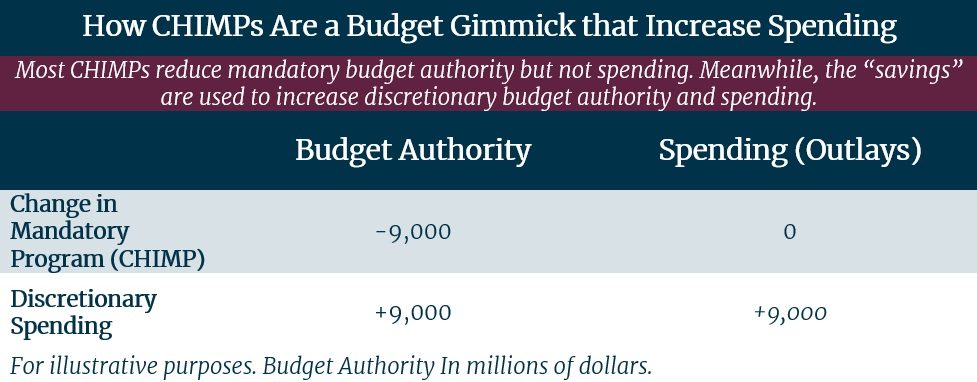
Unfortunately, CHIMPs are almost always a gimmick rather than representing genuine savings. Appropriators make changes that reduce mandatory BA but do not actually reduce total spending, or outlays (OT). Instead, they trade mandatory BA that would
not lead to OT for discretionary BA that
does lead to OT. The result is a higher amount of spending than ought to result from the BA limit.
CHIMPs have become such a standard practice that budget agreements often include a maximum amount of BA that appropriators can obtain from the gimmick. This can be done through a
budget resolution limiting the volume of CHIMPs, or secret agreements on the level of appropriations gimmickry. In an example of the latter, the 2023 Fiscal Responsibility Act set a $1.59 trillion BA limit for appropriations but came with a backroom deal for $54 billion in “adjustments” such as CHIMPs. This provided a fig leaf of fiscal responsibility to hide a
significant spending increase.
Policymakers should know that CHIMPs are nearly impossible to find by reading the bill text and committee reports of appropriations packages. Instead, the details of CHIMPs are a form of esoteric knowledge typically reserved for a relative handful of legislators, committee staff, and scorekeepers at the Congressional Budget Office (CBO).
Due to the lack of unused BA in most mandatory programs, there is a limited number of programs for appropriators to manipulate for the CHIMPs gimmick.
CHIP
The
State Children’s Health Insurance Program (CHIP) subsidizes health insurance for low-income children and pregnant women. CHIP receives its mandatory BA through the
Social Security Act. CHIP’s BA exploded from $5 billion in fiscal year (FY) 2008 to $19.1 billion in FY 2014 to an uncapped (“such sums as are necessary”) amount for FYs 2024 through 2026.
Starting in FY 2011, Labor, Health and Human Services, and Education (LHHSED) appropriations have regularly included a rescission from CHIP. This is often disguised as coming from section 2104 or 2105 of the Social Security Act. Rescissions have targeted multiple parts of the program, including the Child Enrollment Contingency Fund, the Performance Bonus Payment Fund, and unobligated allotments.
The
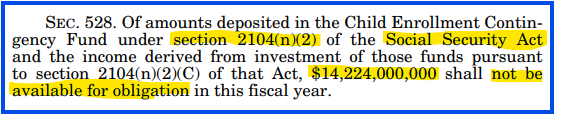
second FY 2024 appropriations package included a $14.22 billion CHIMP rescission from the CHIP program. Note that this was not labeled as a rescission but rather states that the funds “shall not be available for obligation,” which has the same effect.
The draft FY 2026 LHHSED appropriations bills from both the House and Senate contain gimmick CHIP rescissions, labeled as rescissions. The
House bill rescinds $12.84 billion and the
Senate bill rescinds $12.69 billion.
There is no reasonable explanation for Congress to have repeatedly provided CHIP with an excessive amount of BA other than as a CHIMP resource for appropriators. This is not only corrupt but also immoral given the nation’s
$38 trillion gross debt.
Crime Victims’ Fund
The Crime Victims’ Fund (CVF) uses fines collected from federal legal cases to fund programs that benefit the victims of crime. Since there is not a predictable amount of fine revenue, the CVF’s balance
fluctuates from year to year.
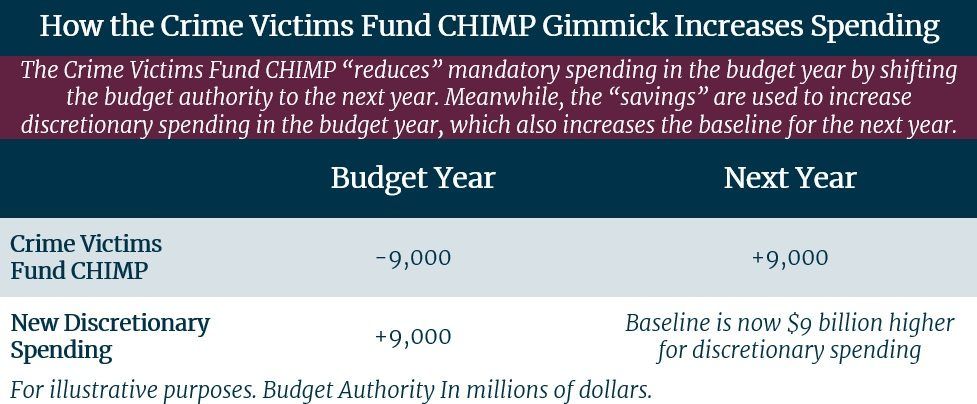
The annual Commerce, Justice, Science (CJS) appropriations bill typically places a limitation on spending from the CVF. The bill is then credited with “saving” the entire balance of the CVF that is above the bill’s spending limitation, even though the CVF programs would likely not have spent the full amount. Since the CVF is a mandatory program, the limitation is a CHIMP.
What makes the CVF gimmick especially egregious is that a given dollar can be “saved” and converted into discretionary BA endlessly. This is because the CVF’s balance is carried forward and can be “saved” again with a limitation CHIMP the next year. The only limit on the gimmick is years where fewer fines flow into the CVF, reducing the balance. Low receipts from FYs 2018 through 2023 reined in the gimmick’s value.
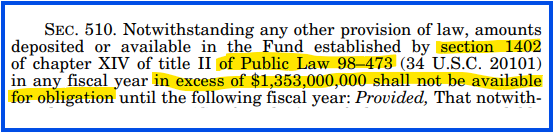
The CVF limitation uses highly obscure language, pointing to section 1402 of its authorizing statute rather than naming the fund. This is how the CHIMP appeared in the first FY 2024 appropriations package.
The draft FY 2026 CJS appropriations bills from the House and Senate contain the CVF limitation. The
House bill’s limit is $2.05 billion, while the
Senate bill’s is $1.9 billion.
This creates a singularly perverse budgetary situation. Since CVF gimmick’s “value” is based on the gap between the spending limit and the CVF balance, a lower spending limit creates more false BA “savings” for appropriations to turn into real spending. Thus, the Senate bill’s lower on-paper CVF limit would likely result in more real spending than the House bill’s higher CVF limit.
Forfeiture Funds
The
Treasury Forfeiture Fund (TFF) and the
Asset Forfeiture Fund (AFF) are similar to the CVF, though at a smaller scale. Both funds are used for federal, state, and local law enforcement activities. While the CVF gimmick takes the form of an obligation limit, the TFF and AFF gimmicks are straightforward rescissions of unneeded BA. This is a TFF rescission in FY 2024 appropriations.

Transparency and Reform
The CBO does not publish full analysis of appropriations legislation (which would include the value of CHIMPs) due to a prohibition in section 402 the
Congressional Budget and Impoundment Control Act. Instead, this analysis is limited to the Appropriations and Budget Committees rather than being provided to all members and the public. Congress should eliminate this prohibition.
Congress should also enact budgetary rules that align budgetary offsets with OT rather than BA, to prevent gimmicks such as CHIMPs. This would lead to more honest budgeting and in turn make spending increases more difficult to enact.