Testimony
Chairman Smith, Ranking Member Neal, and Members of the Committee, thank you for inviting me to testify today.
In 2017, Congress and President Trump enacted monumental legislation that reduced the tax burden on Americans and American businesses. At the time of enactment, the Tax Cuts and Jobs Act of 2017 was estimated by a wide range of economists to increase investment by reducing the cost of capital while also lowering marginal tax rates. These effects were estimated to increase the size of the economy along with wages, generate additional opportunities, and increase disposable income for Americans at every level of the income distribution.
Estimates of the TCJA’s effects on economic growth over the 10-year period ranged from about 0.3 percent of GDP (on the low end) to over 2.0 percent of GDP (on the high end). Relative to a pre-TCJA baseline, that is equivalent to an increase in the size of the economy of between $700 billion and $5.7 trillion over the 2018-2027 period.
[1]
Table 1. Estimates of the Effect of the TCJA on Economic Growth
|
Effect Size
(% of GDP) |
Time Period |
Source |
| Congressional Budget Office |
+ 0.7 |
2018-2027 |
CBO (2018) |
| Federal Reserve Bank Dallas |
+ 0.3-2.4 |
2018-2020 |
Mertens (2018) |
| Moody’s Analytics |
+ 0.3 |
2018-2027 |
Zandi (2017) |
| Penn-Wharton |
+ 0.6-1.1 |
2027 |
PWBM (2017) |
| Tax Policy Center |
+ 0.5 |
2018-2027 |
Page et al. (2017) |
| Tax Foundation |
+ 1.7 |
2017-2027 |
Tax Foundation Staff (2017) |
| Heritage Foundation |
+ 1.67 |
2018-2027 |
Michel and Sheppard (2018) |
| Barro and Furman |
+ 1.2 |
2027 |
Barro and Furman (2018) |
Source: Hyperlinks are in the source column of this table.
Any extent to which the TCJA was anticipated to depress output was associated with the fiscal effects of deficit financing. However, some have argued that on a dynamic basis, the increase in revenue associated with additional economic growth would have made up any static loss in revenue from the TCJA.
[2] Others have argued that the TCJA permanently lowered revenue which could trigger higher interest rates and thus create a drag on the economy.
[3]
Given the economic contraction associated with the Covid-19 pandemic, and the increase in debt that followed, it is impossible to evaluate the validity of these earlier estimates. That said, it is worth noting the consensus among economists that the TCJA was beneficial for the economy even though there are some disagreements on the magnitude and effectiveness of individual provisions. At the same time, immediately after the TCJA was enacted there was increase in investment, economic growth, and interest rates on safe assets remained near historically low levels.
[4]
One of the issues that limited the growth potential of the TCJA was the expiration of provisions that relieved tax burdens on investment. Under current law, many of components of the TCJA will expire at the end of next year. However, we cannot view the expiration of these provisions without also considering what has changed within the broader economy or the nation’s fiscal position since 2017.
Specifically, the nation’s fiscal position has deteriorated over the past several years. Before the Covid-19 pandemic, federal net spending as a percent of GDP was about 20 percent.
[5] At its peak in 2020, federal spending was 31 percent of GDP but remains more than 22 percent despite the pandemic having ended. Since 2020, debt held by the public has increased by $9.1 trillion. This year, roughly $8.9 trillion in Treasury bonds will mature and the deficit is projected to be about $1.5 trillion.
Between the beginning of 2020 and the end of 2023, new bonds paid for 76 percent of all new spending.
[6] Money creation has paid for 14 percent, while tax revenues have paid for 7 percent. The federal government has not relied so heavily on debt and money creation to finance new spending since the Civil War.
As a comparison, the federal government paid for 46 percent of the spending growth associated with World War II with new debt and about 10 percent with money creation.
In terms of the government’s fiscal position, the increase in debt associated with the pandemic-era spending means that the Department of Treasury will need roughly $10 trillion in additional borrowing to roll over existing debt and to pay for new debt, during a period when the Federal Reserve is reducing the size of its balance sheet to reduce inflation.
[7]
Normally, during times of crises, investors purchase Treasuries as the world’s premier safe asset to hold value. However, institutional and foreign investors have been buying fewer Treasuries over the past several years. In this environment, the law of supply and demand would suggest that if much more additional debt is issued, for whatever reason, the interest rate on Treasuries will increase thus reducing the nation’s fiscal space.
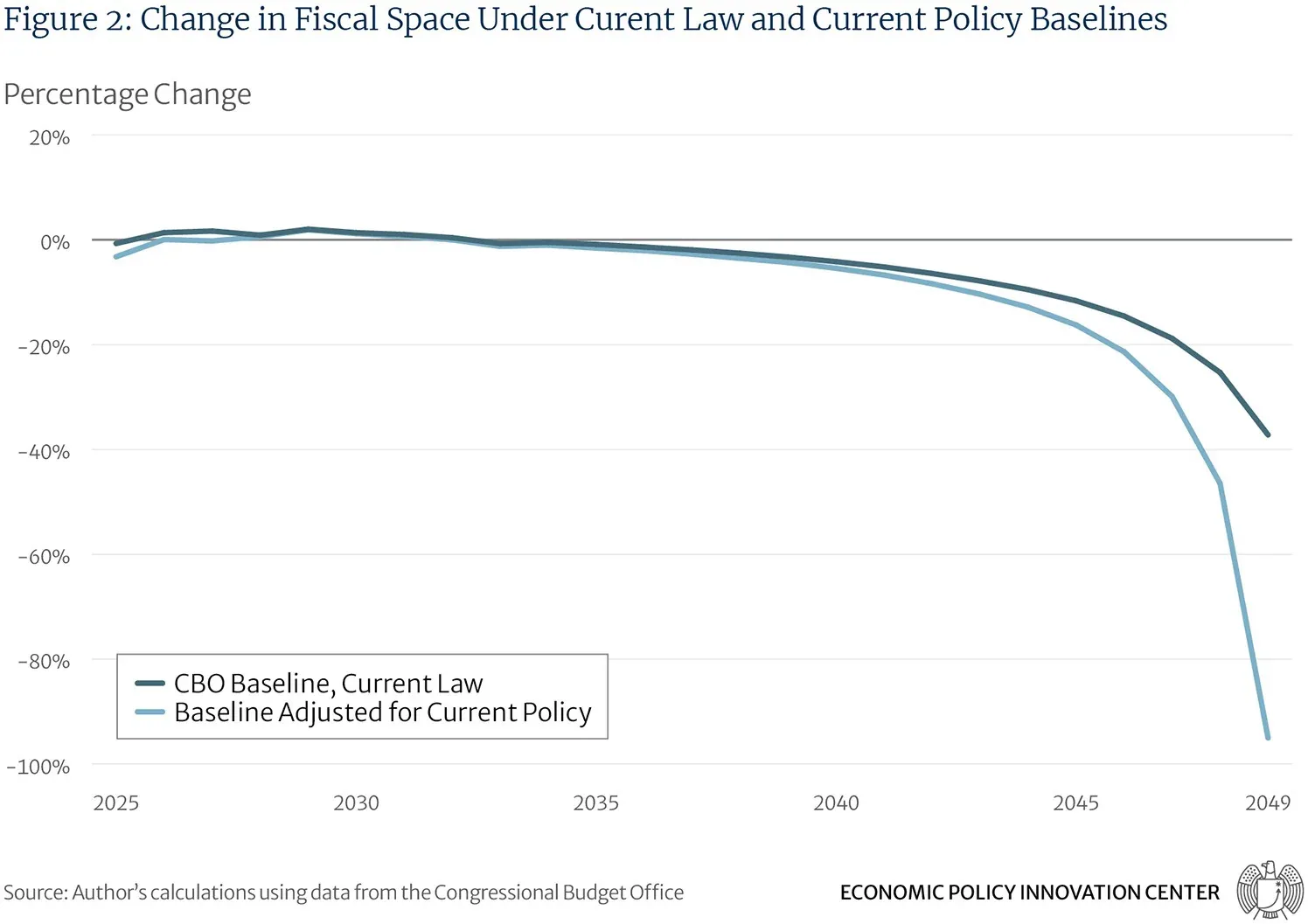
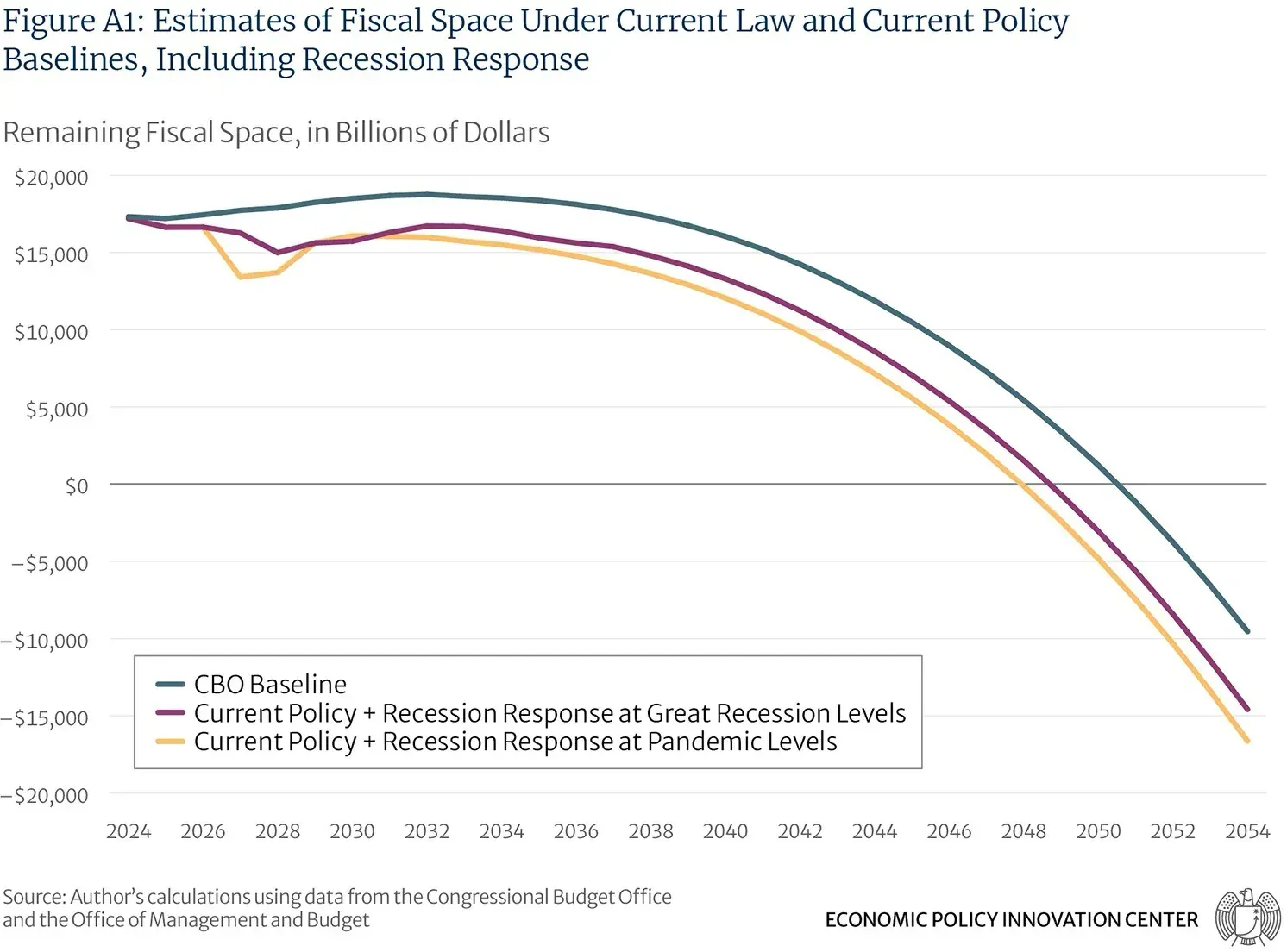
Even under the baseline projection that assumes no wars, recessions, pandemics, relatively high potential economic growth, and low interest rates, the rate at which it is expected to grow will become difficult to keep pace with through economic growth alone. That will cause the U.S. government to enter what is called a debt spiral. At that point, interest rates will increase, fiscal space will evaporate, and it will become necessary to reduce the deficit to achieve a primary surplus.
In a recent paper, I estimate that this would begin to happen around 2035 under current law, or by 2032 under current policy.
[8]
This is, coincidentally, around the same time when the Medicare Hospital Insurance and Social Security Old Age and Survivors’ Insurance trust funds are exhausted.
[9] In other words, extending current policy, including the tax cuts, only pulls the debt spiral forward by three years. This highlights the underlying problem of the federal budget being spending growth at unsustainable rates.
[10]
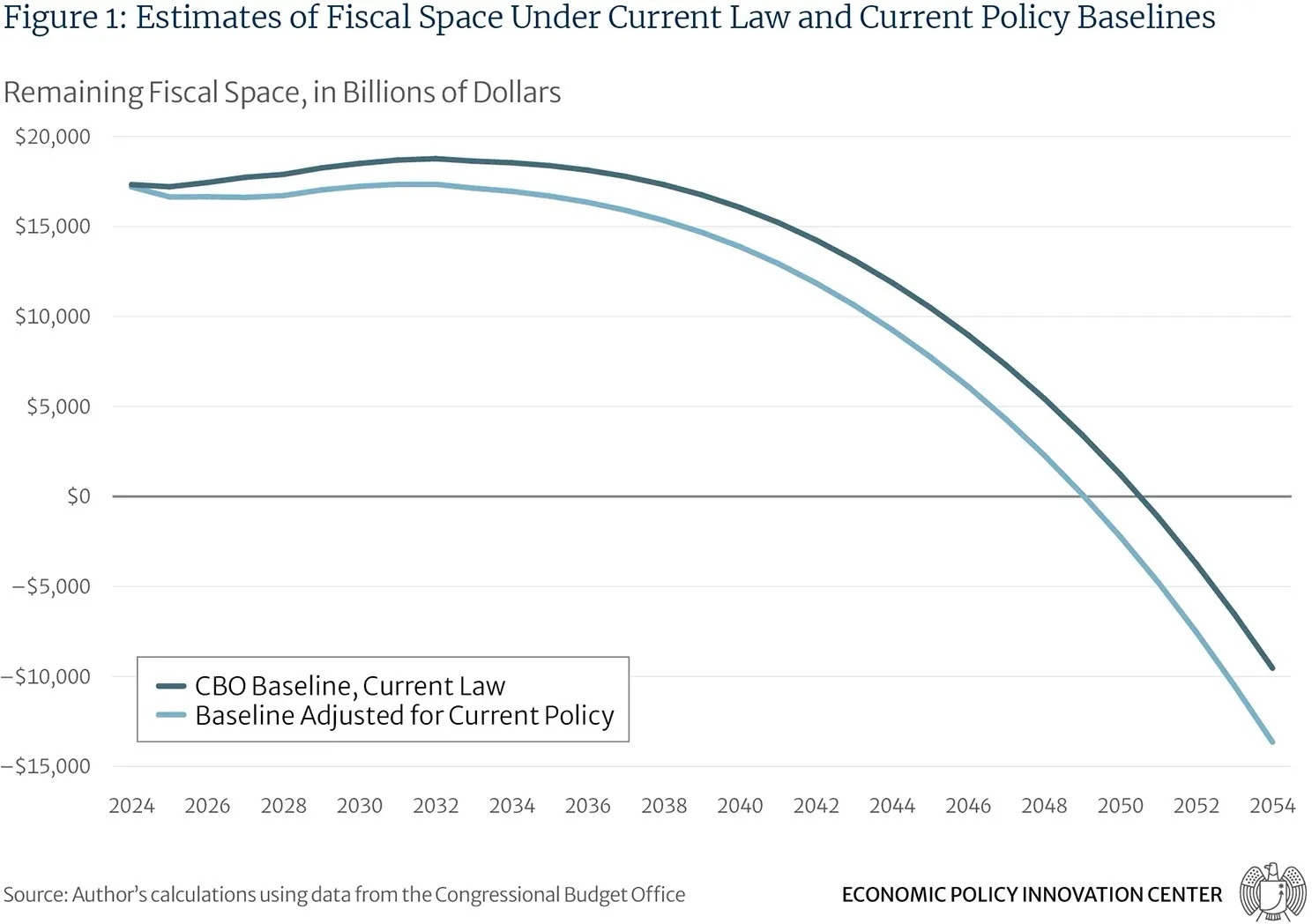
My estimates suggest that to delay the debt spiral from happening over the next 20 years the federal government would need to implement a primary deficit reduction (that is, not including interest) of about $2.1 trillion before 2035, without compromising economic growth. This is in addition to paying for any new spending or reduction in tax revenues not assumed in the Congressional Budget Office’s current law baseline.
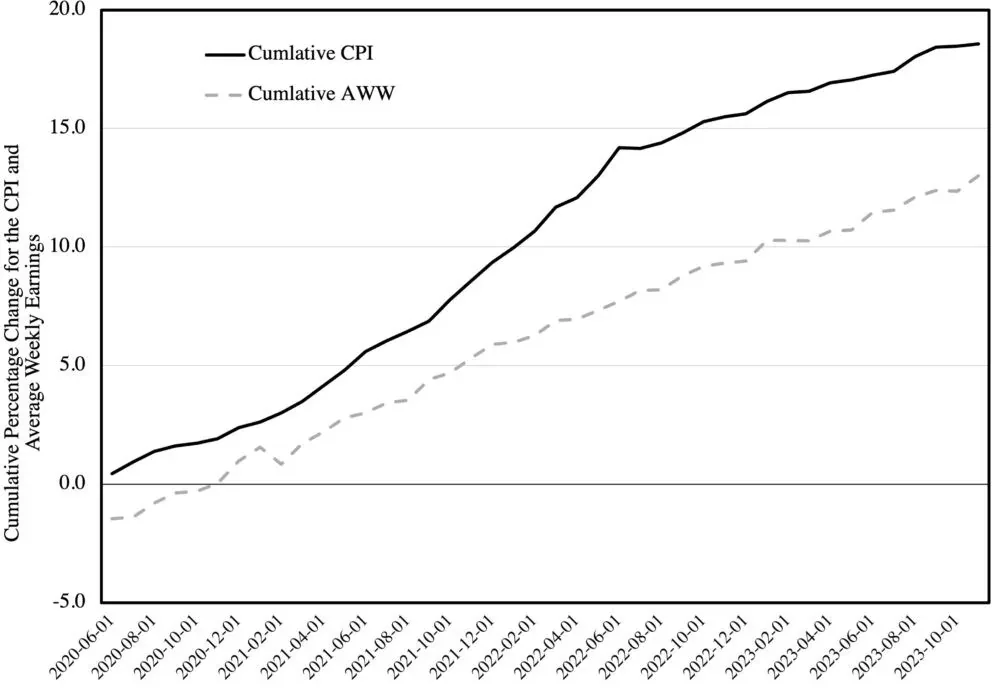
These broader fiscal challenges also have effects on American households. Given the reliance on debt and money creation, it is no wonder that the hidden tax of inflation has put pressure on American’s budgets. Between June 2021 and May 2023, inflation grew considerably faster that average earnings. That difference (or the wedge between the cost of living and the earnings) remains a significant economic problem. This is because households have lost real purchasing power even as the inflation rate has slowed down (see Figure A2 in the Appendix).
Therefore, any policy that puts additional pressure on household budgets or small businesses would be unwarranted. This includes allowing the tax cuts to expire which would reduce take home pay and investment. Allowing the expiration of these tax cuts would damage our ability to counteract inflation through positive wage growth and higher productivity, while also reducing aggregate demand thereby slowing domestic investment.
Policymakers will face a number of fiscal inflection points over the next few years.
[11] It will be necessary to balance an approach that does not raise taxes on the middle class and does not put additional pressure on the debt. Congress can accomplish this by pairing legislation to prevent tax increases with provisions that broaden and correct the tax base, spending reductions, and other policies such as removing regulatory burdens to grow the economy.
Appendix
Source:
Beach and Winfree (2024).