Healthcare has become increasingly unaffordable in the last few decades, with medical costs growing at a
significantly faster pace than general inflation.
Government healthcare spending, including all federal, state, and local healthcare programs, has grown even faster.
More Government Spending than Ever on Healthcare
Proponents of government intervention argue that more programs and spending would reduce healthcare costs, but government spending and overregulation is exactly what got us into this situation in the first place.
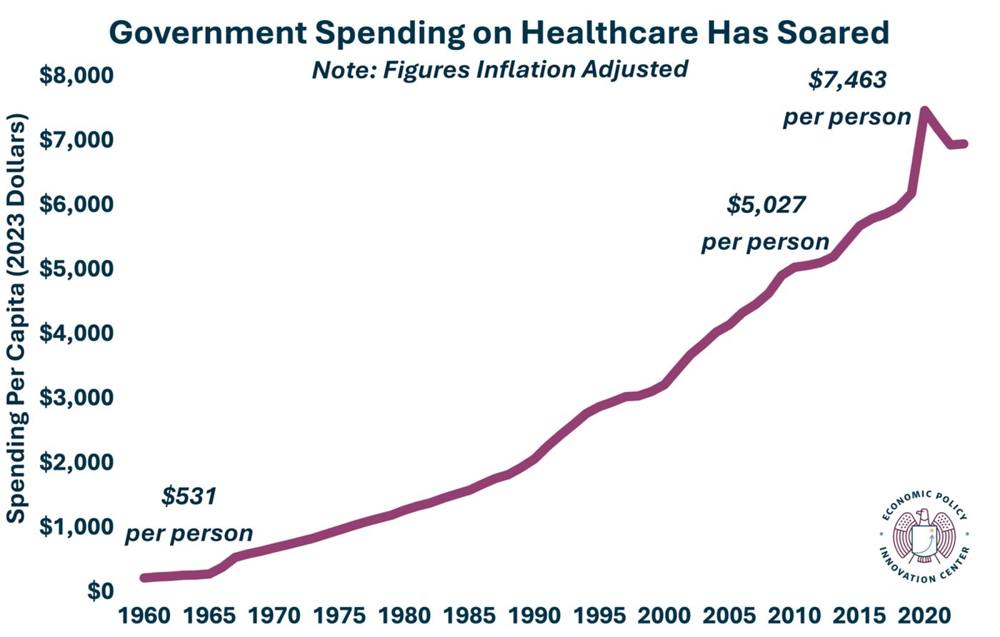
After adjusting for inflation, government healthcare spending per person has gone from $211 in calendar year (CY) 1960, to $3,210 in CY 2000, to $6,943 per person in CY 2023.
More GDP Spent on Government Healthcare
Government healthcare spending has grown from less than 1% of GDP in CY 1960 to more than 8% of GDP in CY 2023.
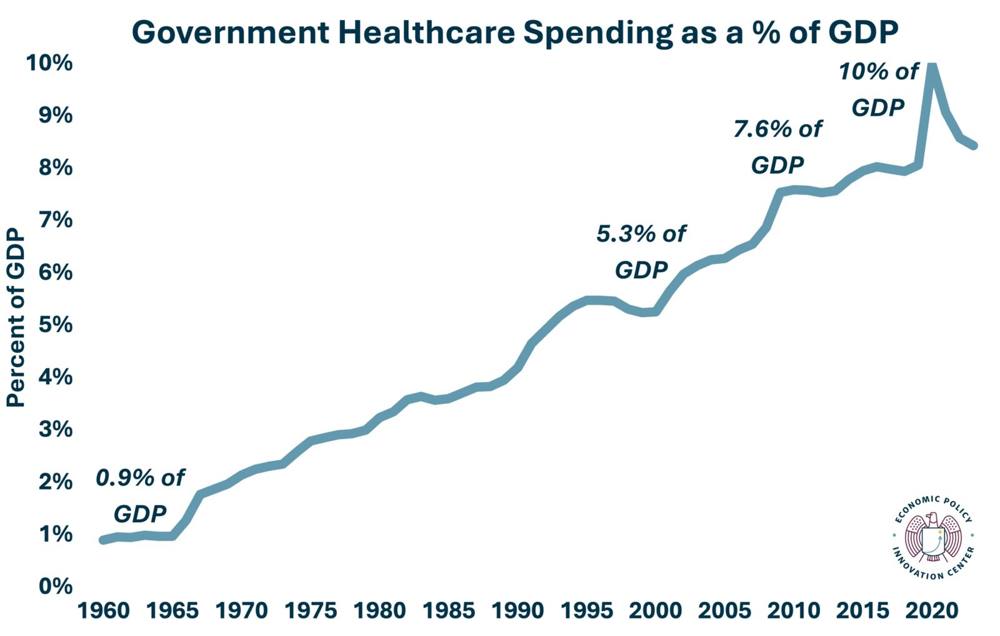
That means, as a portion of total economic activity, the government is spending over nine times more on healthcare now than it did in 1960. It is spending almost one tenth of the nation’s total economic output on government healthcare programs today.
Ostensibly, the purpose of government spending in healthcare has been to alleviate the burden of rising costs for those in need, but there have been no signs that the situation has gotten better with more funding; if anything, costs have only increased.
Government Is the Biggest Player in Healthcare
Overall health expenditures have grown in the last few decades, and the portion of those expenditures coming from the government grew at an even higher rate.
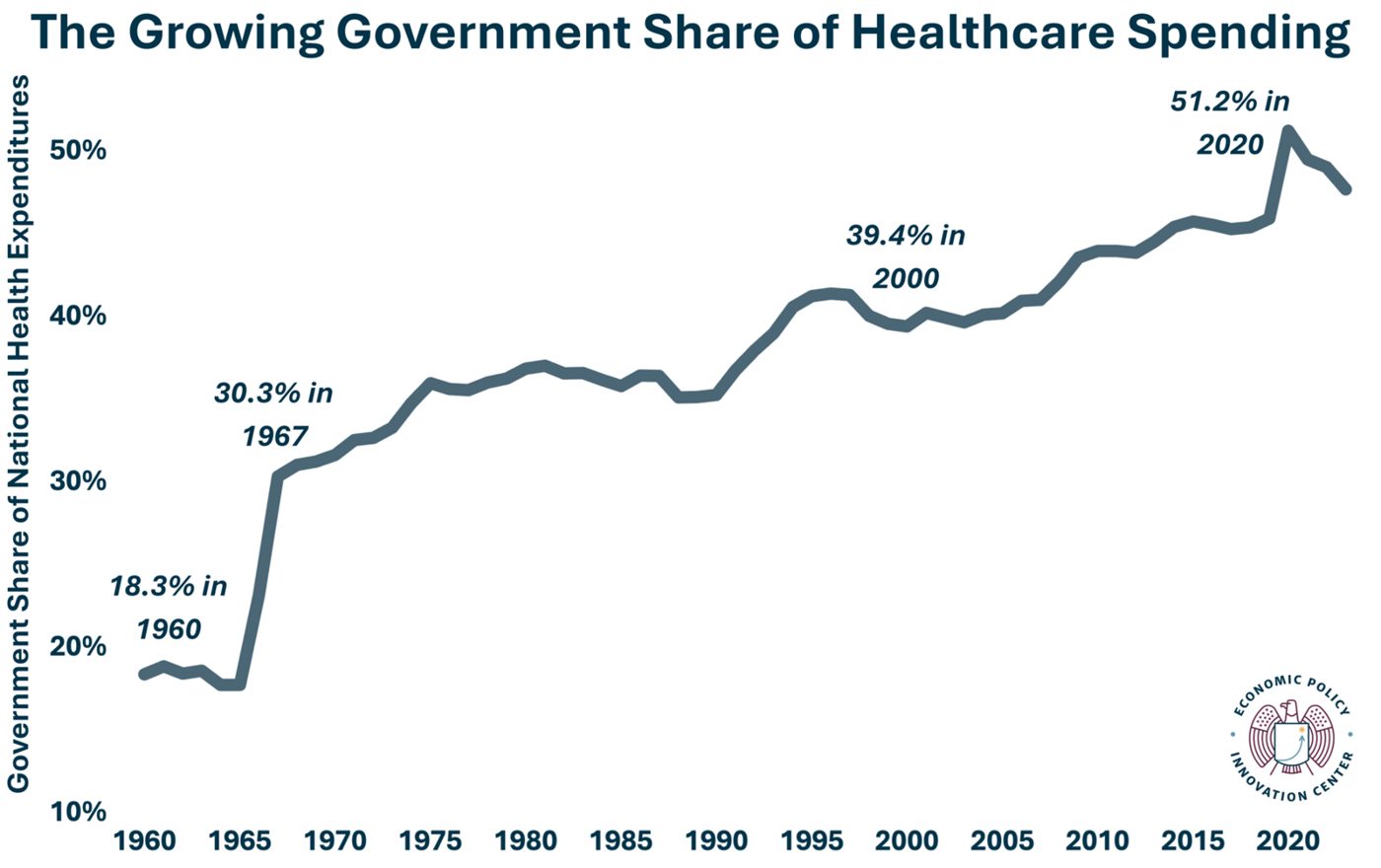
Before Medicare and Medicaid were enacted in 1965, government spending made up less than 20% of national healthcare expenditures. After those programs were enacted, the government share jumped to 30% of healthcare spending. Since then, the government share of healthcare spending has steadily climbed to almost 48% in 2023.
Government spending as a portion of total national health expenditures peaked at 51.2% in 2020 during the COVID-19 pandemic, meaning that government spending made up more than half of the total expenditures on healthcare in the country.
The cost of all federal healthcare programs from CY 1960 to CY 2023 totaled $32.6 trillion, and annual federal spending on healthcare was $2.1 trillion dollars in CY 2023. This is a growing contributor to the national debt, which recently surpassed a massive $38 trillion.
The share of government spending in healthcare has grown dramatically, and yet costs keep climbing. Clearly, the trajectory towards complete government domination of the medical industry isn’t leading Americans to affordable healthcare.
Other Government Intervention in Healthcare
The share of government spending in total national health expenditures is only one measure of government involvement in healthcare. Countless taxes, regulations, and
other government interventions such as
Obamacare in the healthcare and insurance markets also serve to increase costs and limit competition from
potentially innovative alternative models of medical care.
The healthcare system that we have now is a far cry from a free market that its critics characterize it as, and it has only gotten worse the more government has stepped in.
Patients are forced to navigate more complicated government and insurance company bureaucracies, only to receive worse coverage and care at higher costs than they did before. This all occurs while private health insurance companies
lobby to continue profiting illegitimately from taxpayer resources.
The Path Forward
If lawmakers want to fix our problematic healthcare system, more government spending and regulation has not been and will not be the answer.
Instead, policymakers should eliminate problematic regulations that have made healthcare costs climb. Policymakers should also reduce spending across healthcare policies, from Obamacare to Medicaid. Finally, the government should get out of the way of innovation in the health sector.