As Congress considers the Senate’s proposed language for the One Big Beautiful Bill, one provision requires greater scrutiny: the expansion of the Radiation Exposure Compensation Act (RECA). While RECA was originally enacted to provide one-time payments to individuals exposed to harmful radiation during nuclear testing, the proposed changes in this bill would create a budgetary cliff.
RECA Restructuring
RECA was designed as a compensation program for individuals impacted by the United States’ atmospheric nuclear tests or uranium mining that occurred between 1942 and 1971. Under the
current law, payouts range from $50,000 to $100,000 depending on the category of claimant. Those exposed to radioactive fallout from testing, so-called “downwinders”, receive $50,000 in compensation, on-site participants, can collect $75,000, and uranium workers garner $100,000 in compensation. The program stopped accepting new claimants in 2024, prompting several attempts by Congress to extend and expand it. RECA has given just over
$2.6 billion in benefits from 1990 to 2024.
The Senate’s
proposed changes to RECA would dramatically increase its scope and cost. Compensation amounts would be increased, including raising the payout for on-site participants and downwinders to $100,000. Eligibility would be expanded geographically to include individuals beyond historically tested areas to states such as Idaho, Montana, Colorado, and Missouri. The RECA Trust Fund would be reauthorized to accept new claims until December 31, 2027.
A RECA Revival Should Not be Done in Reconciliation
This approach would impose new costs on taxpayers. Based on cost estimates from a
similar expansion attempt in 2023, an expansion of RECA could cost
$147.1 billion over the ten years. This is largely due to the extension of geographic eligibility to more areas, the increase in payments to downwinders and on-site participants, and the expense of setting up new systems to process the claims.
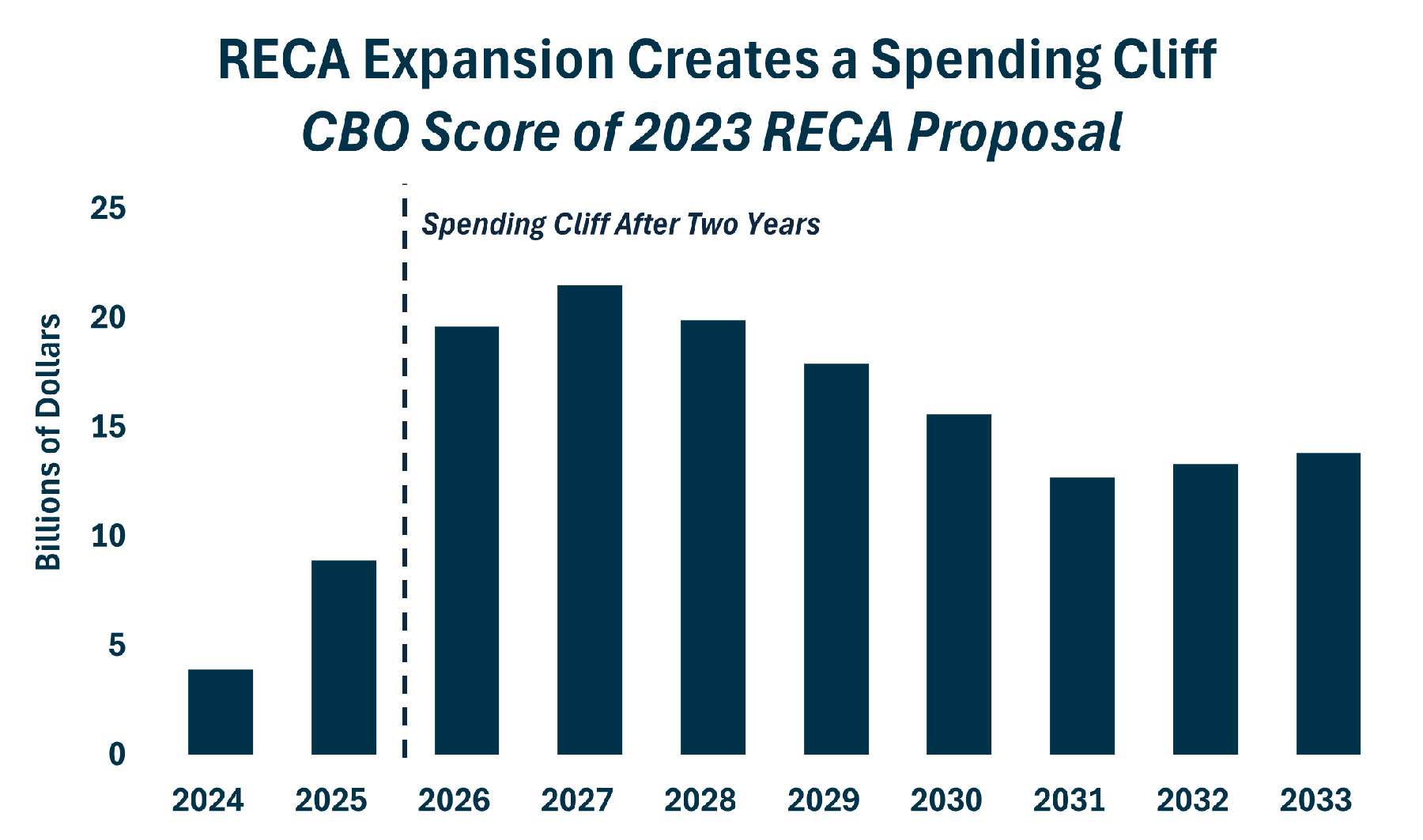
What makes this provision even more concerning is the built-in budgetary cliff. In two years, the program is scheduled to stop accepting new claims and to sunset the RECA trust fund in three years. The proposed short-term expansion sets up a predictable scenario in which lawmakers will face pressure to renew or further expand RECA every few years to process the claims. The expansion sets the stage for a permanent entitlement program with massive, unfunded liabilities.
This is not to say that individuals affected by radiation exposure do not deserve support. Trying to push a RECA expansion through reconciliation, without a long-term funding mechanism or adequate guardrails, risks undermining the very fiscal goals the One Big Beautiful Bill is meant to achieve.
At a time when the nation’s fiscal trajectory is already
unsustainable, the proposed expansion of RECA requires clear fiscal offsets. Congress should ensure that any reform or extension of RECA is properly funded and debated on its own merits.