


Putting Healthy Adults Ahead of Babies and the Disabled
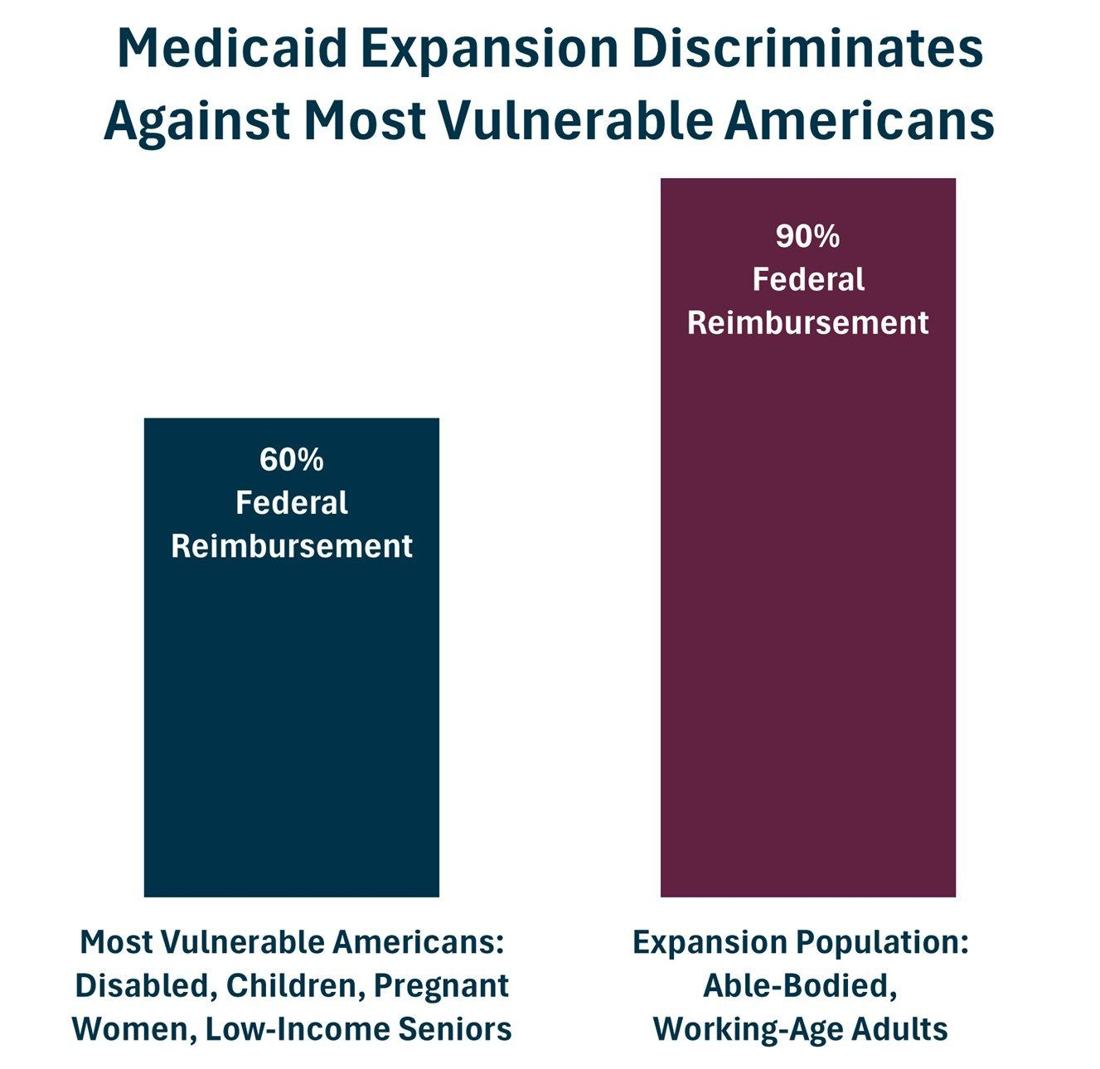 Because Medicaid is a federal-state partnership, any state choosing to expand eligibility to able-bodied, working-age adults would face higher costs. To coax states towards expansion, Obamacare set the Federal Medical Assistance Percentage (FMAP) for the expansion population at 90%. This is far higher than the roughly 60% average FMAP that states receive for the traditional Medicaid population.
For the expansion population, the 90%-10% split means that the expansion population has become welfare for state governments. Increasing the Medicaid expansion enrollment means maximizing “free” federal handouts, with politically influential medical providers reaping a windfall.
Both state governments and medical providers have limited resources. As a result, the shift of Medicaid to a broad welfare program means that traditional recipients, such as pregnant women, children, and individuals with disabilities, face delays in getting appointments, slower ambulance response times, and longer lines at emergency rooms.
Because Medicaid is a federal-state partnership, any state choosing to expand eligibility to able-bodied, working-age adults would face higher costs. To coax states towards expansion, Obamacare set the Federal Medical Assistance Percentage (FMAP) for the expansion population at 90%. This is far higher than the roughly 60% average FMAP that states receive for the traditional Medicaid population.
For the expansion population, the 90%-10% split means that the expansion population has become welfare for state governments. Increasing the Medicaid expansion enrollment means maximizing “free” federal handouts, with politically influential medical providers reaping a windfall.
Both state governments and medical providers have limited resources. As a result, the shift of Medicaid to a broad welfare program means that traditional recipients, such as pregnant women, children, and individuals with disabilities, face delays in getting appointments, slower ambulance response times, and longer lines at emergency rooms.