The Congressional Budget Office (CBO) has published a new report,
The Long-Term Budget Outlook: 2025 to 2055. Using a “
baseline” that assumes federal spending broadly follows trends while tax policy follows statute – a practice
biased in favor of spending – CBO makes projections regarding key budgetary benchmarks.
The picture it paints about America’s future is nothing short of bleak.
Out of Control Spending and Debt
In fiscal year 2024, Washington threw tax dollars around to the tune of 23.4% of GDP. In comparison, spending from 1969 through 2019 averaged 21.2% of GDP.
CBO estimates that spending will rise to 24.4% of GDP in 2035, 25.3% by 2045, and reach a whopping 26.6% in 2055. For perspective, the only times that federal spending exceeded 25% of GDP was during the crises of World War II and the COVID-19 pandemic, yet CBO’s projections assume crisis levels of spending become business as usual.
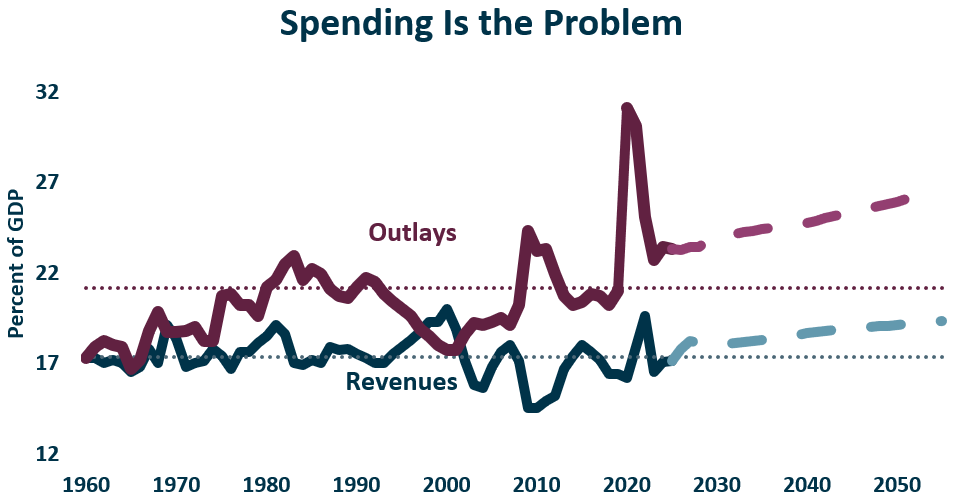
A lack of tax revenue is not the root cause of current or future deficits. The pre-pandemic historical average revenue amount of 17.4% of GDP is in line with the 17.1% level in 2024.
CBO’s baseline assumes that most of the
2017 tax cuts expire. However, under that scenario the growth of spending still rapidly outpaces the growth of revenue. That means ever-larger deficits even if Congress allows an enormous tax hike.
Without a meaningful attempt to at least slow the acceleration of federal spending, ever-larger deficits will lead to record-setting levels of debt.
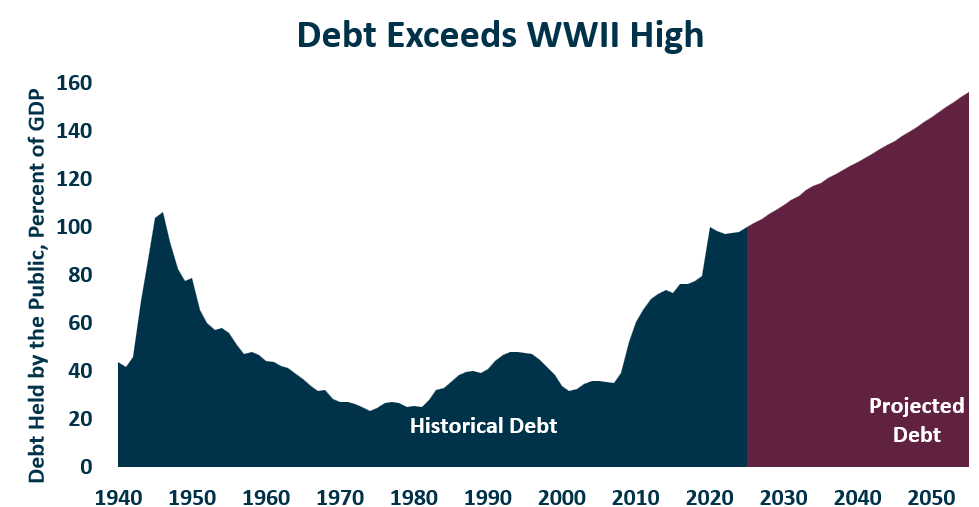
Debt held by the public is now almost exactly 100% of GDP. This dubious milestone was previously reached in 1945 and 1946 in the wake of massive spending during World War II. CBO projects that the federal debt will hit an all-time high in 2029 and reach an eye-watering 150% in 2053.
Unprecedented Interest Costs
The cost of interest on the debt is already surging and is expected to reach catastrophic levels unless Congress takes corrective action.
When interest costs began to exceed 3% of GDP per year in the 1980s and 1990s, legislators used the reconciliation process to produce multiple bipartisan deficit reduction packages.
However, when interest rates and payments declined in the 2000s, Washington decided to take a vacation from the hard work of budgeting. With rising interest rates applied to a larger debt, the cost of interest on the debt has soared and will continue to do so.
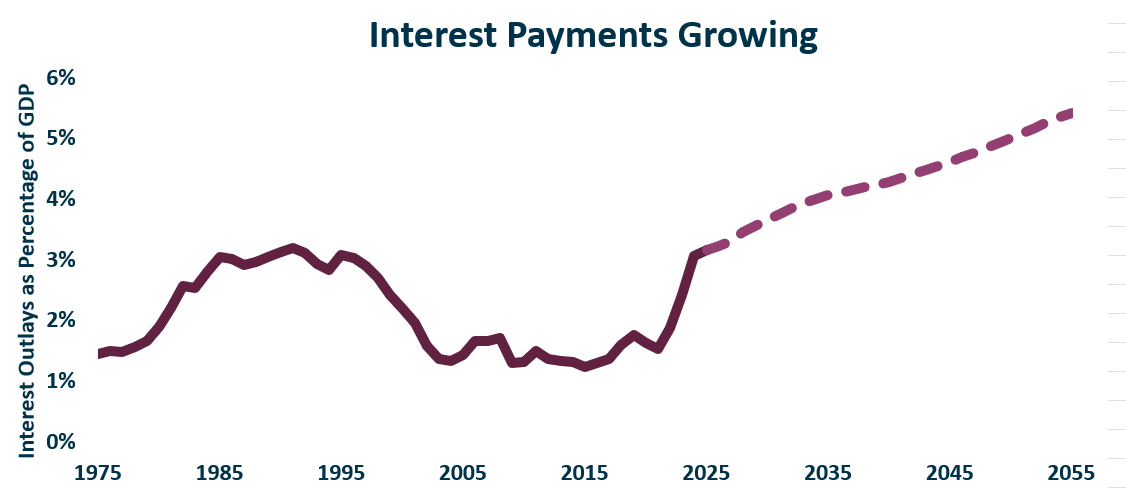
The cost of interest on the debt was just 1.53% of GDP in 2021. Incredibly, it doubled by 3.06% in 2024 – just three years – due to an uptick in interest rates. CBO’s projections assume that interest rates do not dramatically increase from where they are today; most of the higher long-term interest cost flows from higher debt.
However, if debt markets perceive that lawmakers will never change course and rediscover fiscal responsibility, they will stop perceiving that U.S. debt is a low-risk asset. If our debt no longer receives preferential treatment, interest rates will go up further and place the nation at risk of crossing a fiscal red line.
No Time to Waste
As Congress weighs the best approach for
reconciliation, some voices are calling for only modest changes to spending for the sake of political expediency.
Legislators must shout down the siren song of the swamp. In particular, complaints about “deep cuts” are based on “
Washington Math” which assumes that programs are entitled to grow faster than the economy. Merely slowing the rate of growth can produce vital savings.
2025 could be the last chance to change course and avoid federal fiscal catastrophe. Real leadership will require standing up to special interests for the sake of America’s future.