Chairman Burchett, Ranking Member Stansbury, and Members of the Subcommittee, thank you for inviting me to participate today.
The national debt is $39 trillion, or about 126 percent of the size of the economy (measured as its Gross Domestic Product). Publicly held debt is about 100 percent of the size of the economy. Over the next year, about $9.97 trillion in public debt will be maturing. Each month, Treasury rolls over about $1 to $1.5 trillion in short term (4 to 13 week) Treasury securities that have current yields of about 3.6 or 3.7 percent. The government’s strategy in place since the Biden administration is obvious: they are hoping that yields on longer term debt will fall before refinancing. But too much sovereign debt issuance has flooded global markets since the pandemic spending surge, and with the dollar weakening, it is critical that we now bring deficits back to sustainable levels to reduce macroeconomic risk and avoid a crisis.
What this means for Congress is that it’s absolutely critical to determine whether there are functionally duplicative programs and capture efficiency gains wherever possible. That may be facilitated through a reform of the budget and appropriations process that was built for the 1970s and repeatedly fails to meet today’s needs. There should also be a bipartisan effort embedded in permanent committee work and sustained by expanded capacity at the Government Accountability Office (GAO) and other legislative support agencies.
There are several areas that are worthy of immediate attention. The first is low-income support programs that are rife with inefficiencies, benefit cliffs, and poor incentives that do not support intended beneficiaries. The second is the expiration of pandemic era programs that will put political pressure on Congress to continue inflationary and duplicative assistance to the states and local governments. The third is broadband subsidies that have received a tremendous amount of attention over the last few years and attracted wasteful initiatives.
However, I would encourage the subcommittee to fully audit all 1,040 discretionary budget accounts and 930 direct spending accounts within the entire federal government and across all agencies.
Low-Income Support Programs
Over the past 10 years, mandatory spending on low-income assistance has increased by about 5.5 percentage points per year, or from about $700 billion in 2015 to $1.2 trillion in 2025. Many of these programs were expanded during the Covid-19 pandemic while eligibility and benefit levels remain elevated.
[1]
There are hundreds of low-income assistance programs spread across the federal government. Many of these programs are functionally duplicative and serve the same populations. For example, there are at least 160 different housing and rental assistance programs administered by 20 different federal entities.
[2] With this much attention, one would think that housing would be more affordable. Yet the experience of some local governments has shown that deregulation and permitting reforms have done more than subsidies to reduce rents by expanding housing stock over the past few years.
[3]
The lack of coordination in the design of many of these programs has led to unintended consequences such as “benefit cliffs.” This is when an increase in wages or change in family structure (such as marriage) can result in both higher taxes and a loss in benefits which can lead to lower financial resources. This penalty associated with earning a higher income can act as a significant barrier to upward economic mobility as the benefits of promotion can be eroded through higher taxes and a loss of public assistance. For example, the Federal Reserve Bank of Atlanta has shown how benefit cliffs associated with low-income assistance could penalize the career progression for a person earning a minimum wage (“Leia”) who may want to go into the nursing profession. Over a lifetime, becoming a nursing assistant (CNA) or nurse (LPN) has significant benefits. However, in the short-term there are major penalties to work associated with the current tax and benefits system.
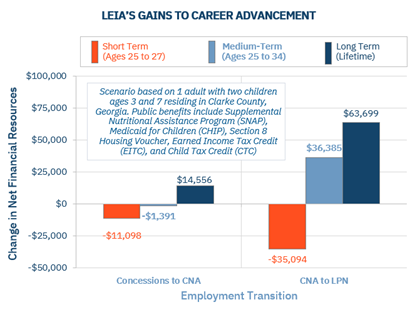 Source:
 Federal Reserve Bank of Atlanta at
https://www.atlantafed.org/what-we-study/workforce-development/advancing-careers-for-low-income-families/what-are-benefits-cliffs
Note: “Leia” is a person living in Clarke County Georgia who has two children and works a minimum wage job but has considered entering the nursing profession.
Benefit cliffs can also reduce the likelihood that low-income households will relocate for better opportunities. Research has shown that lack of coordination in federal benefits administered by state governments can reduce geographic mobility by more than 8 percent.
[4] This means that poor design of federal programs directly influences decisions of workers to take better paying jobs in other states thus limiting their economic mobility and reducing productivity across the entire economy.
The Expiration of Pandemic Era Programs
One of the primary drivers of functional duplication in the federal government is crisis response. When emergencies arise, Congress routinely creates new programs with new funding layered on top of existing ones, rather than relying on automatic stabilizers already embedded in the system.
During the Biden administration, Congress passed the American Rescue Plan Act of 2021 (ARPA) that was supposedly in response to the Covid-19 pandemic. ARPA created a new program called the State and Local Fiscal Recovery Fund (SLFRF) that provided $350 billion to states and local governments to use on revenue replacement, negative economic impact, infrastructure (including broadband), surface transportation projects, public health, public housing, public safety, premium pay for government employees, and administration.
[5]
The law required that the funding was obligated by the states and local governments by the end of 2024 and spent by the end of calendar year 2026. In practice, the Department of Treasury approved practically every project given the open-ended nature of the authorization. Most of that funding has been spent on subsidizing pay and existing programs by states and local governments.
[6] This has created an environment where states and local governments have become much more reliant on federal transfers and will likely look to Congress for additional funds when the money runs out later this year.
However, the lack of oversight also created duplicative programs and funding that facilitated waste. For example, $185 million from the SLFRF went to projects related to improving golf courses (e.g., updating irrigation systems or buying golf carts), $400 million went to swimming pools, $80 million when to sport stadiums, $34 million went to building tennis and pickleball courts, $10 million went to rodeos, and one Illinois town received $15 million to install commercial showers and a kitchen to host the circus and local flea market.
[7] Congress should allow the SLFRF to fully expire without renewed funding, and the next time an emergency occurs it should be careful to add proper oversight controls so as to avoid inefficiencies and duplicative efforts across existing federal programs.
Broadband Subsidies
Over the past several years, more than $800 billion in federal funding has been directed at expanding broadband to unserved or underserved households and businesses.
[8] This is in addition to the $2.2. trillion in private sector investments that have been made to expanding high-speed internet since the late-1990s.
[9]
In 2023, GAO identified 133 programs administered by 15 agencies that are used to subsidize broadband deployment, coverage, planning, devices, and acquisition of skills.
[10] Furthermore, 25 of these programs have expanding broadband coverage as their main objective. Last year, GAO found that agencies responsible for the core administration of these programs (including the Departments of Commerce, Agriculture, and Treasury in addition to the Federal Communications Commission) have not “documented a formal process for avoiding duplicative funding.”
[11]
In yet another attempt to increase the supply of high-speed internet, the Infrastructure Investment and Jobs Act of 2021 (IIJA) provided $45.5 billion “to expand access by funding planning, infrastructure deployment and adoption programs.”
[12] The problems of the Department of Commerce’s Broadband Access Equity and Deployment (BEAD) program in connecting homes to high-speed internet have been well documented.
[13] These failures include providing $547,000 per “unserved” location in Washington, D.C., which encompassed the Butterfly Garden and Otter Pond at the Smithsonian’s National Zoo.
[14]
However, beginning last year, the Trump administration modified the program’s rules that will significantly reduce the costs associated with deploying infrastructure to new locations.
[15] These cost savings will leave a considerable amount of money available to states for other currently approved uses. Some estimates suggest that there could be as much as $20 billion in non-deployment funding.
[16] States have previously proposed using these funds for workforce development, job training, additional permitting review, or even subsiding new devices.
[17] However, these non-deployment uses would only duplicate existing programs outside of the Department of Commerce’s usual jurisdiction. Congress should consider rescinding these funds.
Conclusion
This testimony provides only a few areas (of many) where functional duplication wastes taxpayer funds and creates complications that can be detrimental to the initial intent of the programs. Congress should support additional systemic audits of the entire federal budget while supporting the coordination of programs where there is a lack of communication.
Furthermore, there are many cases where Congress should simply rescind funds made available for duplicative programs. This can be facilitated under existing law as the Impoundment Control Act compels the President to send a rescissions message to Congress whenever it is determined that funding provided will not be needed.
[18] That message cannot be filibustered in the U.S. Senate thus providing a fast-track process to eliminate duplicative programs.
Finally, Congress must consider reforming the entire budget process to address issues that lead to duplication but also other systemic problems. Fiscal policy is currently driven by a cycle of prolonged inaction followed by reactive interventions to a crisis. The result has been poor governance and stewardship of taxpayer resources. When our budget process has been successful in the past it has evolved to meet the challenges of the day in a results oriented way.
[19] Congress should establish a commission to objectively determine these challenges, the biggest problems with the modern process (or lack thereof), and identify goals for reform.
[1] Congressional Budget Office, “Re: Federal Mandatory Spending for Means-Tested Programs and Tax Credits,” June 18, 2025,
https://www.cbo.gov/system/files/2025-06/61472-Means-Tested-Programs.pdf (accessed January 29, 2026).
[2] U.S. Senate Committee on the Budget, “Summary of GAO Work on Housing Program Consolidation Issues,” September 2020,
https://www.budget.senate.gov/imo/media/doc/SBC%20Housing%20Roundtable%20Submission%20(unlocked).pdf (accessed January 29, 2026).
[3] Paul Winfree, “The Productive Path to Affordability,”
National Review, December 22, 2025,
https://www.nationalreview.com/2025/12/the-productive-path-to-affordability/ (accessed January 29, 2026).
[4] Álvaro Jáñez, “Means-tested programs and interstate migration in the United States,”
Review of Economic Dynamics, Volume 55, January 2025,
https://www.sciencedirect.com/science/article/pii/S1094202524000450 (accessed January 26, 2026).
[5] Paul Winfree and Brittany Madni, “The Bidenomics Slush Fund: How $350 Billion is Being Misappropriated,” EPIC for America, December 3, 2023,
../../federal-budget/bidenomics-slush-fund/ (accessed January 29, 2026).
[6] Paul Winfree, “EPIC Analysis: Bidenomics Slush Fund Spending through September 2023,” EPIC for America, February 2, 2024,
../../federal-budget/epic-analysisbidenomics-slush-fund-spending-through-september-2023/ (accessed January 29, 2026).
[7] Paul Winfree and Brittany Madni, “The Bidenomics Slush Fund.”
[8] Citizens Against Government Waste, “FB Live with FCC Commissioner Carr & CAGW President Tom Schatz,” April 8, 2021,
https://www.youtube.com/watch?v=Z4aKoHA5n0s (accessed January 29, 2026).
[9] Deborah Collier, “Private Broadband Investment Is At A Near Record High,” Citizens Against Government Waste, October 22, 2025,
https://www.cagw.org/private-broadband-investment-is-at-a-near-record-high/ (accessed January 29, 2026).
[10] U.S. Government Accountability Office, “Broadband: A National Strategy Needed to Coordinate Fragmented, Overlapping Federal Programs,” May 10, 2023,
https://www.gao.gov/products/gao-23-106818 (accessed January 29, 2026).
[11] U.S Government Accountability Office, “Broadband Programs: Agencies Need to Further Improve Their Data Quality and Coordination Efforts,” April 17, 2025,
https://www.gao.gov/products/gao-25-107207 (accessed January 29, 2026).
[12] BroadbandUSA, “Broadband Equity Access and Deployment Program,” Office of Public Affairs,
https://broadbandusa.ntia.doc.gov/funding-programs/broadband-equity-access-and-deployment-bead-program (accessed January 29, 2026).
[13] John Hendel, “‘People need to see it’: How politics hung up a $42B Biden internet buildout,”
Politico, September 9, 2024,
https://www.politico.com/news/2024/09/04/biden-broadband-program-swing-state-frustrations-00175845 (accessed January 29, 2026).
[14] Senator Ted Cruz, “Red Light Report: Stop Waste, Fraud, and Abuse in Federal Broadband Funding,” U.S. Senate Committee on Commerce, Science, and Transportation, September 2023,
https://www.commerce.senate.gov/services/files/0B6D8C56-7DFD-440F-8BCC-F448579964A3 (accessed January 29, 2026).
[15] Department of Commerce, National Telecommunications and Information Administration “Broadband Equity, Access, and Deployment (BEAD) Program: BEAD Restructuring Policy Notice,” June 6, 2025,
https://www.ntia.gov/other-publication/2025/bead-restructuring-policy-notice (accessed January 29, 2026).
[16] Linda Hardesty, “A $20B fight looms over BEAD non-deployment funds,” Fierce Network, December 1, 2025,
https://www.fierce-network.com/broadband/20b-fight-looms-over-bead-non-deployment-funds (accessed January 29, 2026).
[17] Jericho Casper, “Flush With BEAD Cash, at Least 13 States Make Plans For ‘Nondeployment’ Funds,” Broadband Breakfast, March 4, 2024,
https://broadbandbreakfast.com/flush-with-bead-cash-at-least-13-states-make-plans-for-nondeployment-funds/ (accessed January 29, 2026).
[18] Congressional Budget and Impoundment Act of 1974, Public Law 93-344.
[19] Paul Winfree,
A History and Future of the Budget Process in the United States, New York, NY: Palgrave Macmillan.