The Department of Energy (DOE) is implementing its
shutdown plan alongside other federal agencies as the
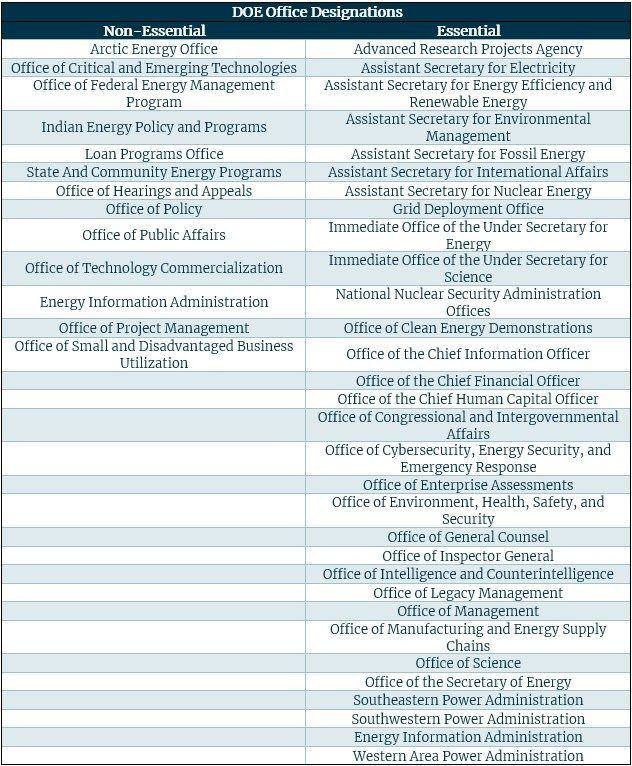
temporary lapse in government appropriations (also called a “shutdown”) continues. The shutdown plan of the DOE reveals what projects and departments are essential to serving American energy priorities and which are not. Congress should make this restructuring of the DOE permanent by defunding projects and offices that are not contributing to a reliable, cheap, and secure energy supply.
The DOE Shutdown Plan
Under the Antideficiency Act, government agencies must halt activities that do not have appropriated funds unless they are expressly authorized by law, necessary to discharge the President’s constitutional duties, or required for the protection of life and property. Of the DOE’s 15,523 employees, 9,816 (63%) were furloughed on September 30, 2025, and 5,707 (37%) were retained as “essential.”
The DOE’s plan is built around those guardrails. Essential activities performed by the DOE are primarily focused on nuclear security issues (
i.e., experts on naval nuclear reactors and nonproliferation staff stay on duty to monitor and secure nuclear materials). Other departments that have received the essential designation include the Power Administrations, the Office of Cybersecurity, Energy Security, and Emergency Response, and the Office of Intelligence and Counterintelligence.
Most DOE offices closed during the government shutdown are resource and advocacy offices that issue grants and fund energy projects outside of the scope of national security or constitutional duties.
Not All Operating DOE Offices Are Truly “Essential”
Most offices under the essential heading are fulfilling constitutional duties or ensuring the security of essential personnel or property.
Others that do not perform these essential functions continue operating because they have current appropriations, not necessarily because they are national priorities.
The Office of the Assistant Secretary for Energy Efficiency and Renewable Energy (EERE) leads efforts to develop and implement clean energy technologies and is part of the grant issuing process for those projects. Because of advance appropriations, they can continue this work with the nearly
$8 billion dollars in budgetary resources available.
Similarly, the Office of Clean Energy Demonstrations (OCED)has over
$10.5 billion in available budgetary resources that they can use to continue funding “green” energy projects and promoting decarbonization initiatives despite the government shutdown.
The DOE’s four Power Marketing Administrations (Bonneville, Southwestern, Southeastern, and Western Area) should face tougher scrutiny from Congress despite their continued operation during the shutdown. The Bonneville Power Administration operates under an indefinite appropriation and has funds available to continue operating fully during the government shutdown. The other Power Marketing Administrations still have budgetary
resources available to them and have continued to operate and provide power during the shutdown.
Power Administrations were created to sell federal hydropower and support rural electrification. Today, they function as government-run utilities with access to taxpayer money. The shutdown is an opportunity to re-evaluate the usefulness of these Power Administrations and whether they are still necessary. Rural electrification is well established with state and regional energy markets operating electricity generation and transmission systems across America. These Power Administrations should be phased out and removed to minimize the distortion of energy prices and allow more market competition between energy producers.
When the government reopens, Congress should consider defunding and phasing out these entities as part of the effort to right-size Washington and bring the
growing national debt under control.
Office Closures that Should be Made Permanent
The DOE shutdown plan includes thirteen offices that it considers non-essential. Primarily, these offices focus on implementing climate programs, grant distribution, or industrial policy initiatives are not deemed necessary for the protection of life and property.
For example, the
Arctic Energy Office largely funds studies, partnerships, and initiatives that focus on energy development in Alaska and the Arctic that do not contribute to nationwide energy reliability or security. They primarily focus on introducing and experimenting with renewable energy in the Arctic regions, such as the Alaska Solar Microgrid Working Group.
Similarly, the Indian Energy Policy and Programs Office
provides grants, technical assistance, and planning support to Tribal governments for energy projects. In the absence of this Office, private partnerships and state-level programs could support Tribal energy development without requiring federal funds.
The Office of Small and Disadvantaged Business Utilization should be removed entirely. This office
promotes contracting opportunities for small and minority-owned businesses within DOE. Tax dollars should not be steered towards identity-based categories and DEI targets which results in the government picking winners and losers. Grants to minority-owned businesses are not essential to protect public safety and do not serve to enhance the performance of our energy grid.
Other offices providing grants or loans with little real value added include the State and Community Energy Program, the Loan Programs Office, the Office of Technology Commercialization. None of these offices provide critical funds for energy reliability or securing energy grids from attacks. Instead, they increase government interventions in the energy marketplace,
driving up prices and reducing competition. Grants to “green energy sources” are not dispatchable, meaning that they cannot provide power when it is needed most, forcing utilities to maintain backup systems powered by fossil fuels or nuclear energy or else be unable to supply power when demand peaks. By subsidizing these projects, American consumers receive more expensive energy with less reliability. Offices dedicated to funding these projects are not serving the American people and should be closed.
The Energy Information Administration collects and publishes energy data, forecasts, and statistics. Although this data is useful, pausing these reports during a shutdown does not stop government operations or energy delivery. Congress should reassess whether to restart the office at its current scale, as many energy statistics are already produced by industry and independent analysts.
A Path to Sound Policymaking
Policymakers should use the DOE’s shutdown plan and office designations as a prioritization map going forward. Certain functions and projects that are still operating cannot fail without harmful effects: safeguarding nuclear materials, defending the energy system against cyber and physical threats, and meeting specific constitutional and legal obligations.
To prevent taxpayer funds from continuing to support wasteful energy initiatives, reforms such as the OCED Elimination Act of 2025 (H.R. 4172) sponsored by Rep. Brandon Gill (R-TX-26) are needed.
Programs that have paused are, by definition, not required for immediate public safety. If an initiative can be temporarily suspended for over a month without risking life, property, or national security, it
deserves a closer look at whether it should be funded at all. Congress should demand measurable value for taxpayers before it grows or reauthorizes those offices and their lines of effort.