
The Baselines
The House and Senate are using two different baselines. A budget baseline provides a benchmark against which to measure legislative proposals. The House budget resolution was prepared using the official baseline prepared by the Congressional Budget Office. The House budget also included assumptions about deficit reduction that would accrue due to future economic growth. The Fiscal Framework of the budget resolution, which requires tax reductions in excess of $2.5 trillion be offset on a dollar-for-dollar basis by savings produced in other committees, is also tied to the official baseline. Meanwhile, the Senate budget resolution used a “current policy” baseline. Senate Budget Committee Chairman Lindsey Graham (R-SC) has instructed the Congressional Budget Office (CBO) and the Joint Committee on Taxation to assume that certain expiring provisions of the 2017 Tax Cuts and Jobs Act (TCJA) are extended in the baseline.Official Baseline - Conventional Scoring
The CBO estimates that the One Big Beautiful Bill as proposed by the Senate would reduce outlays by $1.2 trillion, reduce revenues by $4.5 trillion, and increase the deficit by $3.3 trillion over the FY 2025 – 2034 period.|
One Big Beautiful Bill As Proposed in the Senate - Conventional Scoring |
|||||||||||
|
2025 |
2026 | 2027 | 2028 | 2029 | 2030 | 2031 | 2032 | 3033 | 3034 |
2025 - 2034 |
|
| Outlays |
-171 |
19 | 8 | -42 | -88 | -132 | -176 | -204 | -206 | -221 |
-1,213 |
| Revenues |
-131 |
-460 | -581 | -578 | -521 | -443 | -411 | -418 | -446 | -477 |
-4,466 |
| Deficit |
-40 |
479 | 588 | 535 | 434 | 311 | 235 | 214 | 240 | 256 |
3,253 |
| In billions of dollars. Source: Author Calculations based on Congressional Budget Office. | |||||||||||


Dynamic with Interest
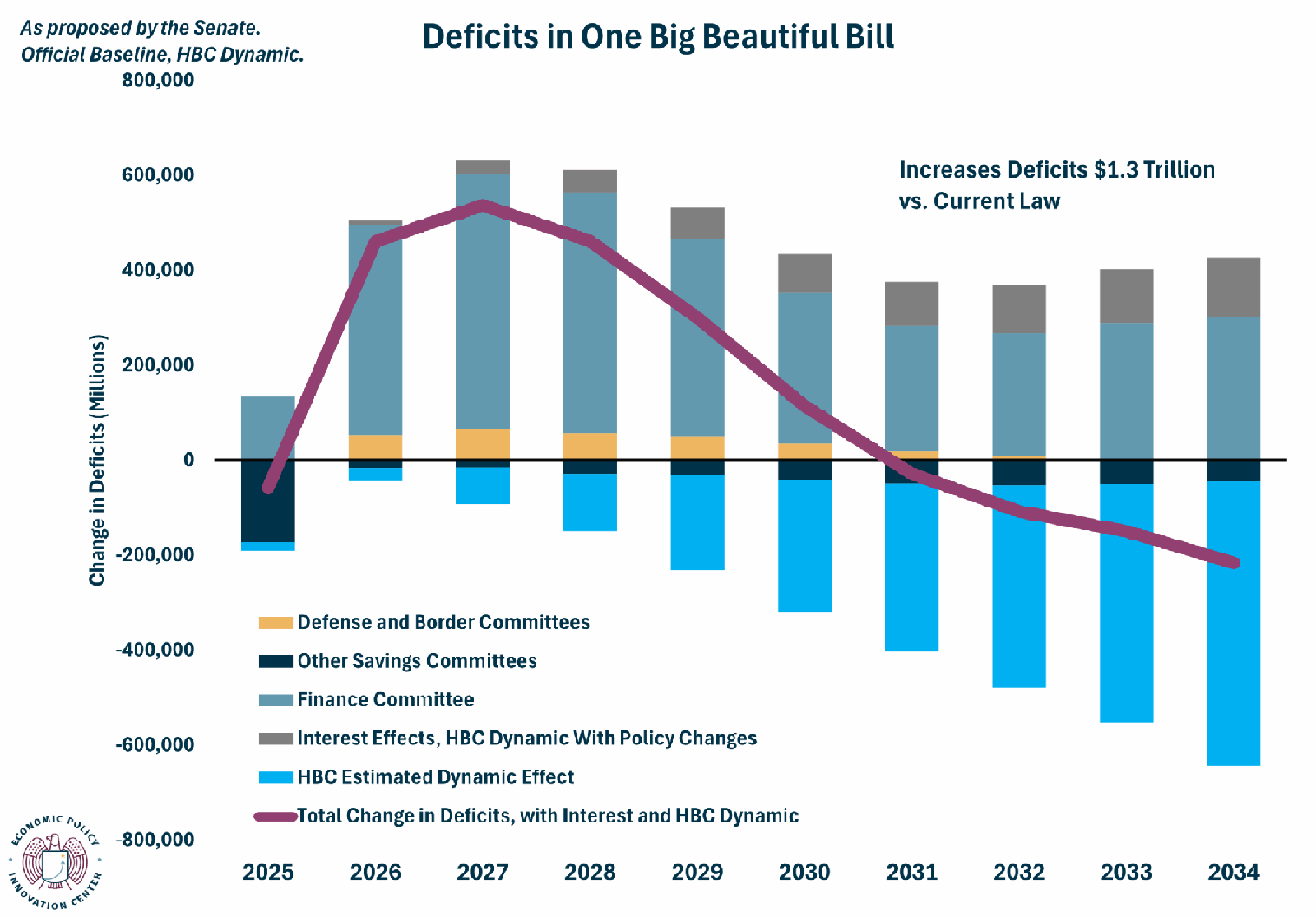
The House Budget Committee “estimates that economic growth will average 2.6 percent over ten years—generating a substantial $2.6 trillion in deficit reduction.” The bill would increase net interest costs by $661 billion, after taking the Budget Committee’s assumed dynamic revenues into account. Taking the House Budget Committee’s dynamic assumptions and the resulting net interest costs into account, the One Big Beautiful Bill as proposed by the Senate would reduce outlays by $552 billion, reduce revenues by $1.9 trillion, and increase the deficit by $1.3 trillion over the FY 2025 – 2034 period.|
One Big Beautiful Bill As Proposed in the Senate - HBC Dynamic with Interest Costs |
|||||||||||
|
2025 |
2026 | 2027 | 2028 | 2029 | 2030 | 2031 | 2032 | 3033 | 3034 |
2025 - 2034 |
|
| Outlays |
-171 |
26 | 35 | 5 | -22 | -51 | -83 | -101 | -93 | -96 |
-552 |
| Revenues |
-114 |
-434 | -503 | -456 | -322 | -166 | -55 | 7 | 57 | 121 |
-1,866 |
| Deficit |
-58 |
461 | 537 | 462 | 300 | 115 | -28 | -108 | -150 | -217 |
1,314 |
| In billions of dollars. Source: Author Calculations based on Congressional Budget Office. | |||||||||||


Directed Current Policy Baseline Scorekeeping
The CBO estimates that compared to the directed current policy baseline scorekeeping that assumes an extension of the expiring TCJA provisions, the One Big Beautiful Bill as proposed by the Senate would reduce outlays by $1.3 trillion, reduce revenues by $829 billion, and reduce the deficit by $508 billion over the FY 2025 – 2034 period.|
One Big Beautiful Bill As Proposed in the Senate - Directed Current Policy Baseline Scorekeeping |
|||||||||||
|
2025 |
2026 | 2027 | 2028 | 2029 | 2030 | 2031 | 2032 | 3033 | 3034 |
2025 - 2034 |
|
| Outlays |
-171 |
20 | -8 | -58 | -104 | -148 | -191 | -219 | -222 | -236 |
-1,336 |
| Revenues |
-124 |
-249 | -159 | -167 | -113 | -33 | 10 | 16 | 3 | -12 |
-829 |
| Deficit |
-47 |
270 | 151 | 109 | 9 | -114 | -201 | -235 | -225 | -224 |
-508 |
| In billions of dollars. Source: Author Calculations based on Congressional Budget Office. | |||||||||||