America’s national debt has ballooned to an enormous
$38 trillion this year, which is 18%
higher than the total GDP of the country. The only other time our debt has been higher relative to GDP was right after
World War II. Shouldering a war-time debt burden during a time of relative peace has terrible implications both for our government’s ability to finance its spending and for the broader economy.
Interest Payments Are Increasing
As the debt continues to grow out of control, exponentially growing interest payments would make it harder to pay it off, and would make it more difficult to borrow money if a
serious crisis were to happen. Our nation must face the reality that those interest payments are rapidly becoming one of the federal government’s
largest expenses. In fiscal year (FY) 2024, the federal government spent
$881 billion on interest, which was more than defense spending for the same year.
The Congressional Budget Office’s (CBO)
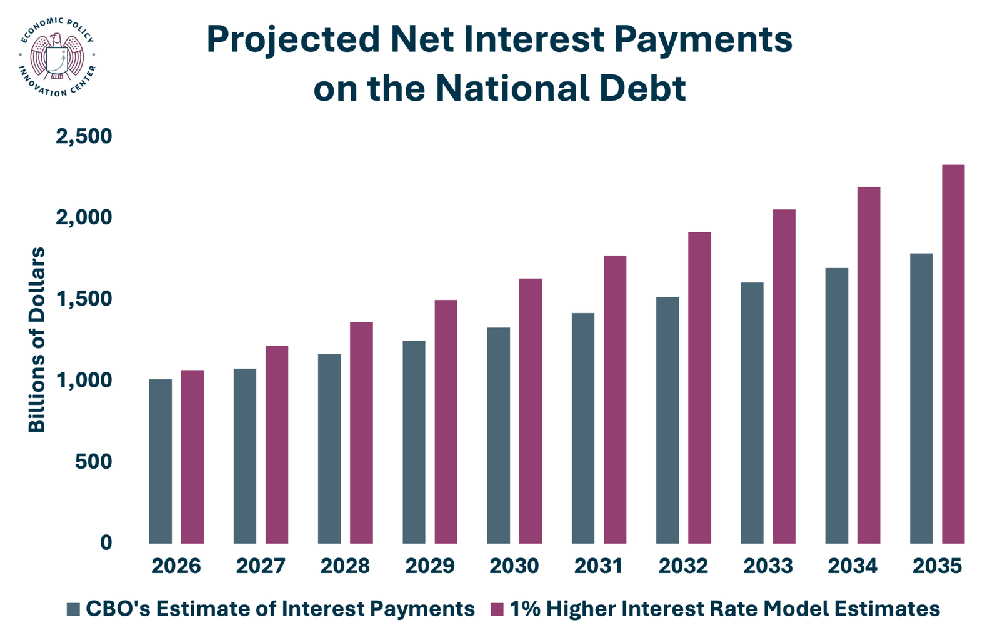
January 2025 baseline projects that interest payments on the national debt will equal $13.8 trillion over the 2026 - 2035 budget window, while the interest rates on 10-year Treasury notes would average 3.85%.
Higher Interest Rates Make the Problem Worse
However, if the interest rate was just 1% higher each year than projected, interest costs would be $3.2 trillion higher over the next decade. A one percentage point error in the CBO’s predicted interest rates is not
historically unusual, given that is about the average error in their interest rate projections on 10-year Treasury notes. Their projections are also low compared to the
historical average of interest rates.
In that higher interest rate scenario, the interest expense in FY 2035 alone would equal $2.3 trillion or 21% of the total estimated federal budget, compared to
13% of the budget in FY 2024. That is $545 billion more than CBO’s current interest expense estimate of $1.8 trillion and is roughly equal the CBO’s estimate for the cost of all discretionary programs for that year. That means net interest would cost more than the sum of defense spending, numerous welfare programs, law and justice, science funding, and many other budget items.
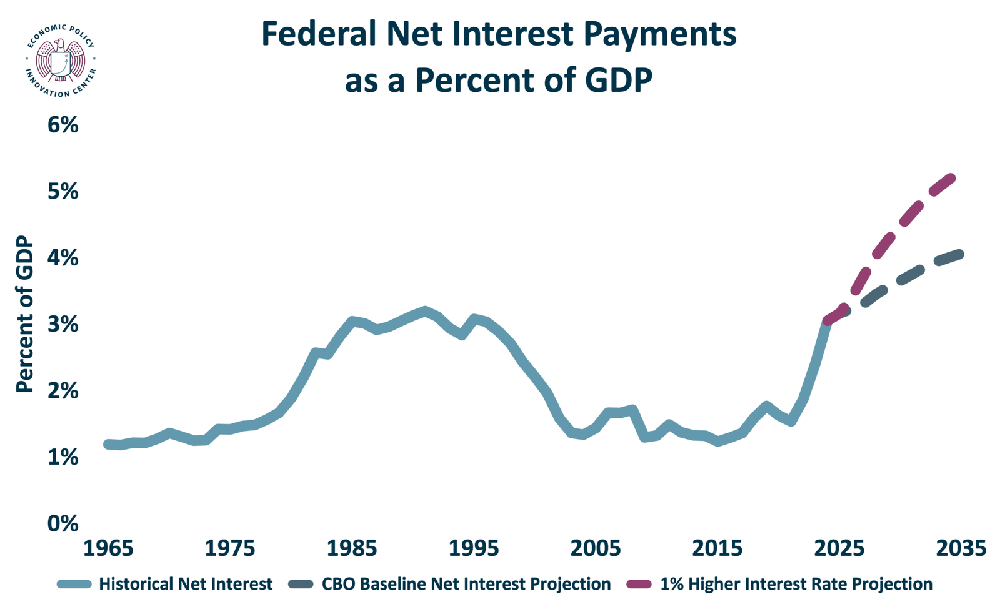
Net interest payments will be at the highest they’ve ever been relative to GDP, regardless of whether you use CBO’s conservative estimates or the higher interest rate model’s projections. This means that more of the nation’s total economic output would be dedicated solely to paying off U.S. debt instead of being used for more productive uses.
A Large Debt Hurts the Economy
Since the debt is increasing to levels it has never been before, it wouldn’t be surprising if investors demanded even higher interest rates due to a lack of confidence in the government’s ability to repay. Increases in the interest rate our government pays on its debt would have negative downstream effects on the broader economy.
Higher rates on
Treasuries would make borrowing in other lending markets more expensive. They would make it harder for businesses to get money for investment opportunities as government borrowing crowds out private investment. It would make mortgage rates for new homes even higher and make consumer borrowing generally more expensive. This would slow overall economic growth and hurt Americans.
If the government wants to prevent a debt spiral, Congress must bring government
spending under control and begin paying off the vast debt it has already accumulated.