
PLEASE NOTE: This site is an archival resource, no longer updated as of June 1, 2026. Current questions: The Fiscal Lab.
Social Programs

Most Work Capable Food Stamp Recipients Don't Work

Social Programs Policy Rapid Response BlogMay 22, 2024 By Matthew Dickerson

Introduction

Few adult food stamp recipients work, even those subject to work requirements.

Over the 2017-2019 period (the most recent complete data available), an average of 38 percent of able-bodied adults receiving food stamps were employed, while 62 percent did not work at all.

Work by this population of work-capable adults is only slightly higher than the 24 percent of all adults receiving food stamps who work.
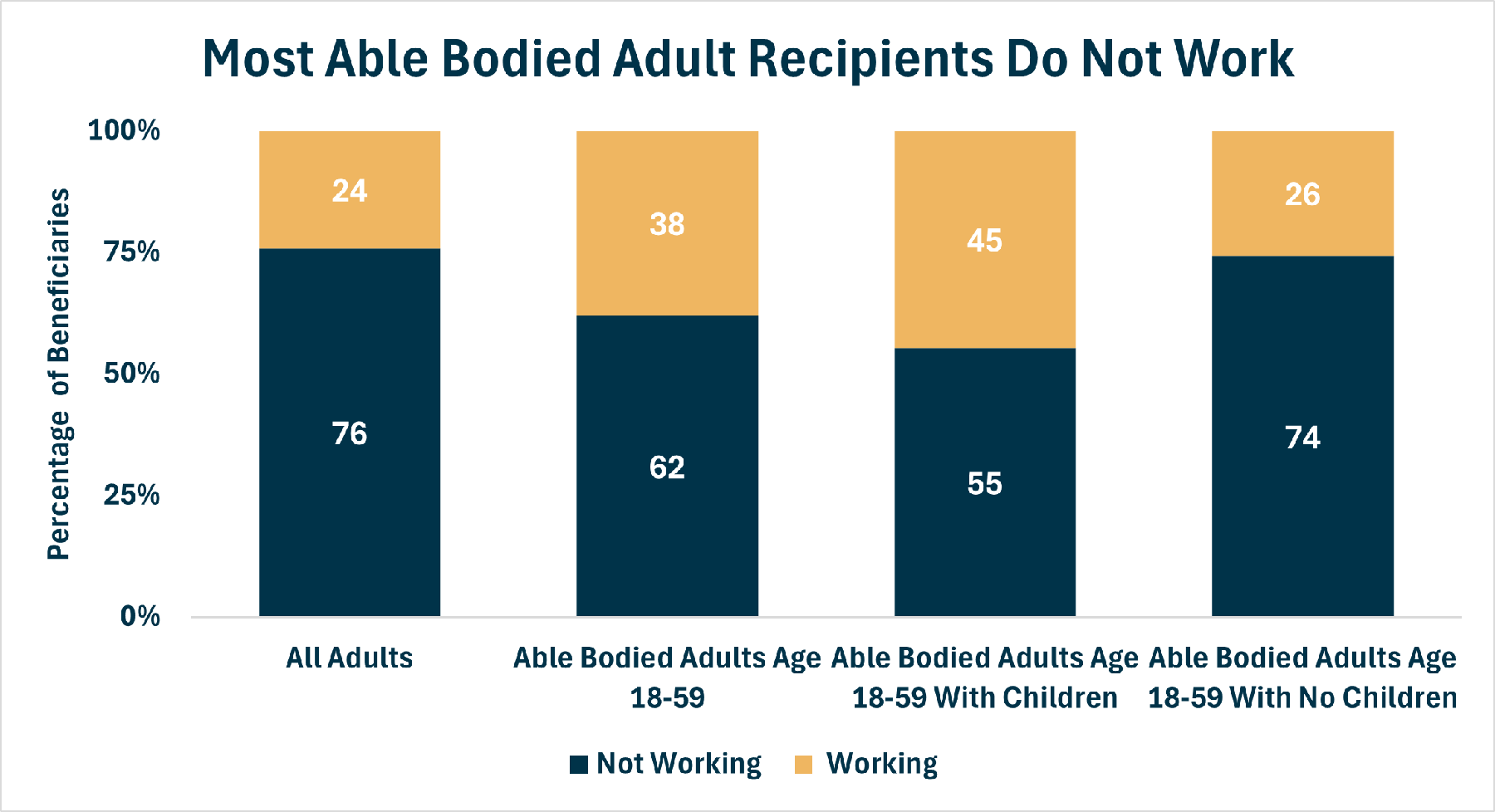
Most Able Bodied Recipients Do Not Work
Source: USDA

Those who do work, do not work very much.

In fact, only 18 percent of ABAWDs age 18-49 worked the 20 or more hours per week needed to satisfy the work requirement through employment between FY 2017 and 2019. This means that 82 percent of those subject to the work requirement did not work enough hours.

These ABAWDs potentially could have satisfied the work requirement through job training or volunteering. However, it is most likely that these work-capable adults were waived or exempted from the work requirements altogether.
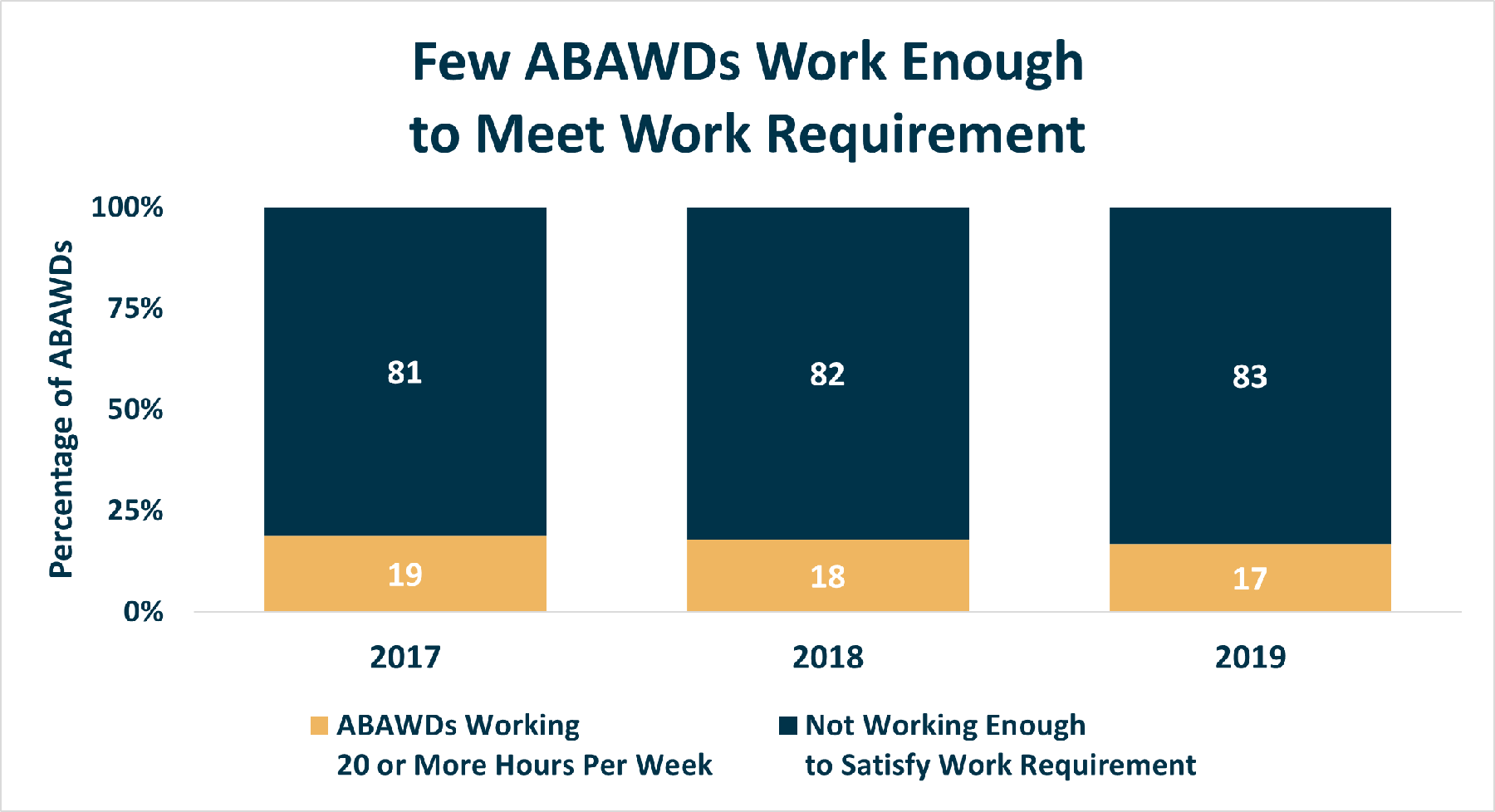
SNAP ABAWDs Working 20 Hours
Source: USDA

The table below summarizes data from the USDA on the work efforts of able-bodied food stamp recipients between FY 2017 to 2019, which is the period where complete data is available.
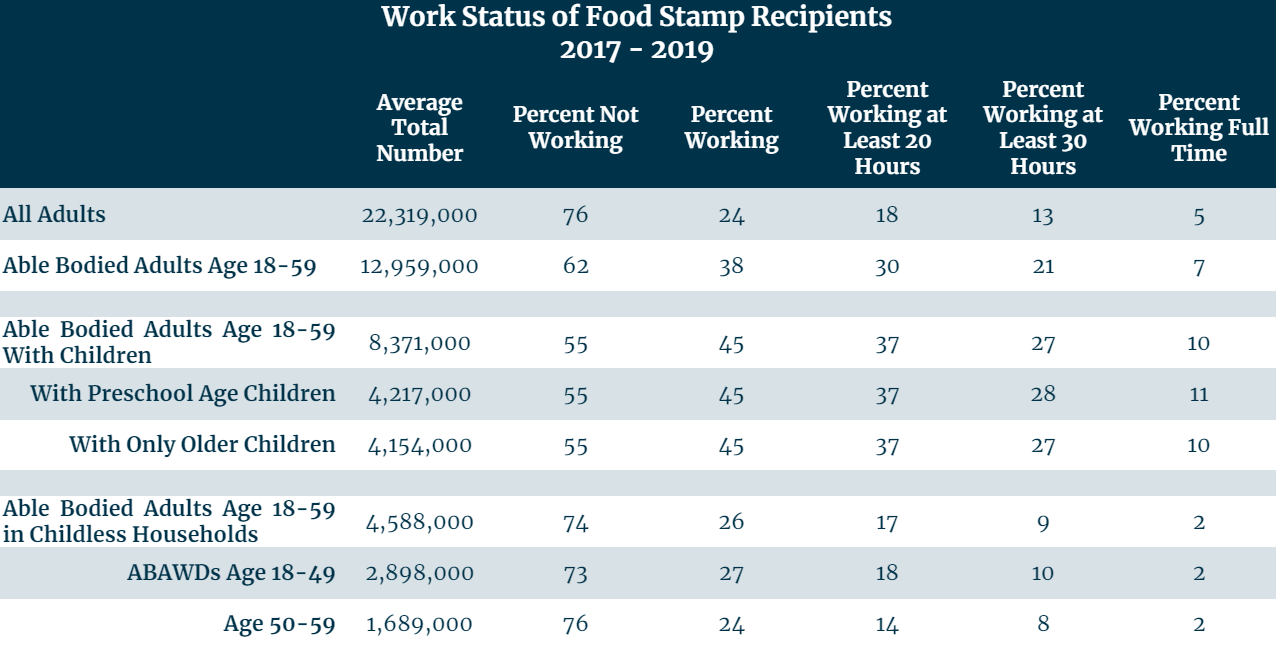
SNAP Work By Able Bodied Adults Chart
Source: USDA

Work is an important value that is vital to human flourishing for individuals, families, communities, and the United States. The food stamp program provides billions of dollars in benefits to millions of work-capable people each year. Unfortunately, the food stamp program undermines work and traps too many people in dependency, rather than promoting opportunity.

Congress should strengthen food stamp work requirements by including all work capable adults, eliminating geographic waivers, phasing up the hours of expected effort, and preventing a lifetime of dependency.



Author

Matthew D. Dickerson

Matthew D. Dickerson

Director of Budget Policy

Matthew D. Dickerson is Director of Budget Policy at the Economic Policy Innovation Center (EPIC). Dickerson is recognized as an expert on fiscal policy issues, including the budget, appropriations, and entitlement reform. His articles have been featured in the Wall Street Journal , the Miami Herald , National Review , the Sacramento Bee , the Washington Times , the Baltimore Sun , The Hill , the Washington Examiner , and other outlets. Prior to joining EPIC, Dickerson served as Senior Policy Advisor on the staff of the House Budget Committee, where he helped lead development of the fiscal year 2024 budget resolution. He has a dozen years of experience on Capitol Hill, including as a senior staffer with the Republican Study Committee (RSC), the caucus of conservatives in the House of Representatives. Under four different RSC chairmen, Dickerson held senior level roles including Policy Director and Senior Policy Staff. Additionally, he served as Legislative Director and other policy positions for the late Congressman C.W. Bill Young (R-FL), a former Chairman of the powerful House Appropriations Committee. During his tenure at The Heritage Foundation, Dickerson was Director of the Grover M. Hermann Center for the Federal Budget. In this capacity, he oversaw a team of budget analysts and economists researching diverse subjects including spending, entitlements, budget process, tax, labor, pensions, and infrastructure issues. He has also been a Policy Manager at Americans for Prosperity, where he supervised a team of fellows and analysts covering a variety of federal and state policy issues. Dickerson is a graduate of the College of William and Mary in Virginia and holds a Bachelor of Arts in Government and History.

More from Matthew D. Dickerson →

← All work