Federal spending on the
Food Stamp welfare program has skyrocketed in recent years.
Congress recently proposed reasonable reforms to the program in the budget reconciliation process. These reforms would promote opportunity and address waste, fraud, and abuse in Food Stamps.
Despite unfounded claims about "slashing benefits," these reforms would only modestly roll back some of the excessive spending increases to the Food Stamp program.
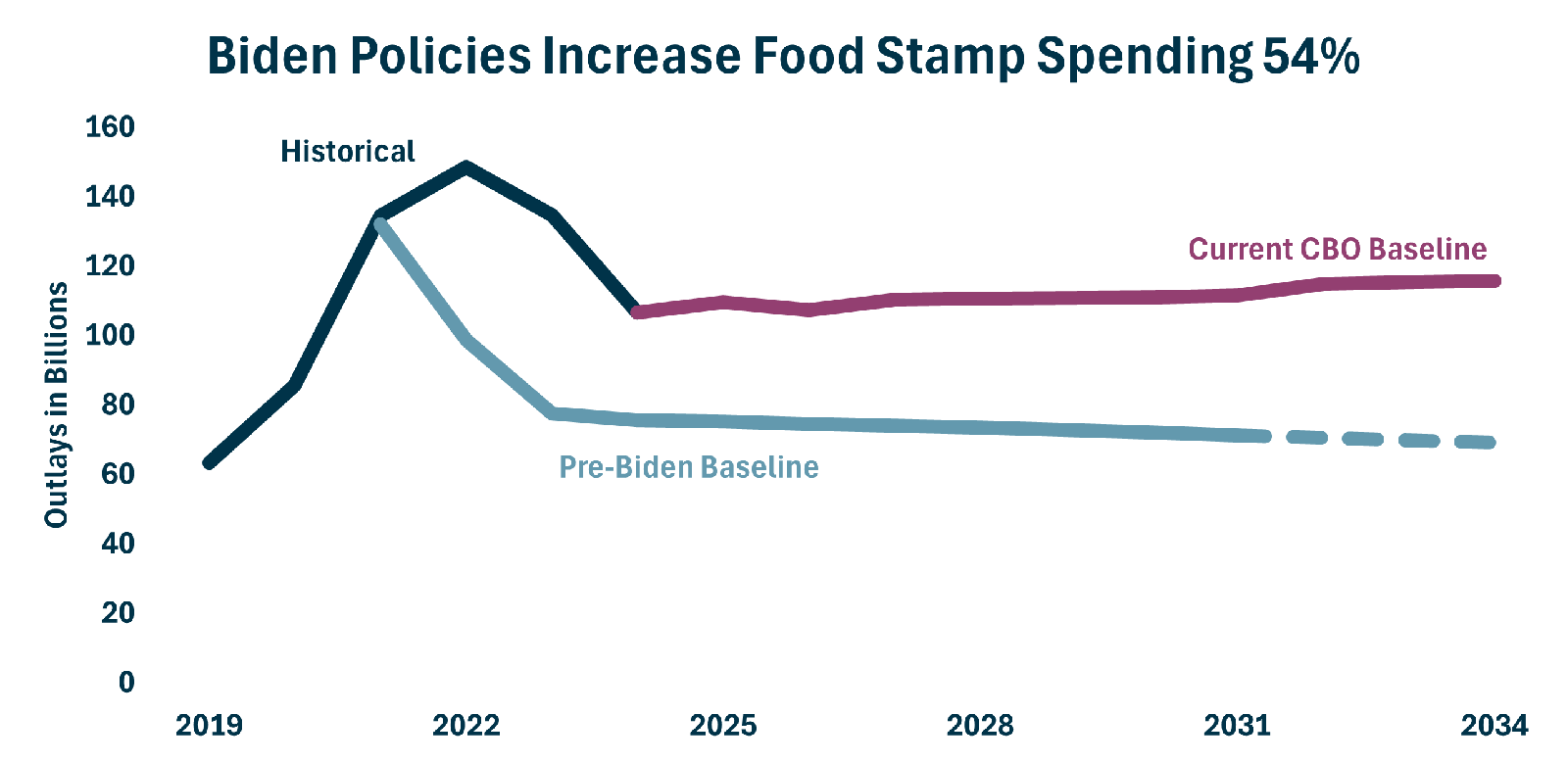
Biden's Food Stamp Spending Blowout Increase Spending 54%
President Joe Biden's policies massively increased spending on Food Stamps.
The current Congressional Budget Office (CBO)
baseline for Food Stamps is now $394 billion higher over the FY 2025 to 2034 period than an extrapolation of the pre-Biden CBO baseline published in February 2021. That is an astonishing 54% increase in Food Stamp spending.
The Biden Administration took several steps to
intentionally and permanently increase the level of Food Stamps spending:
- Biden unilaterally increased Food Stamp benefits in 2021 by 21% above inflation through a “reevaluation” of the Thrifty Food Plan, which is used to calculate benefit levels.
- The American Rescue Plan Act increased the maximum Food Stamp benefit by 15% through September 30, 2021.
- The Administration extended Food Stamp emergency allotments through February 2023, even after President Biden declared “the pandemic is over.”
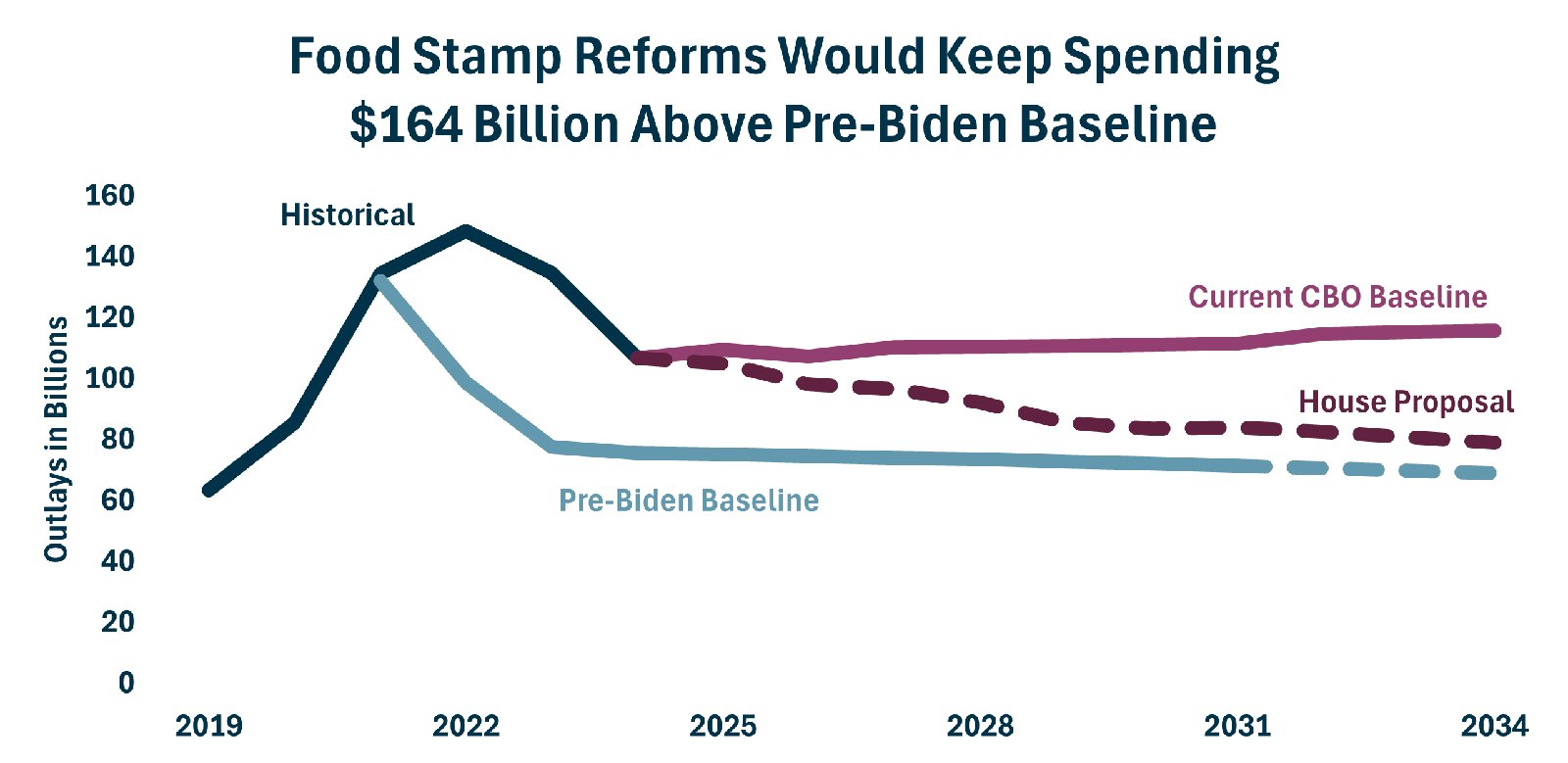
House Reconciliation Proposal Keeps Food Stamp Spending 23% Above Pre-Biden Baseline
The
budget resolution passed by the House of Representatives calls for $230 billion of savings in the jurisdiction of the House Agriculture Committee.
The House Agriculture Committee has nearly $1.5 trillion of spending assumed in its baseline over the FY 2025 - 2034 period. About $1.1 trillion of that spending is on Food Stamps.
Even assuming all of the savings from the Agriculture Committee would be for Food Stamp reforms, that would still produce a level of spending well in excess of the pre-Biden baseline projections. Over the FY 2025 - 2034 period, total Food Stamp spending would be $164 billion, or 23%, higher than the extrapolation of the pre-Biden baseline.
In every year over the next decade, spending on Food Stamps would exceed spending on the Department of Commerce, the Department of the Interior, the Environmental Protection Agency, and the Small Business Administration,
combined.
Food Stamps Filled with Waste, Fraud, and Abuse
The Food Stamp program is in dire need of reform. It is rampant with waste, fraud, and abuse.
Annual Food Stamp spending has
increased by more than $100 billion between 2001 and 2023.
Work requirements remain completely
waived in California, New York, Illinois, Nevada, and Washington D.C., and in parts of 24 other states.
Even before the pandemic, 62% of the able-bodied adults receiving welfare benefits did not work at all. Only 18% of able-bodied adults without dependents (ABAWDs) age 18-49 worked the 20 or more hours per week needed to satisfy the work requirement. This means that 82% of those subject to the work requirement did not work enough hours.
Billions of dollars are also wasted on
improper payments every year. The U.S. Department of Agriculture (USDA) is even required to
ignore $57 of every improper payment.
The savings proposed by the reconciliation budget resolution are incredibly modest in the face of this waste, fraud, and abuse.