
PLEASE NOTE: This site is an archival resource, no longer updated as of June 1, 2026. Current questions: The Fiscal Lab.
Social Programs

These States Have High Food Stamp Payment Errors

The food stamp program makes billions in improper payments each year.
Social Programs Policy Rapid Response BlogMay 14, 2024 By Matthew Dickerson

The food stamp program makes billions in improper payments each year.

Improper payments are government outlays that should not have been made or were made in the wrong amount. These improper payments often include fraud, abuse, and waste, but are not always indicative of illegal activity.

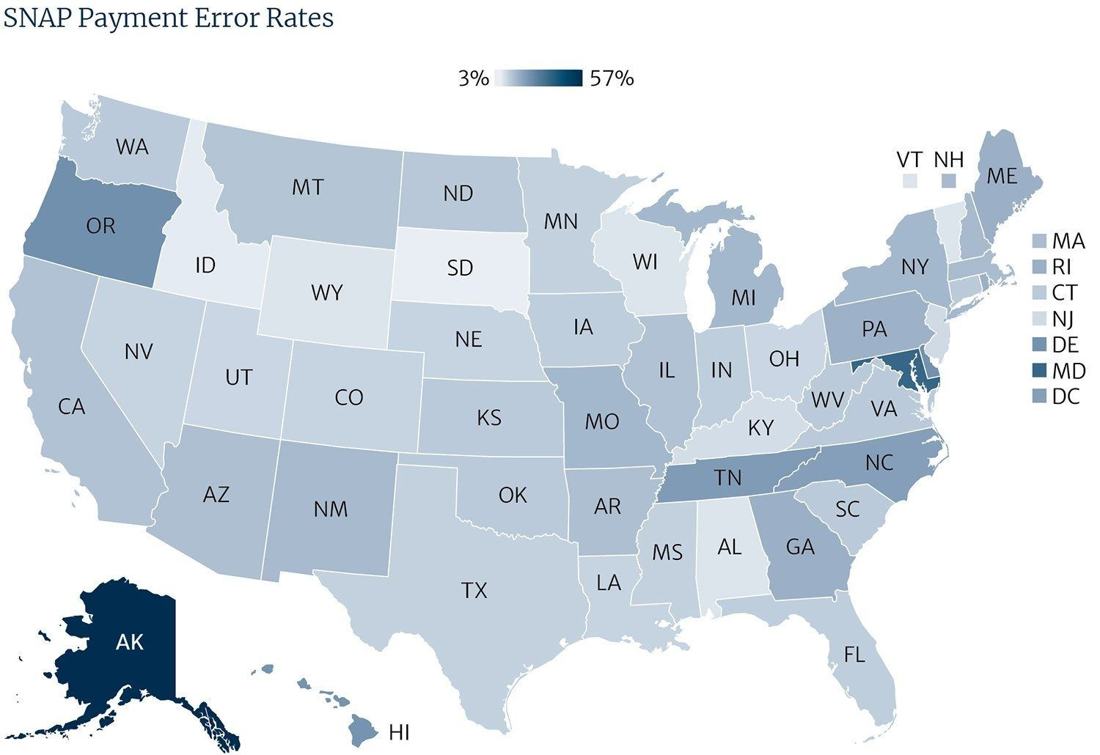
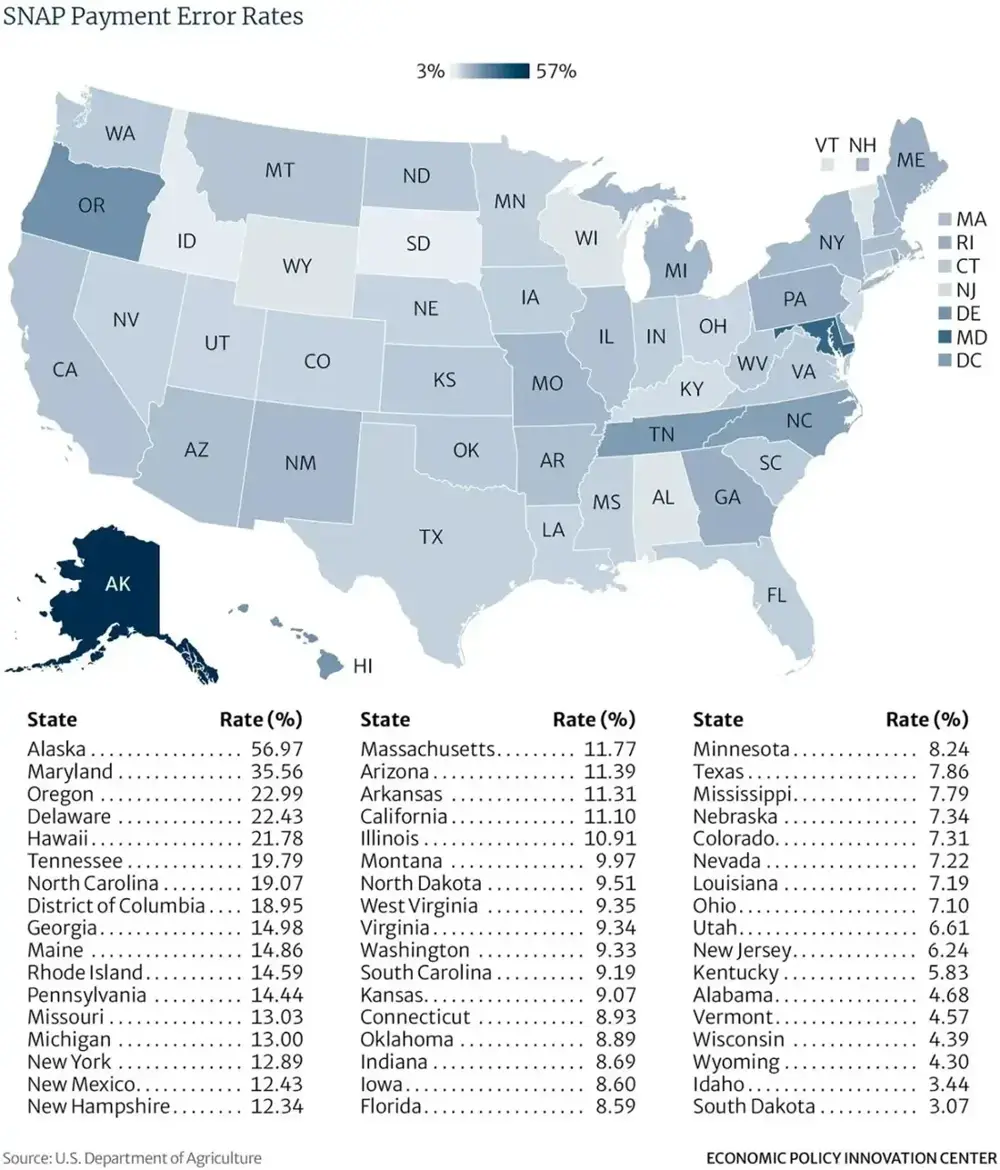
The reported improper payment rates for the food stamp program vary alarmingly across states, indicating stark disparities in program administration.

In FY 2022, an astonishing 57 percent of food stamp payments in Alaska were reported as improper, along with 35.6 percent in Maryland, 23 percent in Oregon, 21.8 percent in Hawaii, and 19.8 percent in Tennessee.

Meanwhile, the reported improper payment rate in South Dakota was 3.1 percent, 4.3 percent in Wyoming, and 4.4 percent in Wisconsin.
Snap Payment Error Rates

Improper payments are likely significantly higher than the reported amounts. In fact, the 2014 Farm Bill instructs USDA to ignore improper payments up to a “quality control tolerance threshold.” This threshold was set at $37 in 2014 and increases with inflation each year. In 2022, the “tolerance threshold” was $48. Thus, any improper payment up to $48 in 2022 was not reported. The tolerance threshold increases to $56 for FY 2024.

The Snap Back Inaccurate SNAP Payments Act, introduced by Rep. Randy Feenstra (R-IA) and Sen. Joni Ernst (R-IA) would clarify that all improper payments must be counted as errors.



Read the EPIC Report: Food Stamps: A Culture of Dependency.

Author

Matthew D. Dickerson

Matthew D. Dickerson

Director of Budget Policy

Matthew D. Dickerson is Director of Budget Policy at the Economic Policy Innovation Center (EPIC). Dickerson is recognized as an expert on fiscal policy issues, including the budget, appropriations, and entitlement reform. His articles have been featured in the Wall Street Journal , the Miami Herald , National Review , the Sacramento Bee , the Washington Times , the Baltimore Sun , The Hill , the Washington Examiner , and other outlets. Prior to joining EPIC, Dickerson served as Senior Policy Advisor on the staff of the House Budget Committee, where he helped lead development of the fiscal year 2024 budget resolution. He has a dozen years of experience on Capitol Hill, including as a senior staffer with the Republican Study Committee (RSC), the caucus of conservatives in the House of Representatives. Under four different RSC chairmen, Dickerson held senior level roles including Policy Director and Senior Policy Staff. Additionally, he served as Legislative Director and other policy positions for the late Congressman C.W. Bill Young (R-FL), a former Chairman of the powerful House Appropriations Committee. During his tenure at The Heritage Foundation, Dickerson was Director of the Grover M. Hermann Center for the Federal Budget. In this capacity, he oversaw a team of budget analysts and economists researching diverse subjects including spending, entitlements, budget process, tax, labor, pensions, and infrastructure issues. He has also been a Policy Manager at Americans for Prosperity, where he supervised a team of fellows and analysts covering a variety of federal and state policy issues. Dickerson is a graduate of the College of William and Mary in Virginia and holds a Bachelor of Arts in Government and History.

More from Matthew D. Dickerson →

← All work