The Senate has released its
amendment to the House-passed budget resolution. To officially activate reconciliation, both chambers will need to adopt the same version of the final budget resolution.
Rather than providing a clear framework for advancing President Trump's reconciliation bill, the Senate amendment highlights the lack of consensus between the House and Senate as to what policies should be included in the legislation. The Senate amendment to the budget resolution is internally inconsistent and is nearly incoherent rather than providing a clear path to extending the tax cuts, reducing spending, and providing necessary resources for the border and national security. It provides vastly different reconciliation instructions to House and Senate committees. The amendment even provides two separate instructions to increase the debt limit which differ by $1 trillion.
It is time for leaders in both the House and the Senate to get serious about finalizing the budget resolution for reconciliation. Reconciliation is the way to achieve the priorities of the American people, including investing in border security, permanently preserving and expanding the 2017 tax cuts, reducing inflation, and draining the swamp. Collaboration and compromise between the chambers are needed to resolve the differences and build consensus on the most important legislation of President Trump's second term.
The Baseline
The Senate amendment proposes using a “current policy” baseline rather than the
official baseline to score the reconciliation bill.
Senate Budget Committee Chairman Lindsey Graham (R-SC)
stated “As Budget Chairman, under section 312 of the Congressional Budget Act, I have the authority to determine baseline numbers for spending and revenue. Under that authority, I have determined that current policy will be the budget baseline regarding taxation."
A current policy baseline would assume that the tax policies in place at the beginning of 2025 already extend permanently, rather than assuming the tax cuts expire as they do under current law. Over the FY 2025 - 2034 period, the Senate amendment to the budget resolution assumes $3.9 trillion in current tax policies are extended in the current policy baseline. If the tax cuts are already assumed to be extended in the baseline against which the reconciliation bill is scored, then permanently extending those tax cuts in the reconciliation bill will not show as increasing the deficit in the outyears, thus avoiding the long-term deficit point of order under the
fifth test of the Byrd Rule.
The use of directed scorekeeping for a current policy baseline could raise unanticipated technical and political challenges. For example, the
first test of the Byrd Rule requires
every provision of a reconciliation bill to “produce a change in outlays or revenues” relative to the baseline. If the baseline assumes current tax policy remains in place, then a reconciliation bill that simply extends current tax policy would not be scored as producing a change in revenues relative to that baseline and would be subject to points of order. For example, simply extending the 2017 tax law’s increase in the standard deduction against the current policy baseline would be scored as not changing revenue (because it is already current policy even though it expires at the end of the year) thus potentially triggering a point-of-order under the Byrd Rule that would require 60 votes to waive.
This could require Congress to make small changes to every provision of the tax code that needs to be extended. If so, this would force lawmakers to renegotiate each of the policies being made permanent, rather than simply extending the 2017 policies. Furthermore, if these taxes are reduced and increase the deficit relative to the current policy baseline, then that could reopen the challenges under the
fifth test of the Byrd Rule that prohibits adding to the deficit in the outyears that prompted the use of the current policy baseline in the first place.
Committee Instructions
The point of adopting this budget resolution is to provide reconciliation instructions that facilitate passage of a reconciliation bill which will achieve certain policy goals.
But the reconciliation instructions for the House and Senate committees envision very different tax and spending policies. The instructions in the Senate amendment would allow the Senate to send back a very different reconciliation bill than the one the House would be required to initially pass.
The House committee instructions
includes a failsafe to achieve at least $2 trillion in deficit reduction savings through reconciliation. Border security would be provided with $200 billion in investments, and defense would be allocated $100 billion. It also allows the House Ways and Means Committee to increase deficits and reduce taxes by $4.5 trillion beyond extending current tax policy.
In contrast, the Senate instructions require a minimum of only $4 billion of savings. Border security would be provided with $350 billion of investment, and defense would be provided an additional $150 billion. The Senate Finance Committee would be permitted to reduce taxes by $1.5 trillion beyond extending current policy.
Reconciliation Instructions in Senate-Amended Budget
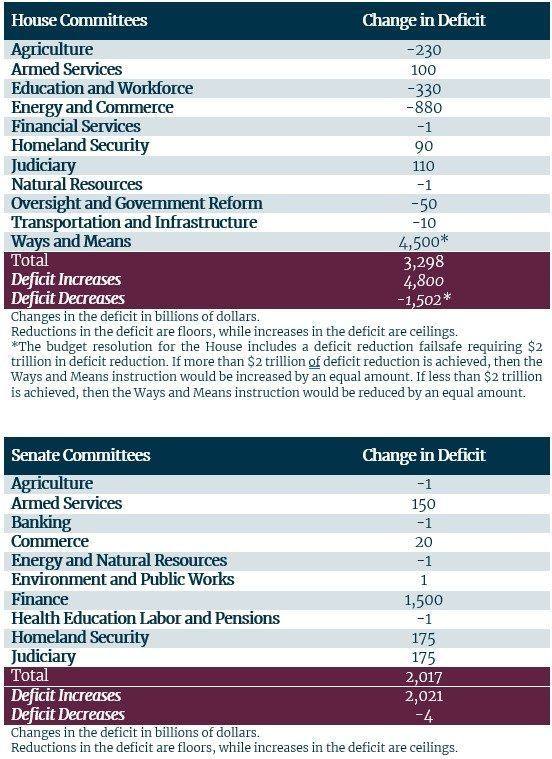
Senate Republicans claim that the instructions are for a "minimum amount of savings that creates maximum flexibility" to comply with the Byrd Rule requirements with "the goal of saving as much as possible." While some flexibility is needed, it should be balanced with instructions that ensure agreed-upon policy priorities will be included in the final bill, which is the purpose of reconciliation instructions.
The underlying problem is that there is not yet agreement on what priorities should be included in the reconciliation bill.
Debt Limit
In addition to the different instructions for tax and spending policies, the Senate amendment also includes divergent instructions for dealing with the
debt limit in the House and the Senate.
The House instructions require the Ways and Means Committee to report a $4 trillion debt limit increase. The Senate instructions require the Finance Committee to increase the debt limit up to $5 trillion.
A $4 trillion debt limit would likely be reached again in fall 2026, while a $5 trillion increase would extend into the middle of 2027.

The debt limit will
need to be increased as early as June 2025, or at least before August 2025 (when Congress typically recesses). Dealing with the debt limit in reconciliation would allow it to be
responsibly paired with savings.
Spending Topline
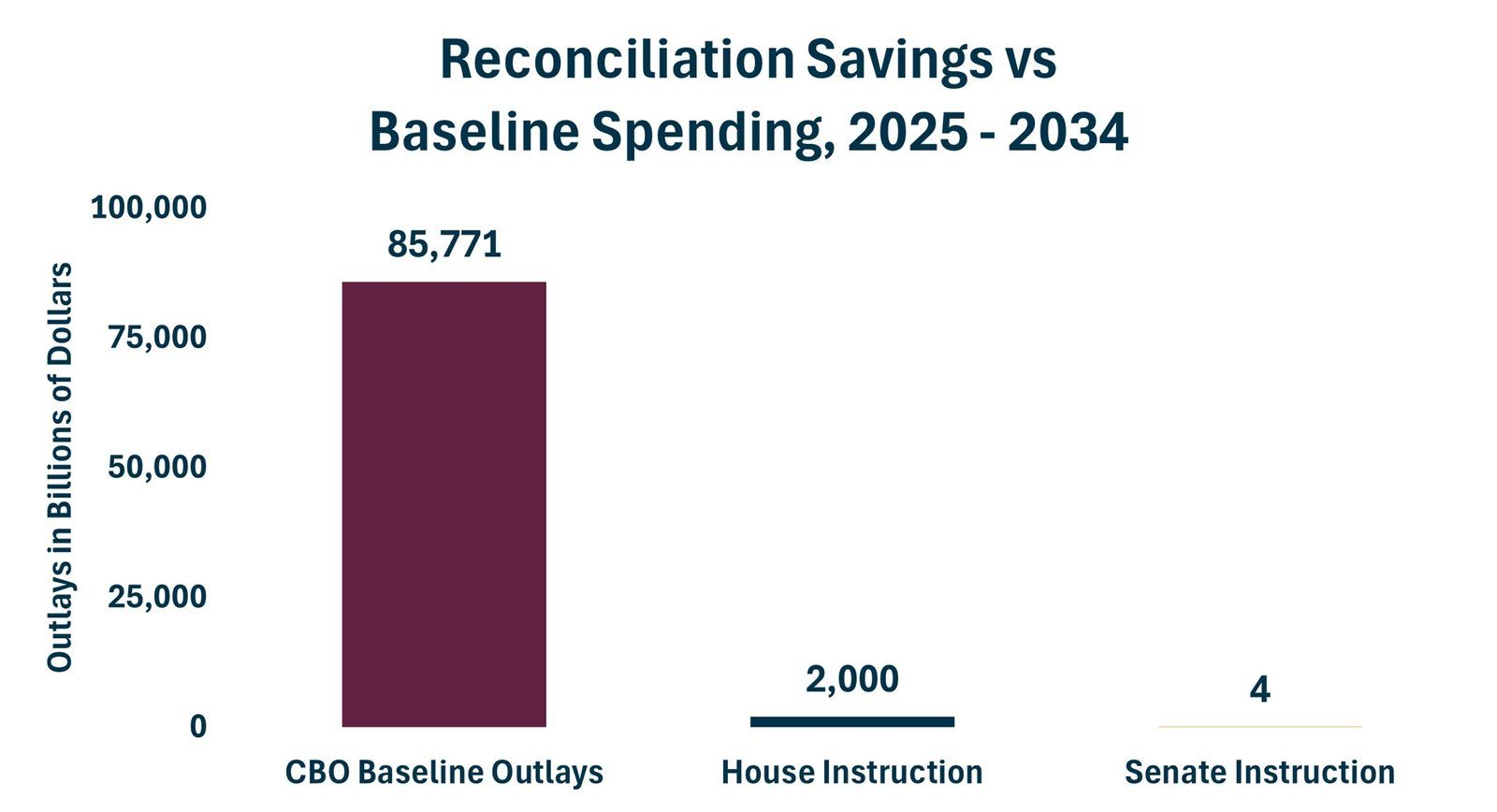
Some might point to the "topline" spending levels called for in the Senate amendment to the budget resolution as evidence that the adopted resolution would help return spending to responsible levels. The budget predicts that total outlays in FY 2025 will be $6.1 trillion, about $1 trillion less than the Congressional Budget Office's baseline projection for this year.
Controlling spending is essential to making the budget sustainable and achieving other objectives of the administration like reducing the trade deficit. Unfortunately, this budget resolution provides no way for Congress to make changes in laws to achieve the spending targets within the next five months.
The Budget Act, which established the modern budget process, creates two ways for an annual budget resolution to produce changes in actual spending and revenues to reduce the deficit. First, the budget resolution establishes the "302(a)" topline spending level for the discretionary spending appropriations bills for the upcoming fiscal year. Second, the budget resolution can activate the budget reconciliation process to fast-track changes to tax policy and "mandatory" autopilot spending programs (other than Social Security or interest costs on the debt).
This is the Fiscal Year 2025 budget resolution. Congress finalized the FY 2025 appropriations process three weeks ago.
The only point to advancing this budget resolution is for the reconciliation bill it enables. The Senate reconciliation instructions allow for up to $521 billion in higher spending, but only a minimum of $4 billion in spending reductions over the FY 2025 - 2034 period, in addition to trillions of reductions in revenues. The resolution includes a Senate "Spending Reduction Reserve Fund to Save More Than $2 Trillion," but this provision does nothing to force or require savings.
The Path Forward
It is not clear that the Senate amendment to the budget resolution has the votes to be adopted by the House. A compromise conference to produce a final budget resolution seems like it will be required.
The most important issue to be resolved between the House and Senate is the level of savings required by the reconciliation instructions. Strong savings instructions will be essential.
Permanently extending the expiring provisions of the 2017 Tax Cuts and Jobs Act (TCJA) is also an important policy goal.
Senate Finance will be Key
The reconciliation instruction provided to the Senate Finance Committee by the final budget resolution will be the most crucial factor in addressing these key issues and determining the success of the reconciliation effort.
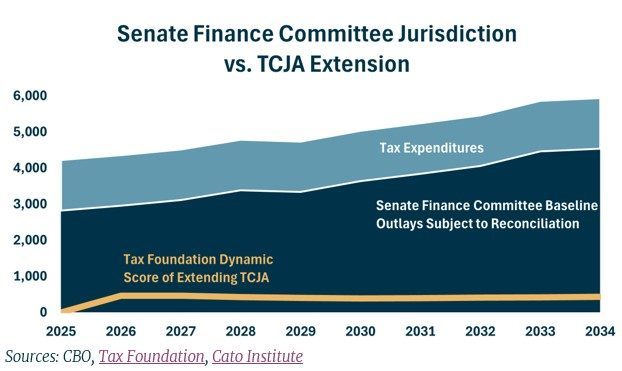
The Senate Finance Committee’s jurisdiction not only includes tax policy, but also most of the spending in the federal budget. More than 75% of the baseline spending subject to reconciliation over the FY 2025 – 2034 budget window is in the jurisdiction of the Senate Finance Committee. The next largest Senate committee jurisdiction has just a $2 trillion reconciliation baseline.
Of the $73 trillion of spending in the Senate Finance Committee’s baseline over the FY 2025 – 2034 period, more than $36 trillion in outlays are subject to reconciliation (this excludes Social Security and interest costs). The Committee’s jurisdiction includes
$900 billion or more in Inflation Reduction Act green energy subsidies, $8.5 trillion for
Medicaid and CHIP, $1.3 trillion for Obamacare subsidies, and $2.5 trillion for TANF and other welfare programs.
Reconciliation is Essential
Reconciliation is the best way to achieve the promises made to the American people.
The House and Senate have made important strides in advancing President Trump’s reconciliation legislation. The pace of negotiations must continue so that vital investments are made to secure the border and ensure national security, inflation is reduced, the 2017 tax cuts are preserved and expanded, work pays again, and the swamp is drained.