The Department of the Treasury recently released its
Monthly Treasury Statement (MTS) for December 2025, alongside The Congressional Budget Office’s (CBO)
Monthly Budget Review for the same month. Both reports contain a treasure trove of useful data on the federal government’s finance, and show concerning trends in its spending.
Deficit Watch
Government spending is worryingly high, totaling $1.8 trillion in Q1 of FY 2026, more than all spending in FY 2000. The deficit in Q1 of FY 2026 was $602 billion, more than the federal government’s total deficit in FY 2016.
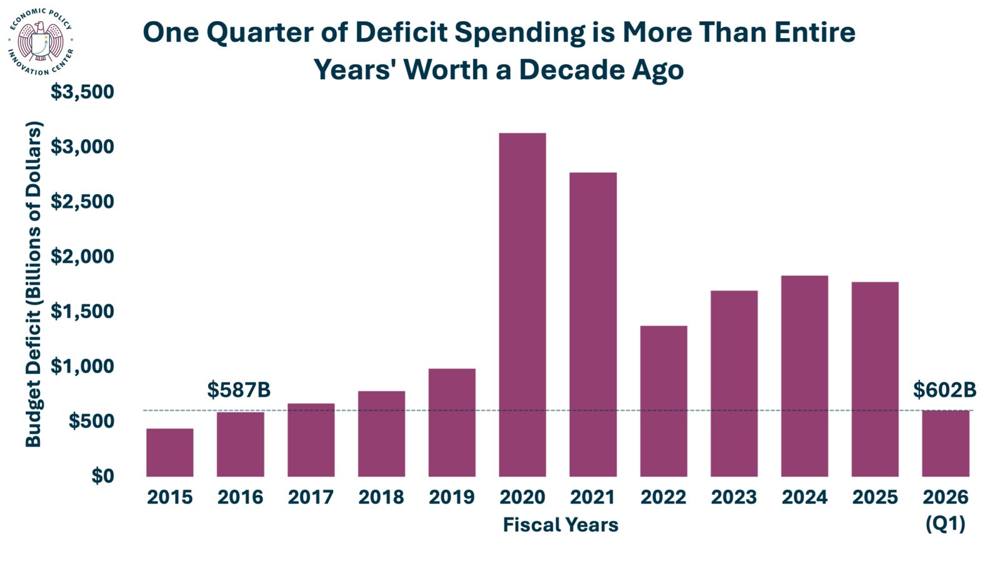
It is shocking that three months of spending produced a greater deficit than an entire year’s worth did only a decade ago. The first quarter of the fiscal year historically
tends to have lower deficits than the second quarter, meaning the deficit problem will likely grow worse in the coming months. This level of spending is not sustainable in the long-term.
Something of Interest
Interest payments on the national debt are the second largest spending item in Q1 of FY 2026, totaling $270 billion. Only Social Security spending is higher, at $402 billion.
Interest payments outpace even national defense spending ($267 billion) in Q1 of FY 2026. Interest payments first surpassed national defense spending back in FY 2024 and continued to grow in FY 2025. Interest payments for the first three months of FY 2026 were higher than interest payments for the whole of FY 2017 ($263 billion).
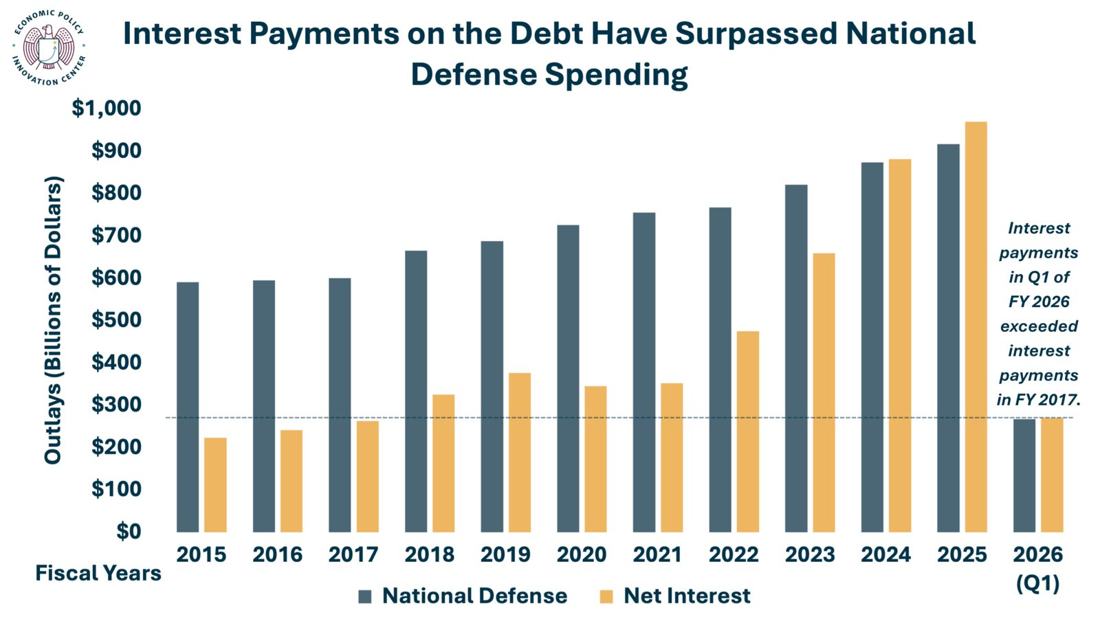
The cost of interest payments has risen dramatically as long-term interest rates have risen alongside the national debt in recent years. With the national debt currently at
$38.4 trillion, small fluctuations in the interest rates on
Treasury debt would have dramatic consequences on the government’s
spending on interest and fiscal stability. Interest rates are already
slightly higher than what the CBO projected last year.
Tracking Tariffs
Treasury reported that custom duties, including tariff revenues, collected in Q1 of FY 2026 summed to $90 billion dollars, more than the total amounts collected in many previous individual fiscal years. The CBO reported that customs duties revenue in Q1 of FY 2026 was four times greater than customs duties revenue at this time last year. Despite this, the revenue that tariffs are raising is not substantial enough to offset the deficit.
Returning to Fiscal Stability
With spending and the deficit at alarmingly high levels, it is imperative that Congress bring federal spending under control. If the national debt continues to grow, it will only reduce the amount of fiscal space the U.S. has to respond to a potential future crisis.