The annual federal appropriations process typically includes
limits on total discretionary budget authority (BA). Such limits include an important caveat: certain categories of spending are
exempt from counting towards limits.
The most important exemption is for spending designated as being an emergency requirement. Emergencies can occur at any time during a fiscal year (FY) and emergency spending rules are designed to provide legislators with flexibility.
Unfortunately, Congress has repeatedly used emergency spending designations as a budget gimmick to enable additional spending. There is also a general sense in Washington that concerns about the national debt should be ignored in the context of emergencies, which is fundamentally irresponsible.
Congress should create stronger guardrails on what qualifies for an emergency designation and ensure that emergency spending is offset over the medium term. There should also be reforms to disaster policy and the spending baseline.
Emergency, Disaster & OCO Spending Designations
Section 251 of the Balanced Budget and Emergency Control Act of 1985 (BBEDCA) establishes the procedure for adjusting discretionary spending limits based on spending designated as emergency. These designations can occur in both regular and “supplemental” appropriations legislation. If a proper emergency designation occurs, it triggers an upward adjustment to discretionary spending limits.
The
American Relief Act, passed in December 2024, was an emergency supplemental package for FY 2025 containing
$110.5 billion in spending with dozens of emergency spending provisions such as the one below.
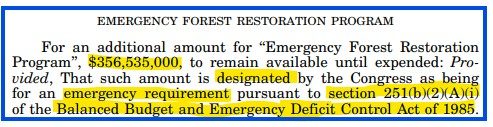
A spending provision intended to be for an emergency but lacking the proper designation language seen above would be subject to spending limits and would potentially trigger a budget point of order in Congress, or it could trigger sequestration by the Office of Management and Budget (OMB) if enacted.
The emergency designation is distinct from the “disaster relief” category. Budget deals in recent years have included annual funding for the Federal Emergency Management Agency (FEMA) Disaster Relief Fund (DRF) based on a formula. These disaster funds are permitted above the base spending caps.
Another type of emergency designation was
Overseas Contingency Operations (OCO) for spending purportedly related to the Global War on Terror. This was meant to distinguish regular national defense appropriations from temporary war activity. However, Congress eventually turned OCO into a work-around for discretionary spending caps by inappropriately designating
billions of dollars per year of regular defense spending as OCO. Members of Congress who rightly view national defense as the federal government’s primary obligation should make the case for prioritizing defense spending within existing caps rather than avoiding debate through shortcuts.
Legislators should not assume that all emergency designations occur in good faith.
In 2023, the Fiscal Responsibility Act established discretionary spending limits for the following two fiscal years. This came with a secret “side deal” of budget gimmicks for appropriators to use, one of which involved designating a portion of standard discretionary spending as an emergency. One such
fake emergency in the
first FY 2024 appropriations package was $450 million for space exploration. In total, FY 2024 appropriations contained $12.5 billion of
gimmicked emergency designations.
Accounting for Emergency Designations
While it is important for Congress to place discretionary spending limits and entitlement policy in the context of America’s
mounting national debt, there has been a failure to address the costs of emergencies.
From 1991 through 2025, Congress passed
$12.5 trillion in various forms of emergency spending, resulting in trillions of dollars in additional interest costs. Since emergency spending almost always occurs without a budgetary offset, that means emergencies and ensuing interest costs are responsible for more than one-third of the current
$38.4 trillion in gross national debt.
Congress can retain its ability to respond to emergencies while also managing the cost of the spending. One method would be to require that Congress offsets the cost of emergency spending over the course of the following three to five years, which would minimize interest costs. The
Emergency Spending Accountability Act introduced by Rep. Marlin Stutzman (R-IN) would use a
PAYGO method to offset emergency spending over a span of five years.
Preventing Abusive Emergency Designations
The OMB has a five-part test to determine whether given spending is a true emergency, using criteria such as urgency, suddenness, and being unforeseen. While BBEDCA includes
guidelines about what should qualify for an emergency designation, they are overly vague and often ignored altogether (e.g. many emergencies are not truly “unanticipated”). Emergency designations are subject to a “surgical”
budget point-of-order requiring a modest three-fifths of members to waive, yet this is rarely utilized.
Congress should create a robust rule for emergency spending qualification similar to OMB’s and strengthen the point-of-order threshold. This would make it far easier for responsible members to stop gimmicky emergency designations.
Reforming Disaster Policy
Federal spending on natural disasters has
escalated markedly in recent decades. While individual disasters cannot be predicted far in advance, certain areas are known to be at high risk while others face minimal risk. This means that low-risk areas significantly subsidize high-risk ones.
With the federal government covering 75% or more of the cost of major disaster response, state and local governments and private actors have less incentive to invest in prevention measures and response resources. State and local officials increasingly lobby for questionable disaster declarations as a way to access
“free” federal handouts, resulting in
disaster creep.
Disaster response legislation is often turned into a vehicle for unrelated and unnecessary spending. Emergency spending bills sometimes use poorly targeted programs such as the Community Development Block Grant to funnel billions of dollars of deficit spending in the general direction of disasters.
Congress should reduce the federal share of disaster spending, which could include a shift from giving states grants to providing short-term loans. Increasing the standard of what qualifies for federal disaster assistance under the Stafford Act is also overdue. Stronger budget rules would make it harder for legislators to sneak wasteful “disaster” spending into supplemental measures.
Reforming federal disaster policy would not only reduce emergency spending but also enable reductions to the discretionary Disaster Relief Fund.
Reforming the Budget Baseline
The Congressional Budget Office (CBO) baseline serves as a key benchmark for congressional budgeting. Unfortunately, the baseline is
biased in favor of higher spending. One example of this is emergency spending, which the CBO extends into future years, inflating the expected level of spending.
Congress should reform CBO’s baseline to no longer assume that temporary spending (such as for emergencies) is permanent.