Debt Limit Current Status: Suspended
The debt limit is suspended through January 1, 2025, under the Fiscal Responsibility Act. On January 1, 2025, the new debt limit will be set automatically at the amount of debt accumulated during the debt limit suspension period.
During the 19-month debt limit suspension period, the national debt is projected to grow by $3.5 trillion.
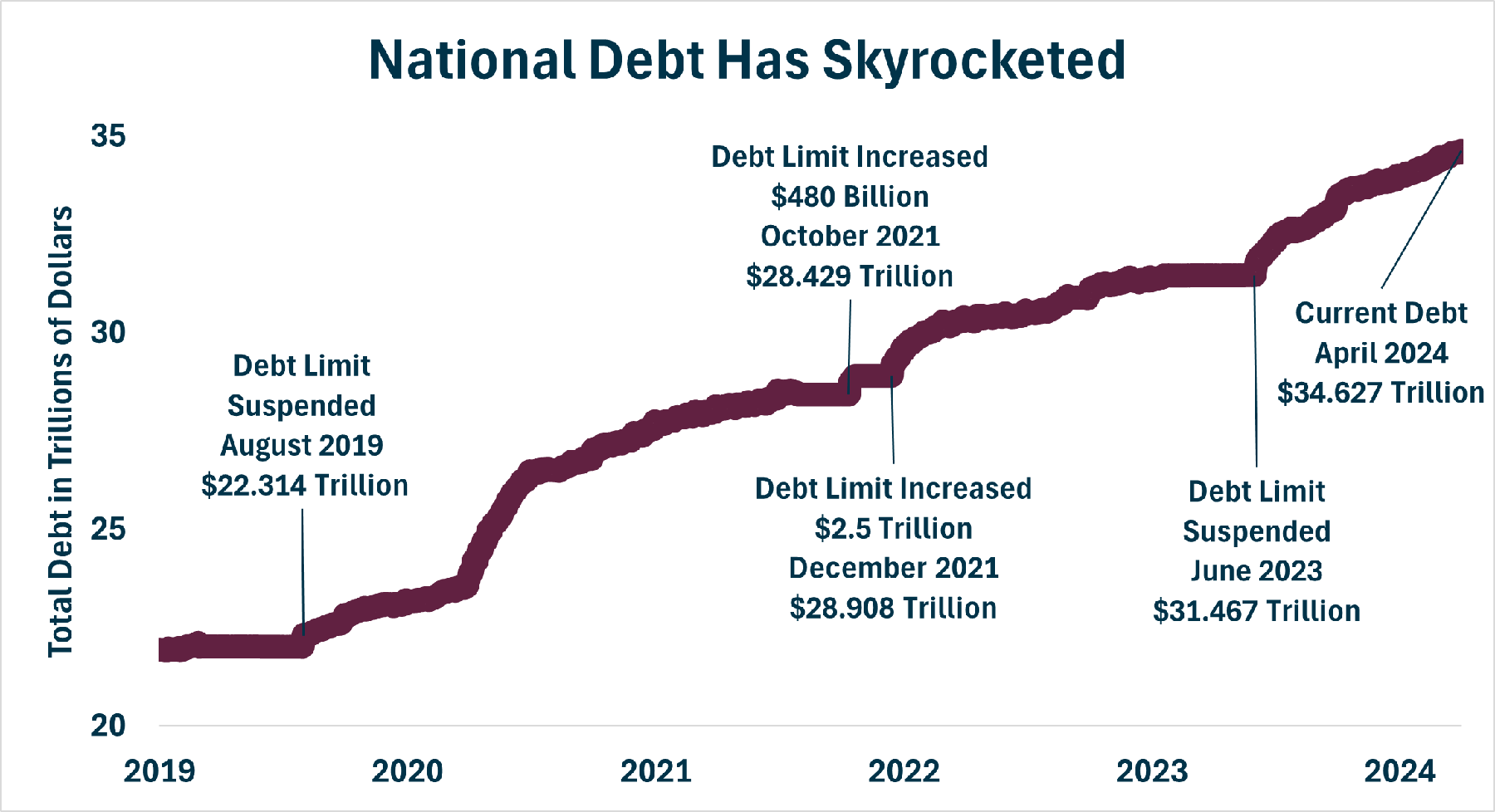
Since August 2019, the debt limit has been modified four times: two suspensions and two specific debt limit increases. Over that four-year period,
the debt has grown by $12.3 trillion. For context, the total
national debt only reached $12.3 trillion in 2010.
Extraordinary Measures
When the debt limit is reinstated on January 1, 2025, the Treasury will begin using "
extraordinary measures" that temporarily reduce certain types of intragovernmental debt in order to provide limited additional borrowing capacity.
Implementing extraordinary measures extends the timeline to the so-called "X-Date." This is the point at which the debt limit must be increased or else the government will be unable to pay all of its obligations.
The X-Date
The X-Date will likely be reached in the summer of 2025, depending on the Treasury's cash on hand balance at the end of December 2024.
Available cash, revenues, and outlays are important factors in predicting the X-Date. Revenue and outlay flows are not uniform throughout the fiscal year. February, March, May, July, and August historically have very high deficits, while April and September provide surpluses.
What Happens After the X-Date?
The Congressional Budget Office forecasts a deficit of $1.8 trillion for FY 2025, necessitating that the Treasury borrow funds to cover legally mandated spending.
If unable to borrow additional debt, the Treasury would be restricted to spending only cash on hand and incoming revenues. In such a scenario, the United States government would be
unable to pay all required outlays in full and on time, meaning it would default on some of its obligations.
The Treasury has
authority to
prioritize payments, such as principal and interest on debt. However, prioritization would present political, technical, and legal challenges. Markets and constituencies are likely to react negatively to any default scenario.
The Debt Limit Has Historically Facilitated Spending Reduction Deals
Going back four decades, successful deficit reduction deals have been tied to debt limit increases, including:
- Balanced Budget and Emergency Deficit Control Act of 1985
- Budget Enforcement Act of 1990
- Deficit Reduction Act of 1993
- Budget Enforcement Act of 1997
- Budget Control Act of 2011
- Fiscal Responsibility Act of 2023
Spending Reduction Needed to Prevent the Erosion of Fiscal Space
The government's "
fiscal space," or capacity to borrow without compromising economic stability, is essentially the true limit on the national debt.
EPIC President and CEO Paul Winfree recently projected that under the current fiscal trajectory and CBO's economic assumptions,
the federal government's fiscal space would be completely depleted within three decades, with the debt spiral beginning within the next 10 years.
It is unsustainable for government spending and debt to grow faster than the economy. The debt-to-GDP ratio is already at its highest level since World War II and is and is
expected to climb due to growing spending. Current
spending exceeds the historical average as a percentage of the economy with projections showing continued growth. Lawmakers should
reject calls to eliminate the debt limit and instead
responsibly pair any debt limit increase with reforms to grow the economy and put spending on a sustainable path.