Presidential Budget Request
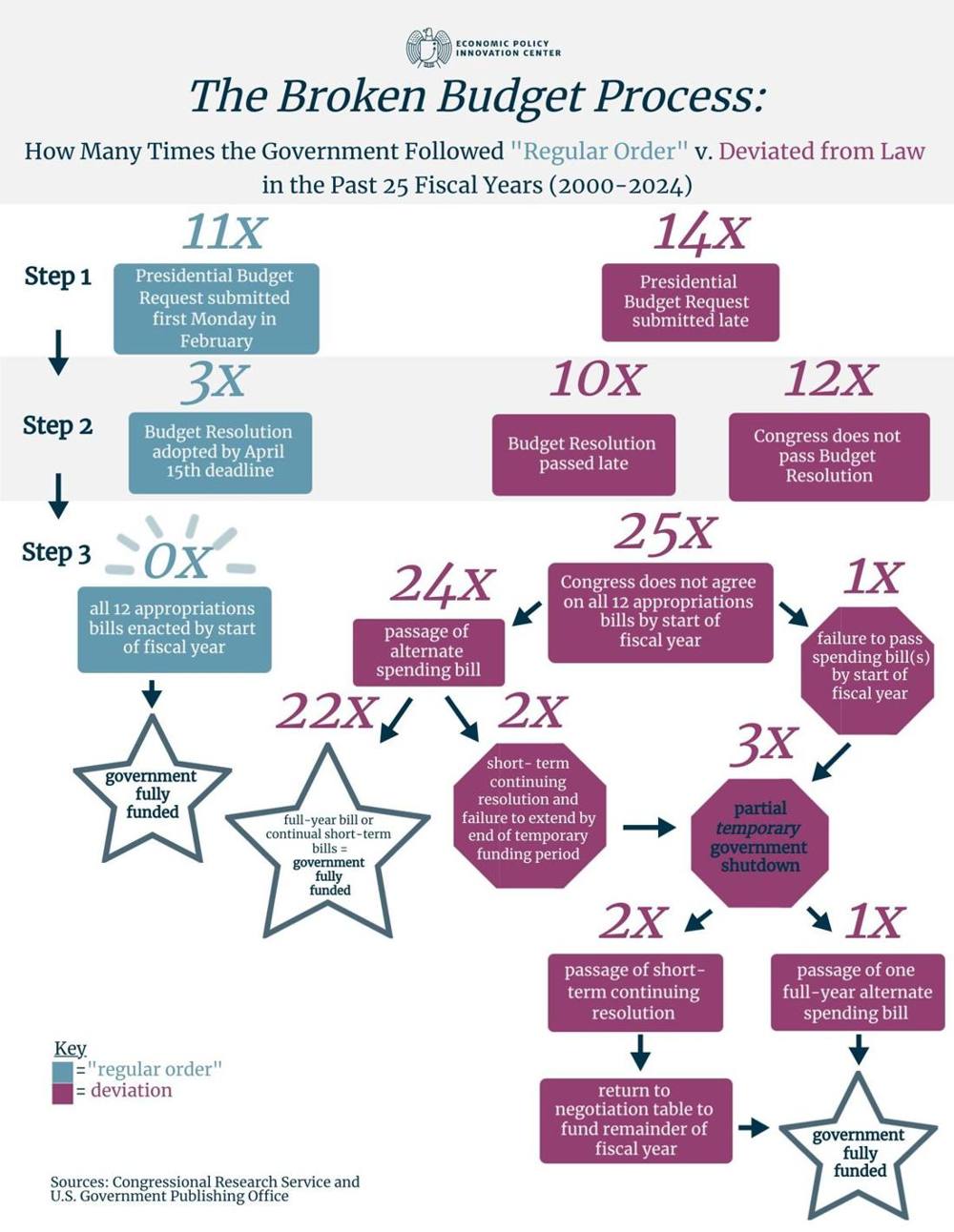
To kick off the annual budget process, the President is supposed to submit the Presidential Budget Request (PBR) by the first Monday in February. In the past 25 fiscal years, the PBR has been submitted late 14 times. Ever since the end of President George W. Bush’s presidency in 2009, the norm has been to ignore the deadline.
President Biden ranks worst for timeliness with his PBRs submitted an average of 58 days late.
Congressional Budget Resolution
After the PBR is submitted, Congress writes a
budget resolution. The budget resolution is supposed to be adopted by April 15th. In the past 25 fiscal years, this has happened only three times. Ten times Congress has adopted the budget resolution late. Twelve times Congress has not been able to agree on a budget resolution and abandoned it altogether. In its place, a deeming resolution was used to set enforceable spending levels without Congress having to agree on a budgetary plan. Since FY 2011, only five budget resolutions have been adopted; each of these was only used as a vehicle for the
reconciliation process rather than as a blueprint for federal spending.
Regular Appropriations
After top-line spending levels are set through the budget resolution or the deeming resolution, Congress is supposed to draft the 12 appropriations bills (actual spending bills) for each category of discretionary spending by the start of the fiscal year on October 1st. But the last time Congress passed all 12 appropriations bills on time was FY 1997. Instead, Congress often resorts to alternative legislation:
continuing resolutions (CR), omnibuses, continuing resolutions combined with an omnibus (CRomnibus), and minibuses. While Congress sometimes does agree on the appropriations bills for some or a few of the discretionary spending categories, like defense, it will use alternative legislation to fund the rest.
Continuing Resolutions
CRs are used most frequently when the regular appropriations bills are not enacted on time. CRs extend funding levels from the previous fiscal year for a certain amount of time – this can be between a few days to the remainder of the fiscal year. Theoretically, short-term CRs are supposed to provide interim funding while all 12 of the regular appropriations bills are negotiated and passed. In reality, multiple short-term CRs are often required. FY 2001 is a notable year with a grand total of 21 CRs passed. Short-term CRs were used to provide initial spending in all but one of the past 25 fiscal years.
Government Shutdowns
In the last 25 years, there have been three partial government shutdowns because Congress failed to enact all the appropriations bills. In FY 2014 Congress failed to pass a spending bill by the start of the fiscal year, resulting in a partial government shutdown that was eventually resolved with a full-year omnibus. With short-term CRs, Congress must eventually return to the negotiating table to pass another spending bill before expiration to prevent a mid-year government shutdown. In FY 2018 and FY 2019, the short-term CRs that initiated funding for the year expired without the passage of another spending bill, resulting in partial mid-year government shutdowns. Both were resolved with another short-term CR.
The Need for Budget Reform
Although there is indeed a lack of accountability and timeliness in Congress, the 50-year-old budget process itself is
flawed and outdated. It was not designed for present circumstances. Despite the fact that nearly three-quarters of our government’s unsustainable annual spending is not discretionary (rather it is on "autopilot"), the budget process is centered around the 12 discretionary appropriations bills, which rarely even get passed.
With quick-fix legislative tools like the deeming resolution and CR, Congress is relieved from thoroughly reconsidering the budget each year, allowing for a perpetual cycle of untamed spending. The overuse of the short-term CR exposes the reality that Congress so often puts its consequential duty of budgeting on the backburner. Our county needs a
reformed budget process that enforces accountability and facilitates the careful re-negotiation of precious American tax dollars every single year.