President Donald J. Trump signed H.R. 4, the Rescissions Act of 2025, into law on July 24, 2025. The bill included 21
rescissions totaling $9 billion. This
canceled FY 2025 budget authority for certain
foreign aid programs as well as advanced appropriations for the
Corporation for Public Broadcasting covering FY 2026 and 2027.
With the end of the fiscal year approaching and Congress likely to consider another
continuing resolution (CR) in September, a natural question is how the rescissions interact with the forthcoming CR.
Does a CR for the new fiscal year automatically incorporate the previously enacted rescissions from the current fiscal year? Or does the CR automatically extend the last spending bill, ignoring the rescissions?
The answer is: it depends how Congress drafts the CR.
A CR does not
automatically do anything. A CR is a bill that is drafted based on political and policy decisions, just like any other piece of legislation. The CR will reflect spending levels for programs in whatever way lawmakers decide to write it.
How a CR Works
Every CR includes at least four components:
- Coverage: References to one or more laws to specify which funding is being continued.
- Duration: Specifies the period of availability for the continued appropriations.
- Spending Level: Specifies the funding rate for the continued appropriations.
- Riders, Restrictions, Anomalies, and Other Provisions: Legislative language that modifies what the Executive Branch may or may not do with appropriated funds.
Coverage
The coverage of a CR specifies what funding is provided by the CR. This is often done by referencing the most recently enacted appropriations bills that Congress wants to prevent from lapsing.
[caption id="attachment_251532" align="aligncenter" width="628"]
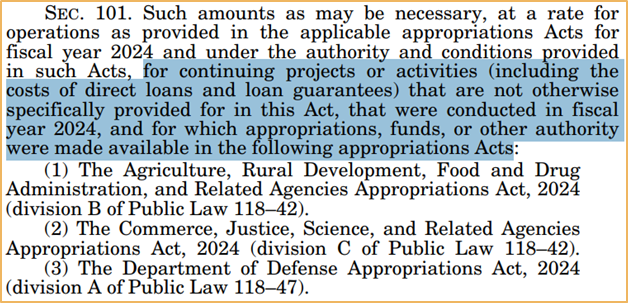
Partial list of the Coverage in the Continuing Appropriations and Extensions Act, 2025[/caption]
A CR does not necessarily need to cover all 12 of the regular appropriations bills. If some bills are covered in a CR but others are not, the government could continue operations for those departments and programs covered under the CR but “shut down” (or temporarily halt nonessential operations during the funding lapse) for those not covered.
A CR can be combined with other full year spending bills as a “CRomnibus.”
Duration
A CR can be written to allow funding until a “date certain,” meaning funding is provided to a specific calendar date written into the bill. These CRs often include language allowing the CR to be superseded by a full appropriations bill if Congress reaches a spending agreement before the provided date.
[caption id="attachment_251533" align="aligncenter" width="628"]
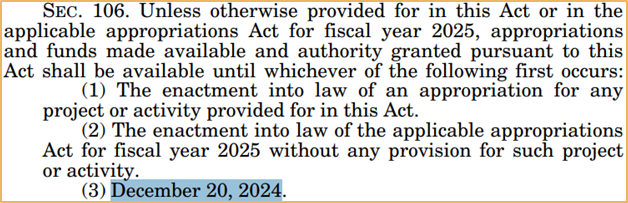
Duration in the Continuing Appropriations and Extensions Act, 2025[/caption]
Spending Level
Because the duration of a CR is usually less than a full fiscal year, funding levels are referred to in terms of the rate of annualized spending. In other words, the spending levels in a CR are shown as what the total spending would be over the full fiscal year if that rate of spending were continued for the remainder of the year.
For example, if the CR duration is one month, and the CR provides funding at a rate of $1 billion for an agency, then the agency would have access to 1/12 of the $1 billion to spend over that one month period of availability.
CRs often extend the same spending rates as the laws referenced by the coverage of the CR.
[caption id="attachment_251534" align="aligncenter" width="628"]
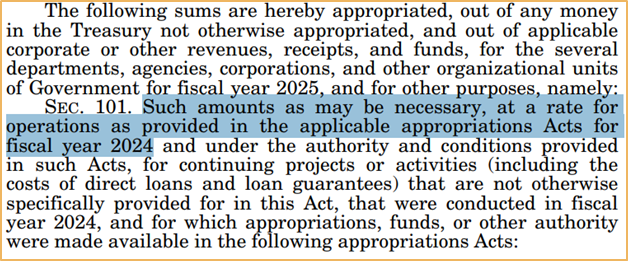
Spending Level in the Continuing Appropriations and Extensions Act, 2025[/caption]
Alternatively, a CR can provide across the board increases or decreases in spending rates. Changes in spending for specific programs can be made by anomalies.
Anomalies
A CR often includes “anomalies” that make modifications from the underlying spending bill that is otherwise being extended.
Sometimes these are simple updates, providing higher or lower spending levels for specific budget accounts based on programmatic needs. Some anomalies provide funding flexibility for agencies to access funds earlier in the fiscal year than they would otherwise under the base CR language (a common anomaly is allowing FEMA full access to the Disaster Relief Fund).
[caption id="attachment_251535" align="aligncenter" width="627"]

FEMA DRF Anomaly in the Continuing Appropriations and Extensions Act, 2025[/caption]
Anomalies can also include extensions of authorizing bills that were due to expire (an extension of TANF is a common reauthorization carried in CRs), or other provisions. Other times, the changes in anomalies can be significant policy riders.
The FY 2025 Full Year CR
The
full year appropriations bill for FY 2025 was a CR signed into law on March 15, 2025.
The full year CR followed the two previous FY 2025 CRs (the
first CR lasted from October 2024 to December 2024; the
second from December 2024 to March 2025).
Each of the three FY 2025 CRs included many anomalies, tailoring funding levels and priorities to needs for this year as an update from the prior year’s levels. Notably, the full year CR removed a rider often included in CRs that restricted the ability of the U.S. Department of Defense to engage in new starts or increase production rates.
What Will the FY 2026 CR Look Like?
Lawmakers will need to make decisions about the coverage, duration, and spending level, as well as the riders, restrictions, anomalies and other provisions that will be included in an FY 2026 CR.
Members who supported the rescission of foreign aid funding and who do not want to see the
wasteful spending restarted in FY 2026 will want to pay particular attention to the coverage of the CR and relevant anomalies. The CR could be written in ways that would either include or exclude funding for these accounts.
The Corporation for Public Broadcasting is a unique account, in that it receives appropriations two years in advance, rather than normal annual funding. Advanced funding for FY 2026 was provided in the
FY 2024 Further Consolidated Appropriations Act, while the advanced funding for FY 2027 was provided in the
FY 2025 Full-Year Continuing Appropriations and Extensions Act. Both of these advanced appropriations were canceled by the rescissions bill. The Corporation has
announced that it will begin an orderly wind-down of its operations and most operations will conclude at the end of FY 2025 when its funding expires. If additional funding for the Corporation for Public Broadcasting is included in a full year FY 2026 appropriations bill, it would be an advanced appropriation becoming available in FY 2028, more than two years after the Corporation ceased operations.
Ultimately, the CR will look however Congress decides. It is also possible that there may be a short-term CR followed by a longer-term or full-year CR rather than new appropriations bills. The same considerations for the first CR would apply to any subsequent CRs.