President Donald Trump’s new Administration is off and running at breakneck speed.
Border encounters have plummeted as the nation’s immigration laws are now being enforced. Important steps are being taken to reduce burdensome regulations and unleash American energy. The Department of Government Efficiency (DOGE) initiative is aggressively reviewing operations across the federal bureaucracy to root out waste.
While President Trump has accomplished much through executive actions in less than a month, key aspects of the America First agenda will require legislative activity to lock in lasting change.
Congress needs to support President Trump by:
The budget reconciliation process is
the way that many of these important priorities could be enacted in 2025. It will be important for lawmakers to move as quickly as possible and match President’s Trump’s energy.
But it is just as important that Congress sends President Trump
good reconciliation legislation that
accomplishes what the American people elected him to do.
Some lawmakers and commentators have expressed concerns that the reconciliation process has yet to begin moving through the legislative process. However, given the historical context of reconciliation in the first year of a new administration, President Trump’s legislative agenda
can remain on schedule — as long as negotiations
remain focused on efficiently enacting President Trump’s policy goals.
Historical Context for Reconciliation in the First Year of a New Presidential Administration
Every president since Ronald Reagan - except Barack Obama - signed a reconciliation bill into law in the first year of their new presidency.
No president has ever successfully shepherded two reconciliation bills into law in their first year. That’s not to say that President Trump won’t be the first; after all no other President in the modern era has been reelected to nonconsecutive terms.
But the fact of the matter is that the reconciliation process takes time to get right.
Signing a reconciliation bill rarely happens in the first 100 days of a new presidential administration. Only one reconciliation bill has been enacted once in the first 100 days of a new administration: President Joe Biden's American Rescue Plan Act (ARPA) of 2021, which was enacted during the COVID-19 pandemic and signed into law 50 days after his inauguration. (ARPA was
the match that lit the inflationary fire, causing inflation to rise 21% over the last four years.)
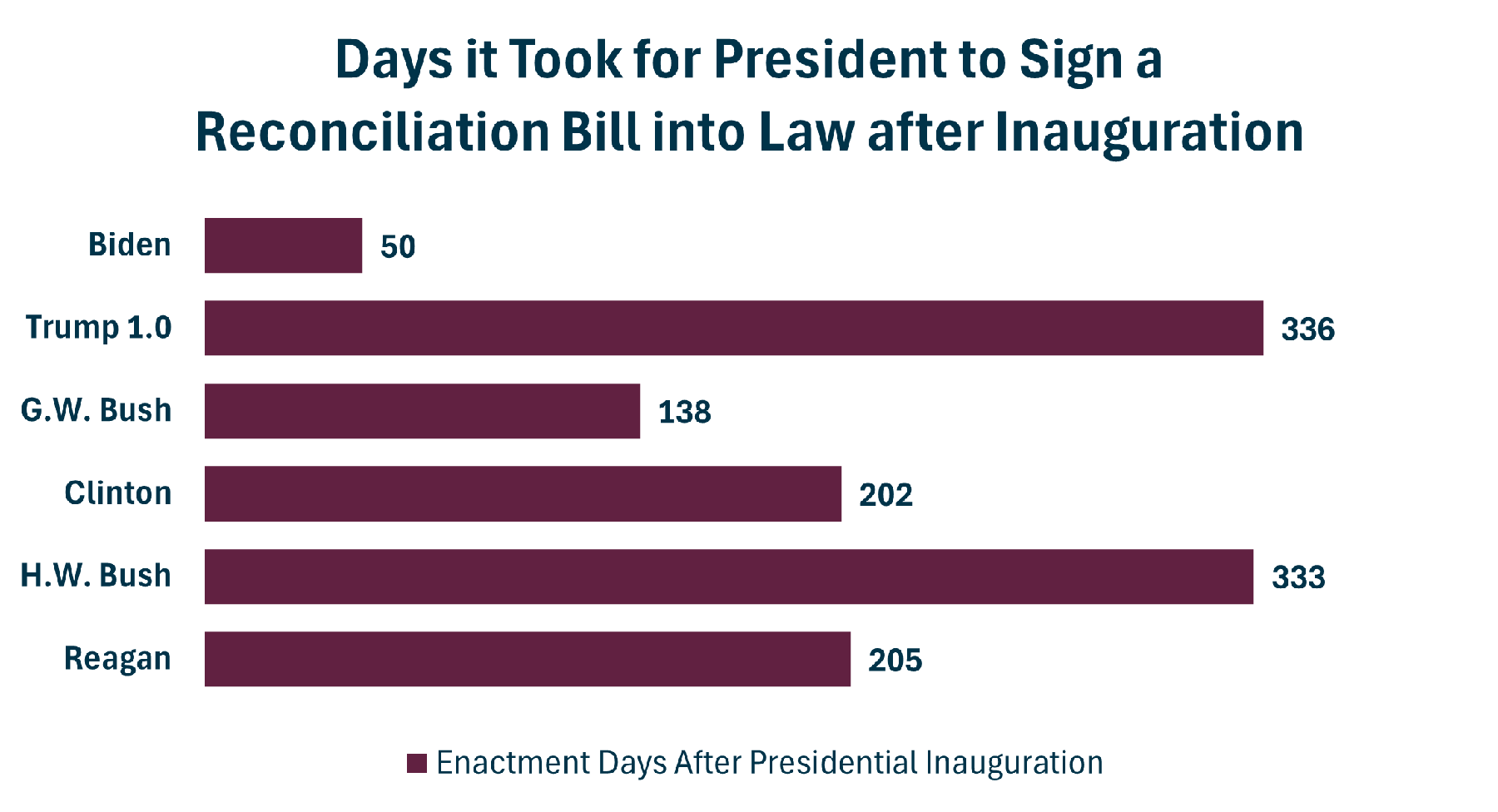
On average, it took 211 days after a presidential inauguration (228 days after the beginning of the Congressional session) for a reconciliation bill to be enacted. The longest lead time occurred during President Trump's first term, with the Tax Cuts and Jobs Act (TCJA) of 2017 being signed into law on December 22, 2017, 336 days after his inauguration (353 days after the beginning of the 115th Congress).
Adopting the Budget Resolution Takes Time
Most of the time spent by Congress on the reconciliation process is devoted to negotiating the budget resolution, which provides reconciliation instructions to House and Senate committees. Without these instructions, Congress cannot begin the reconciliation process. The budget sets the framework for the reconciliation bill.
For the six reconciliation bills enacted in the first year of a new administration, it took an average of 136 calendar days from the start of the Congressional session to adopt the budget resolution. Once the budget resolution was adopted, it took an average of 92 days for the reconciliation legislation to be signed into law.
In only two of the six cases did the time from adopting the budget resolution to enacting the reconciliation bill exceed the time it took to adopt the budget resolution from the start of Congress. (Notably, for ARPA, the time to enactment was just one day longer than the time to adopt the budget resolution.)
The quickest adoption of a budget resolution that initiated reconciliation in the first year of a presidential administration was 33 days after the start of the new Congress. This was the FY 2021 budget resolution, which enabled the enactment of ARPA under President Biden.
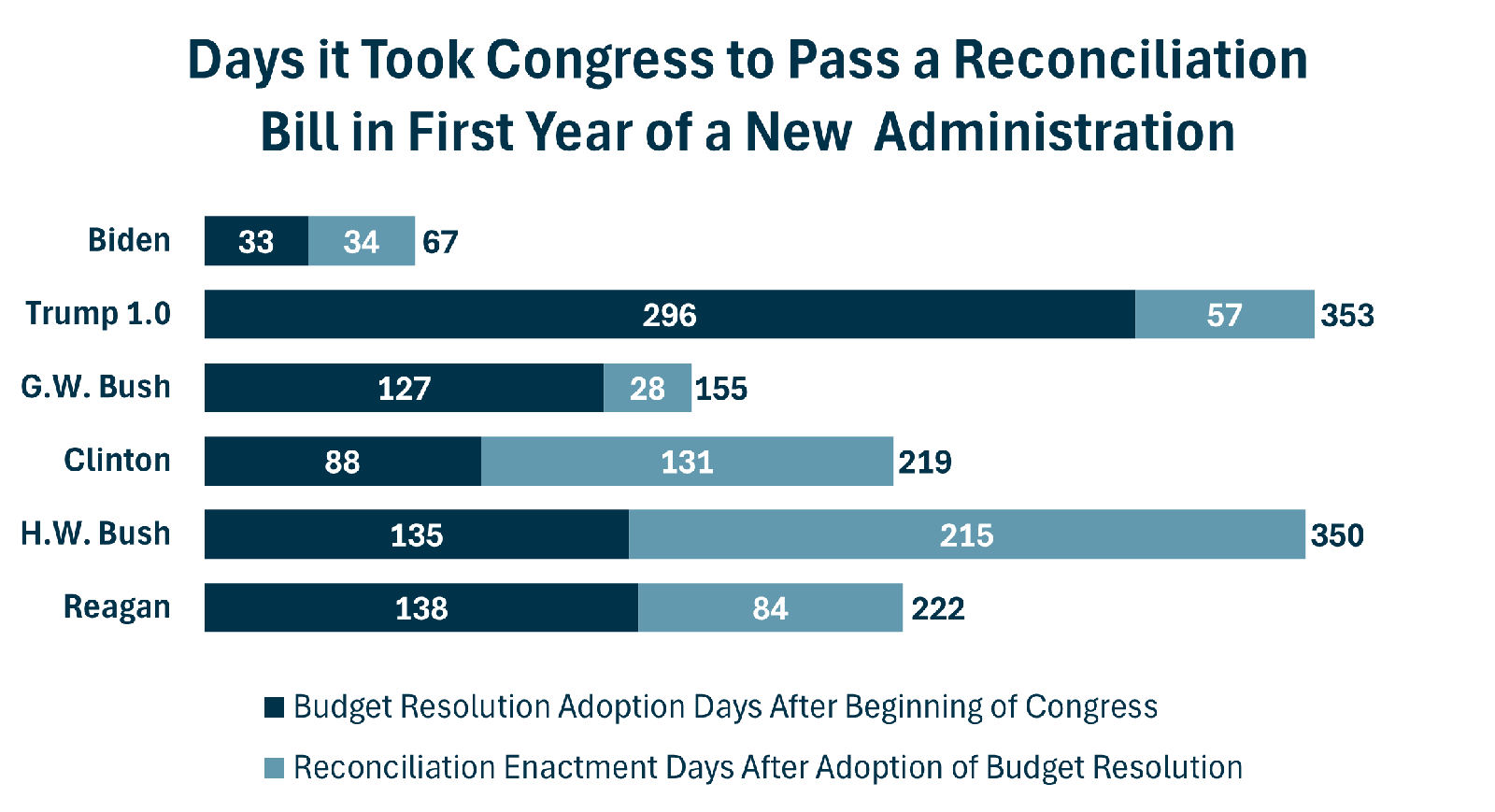
The longest it took for a budget resolution to initiate a reconciliation cycle in the first year of a presidential administration was 296 days after the start of Congress. This was the FY 2018 budget resolution, which facilitated the enactment of the TCJA under President Trump.
The Budget Resolution Sets the Framework
Once a budget resolution is adopted, the recent trend has been for Congress to quickly move on the reconciliation bill. Since 2001, the average time between adoption of the budget resolution to enactment of the reconciliation bill is just 40 calendar days.
In 2001, President George W. Bush signed the Economic Growth and Tax Relief Reconciliation Act of 2001 into law 28 days after Congress adopted the budget resolution. In 2017, President Trump signed the TCJA into law 57 days after Congress adopted the budget resolution. In 2021, President Biden signed ARPA into law 34 days after Congress adopted the budget resolution.
The Failed 2017 Healthcare Reconciliation Effort
The failed healthcare reconciliation effort in 2017 is an important case study of the consequences of a failure to achieve consensus on the goals and policies of using reconciliation.
Although no president has yet signed two reconciliation bills into law in his first year in office, this feat nearly occurred in President Trump’s first term in 2017. It also explains the "delay" in enacting the TCJA later the same year.
Before moving to tax reform, Congress first considered reconciliation legislation related to healthcare. This effort famously failed on the Senate floor after months of disagreements about both the end-goal and the policy details, resulting from a change in strategy.
Throughout 2015 and 2016, Republicans in the House and the Senate worked to pass the Restoring Americans’ Healthcare Freedom Reconciliation Act of 2015, even sending the legislation to President Obama and forcing a veto. This bill would have repealed major provisions of Obamacare. The plan was for the incoming Republican president to sign similar legislation through the reconciliation process in early 2017.
However, President-elect Trump and Congressional leaders decided in January 2017 that they would attempt to replace Obamacare via reconciliation rather than simply repealing the law. After Republicans campaigned for years on repealing Obamacare, there was no consensus on what replacement should encompass, or even if replacement was the correct policy goal.
The House and Senate adopted the FY 2017 budget resolution on January 13, 2017, the fastest reconciliation budget resolution ever in the fist year of a new administration. But the reconciliation instructions, crafted in the midst of the strategy change, were not designed for any specific reconciliation policies.
As a consequence, it took months for the House committees to produce reconciliation recommendations. The House Budget Committee reported the initial version of the reconciliation bill on March 20, 2017. It took another six weeks of negotiations before the House was able to pass H.R. 1628, the American Health Care Act of 2017, on May 4, 2017 (104 days after President Trump’s inauguration).
The bill then became bogged down by further negotiations and disagreements in the Senate. After a series of failed votes on different proposals, the final thumbs-down vote was cast on July 28, 2017 (189 days after inauguration), effectively killing the healthcare replacement reconciliation process.
Time Is of the Essence
Reconciliation will allow President Trump and Congress to
achieve many important priorities of the American people in 2025. As the historical record shows, the new Administration will face challenges in getting its agenda enacted quickly.
The 119th Congress will need to work diligently to adopt a budget resolution that sets the framework for reconciliation legislation. They will then need to move quickly through each of the
steps of the process in the House and
Senate to get reconciliation legislation to President Trump's desk to be signed into law.
Appendix: Steps in the Budget Reconciliation Process
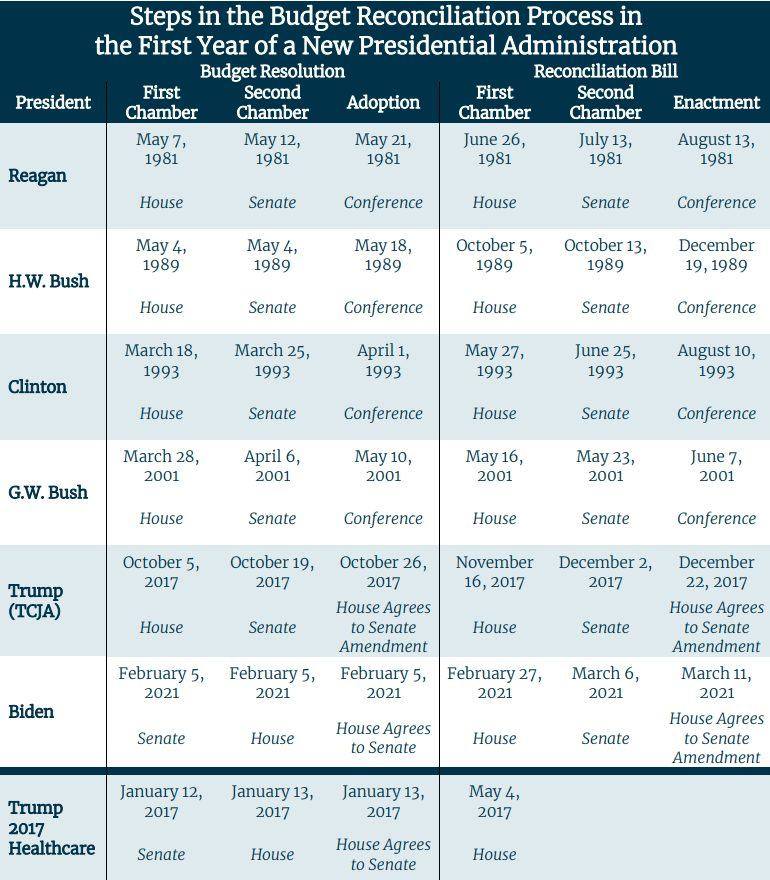 Data in this report is sourced from Congressional Research Service reports: