Medicaid Improper Payments Exceed Half-a-Trillion Dollars; Federal Government Needs to Hold States Accountable
Despite the federal government paying for about $2 out of every $3 in Medicaid spending, Medicaid programs are administered by state governments. This includes determining who is eligible for benefits (within a broad set of federal guidelines), verifying individuals' eligibility for benefits and providers' eligibility for payments, and issuing payments. When paying only one-third of Medicaid costs, states lack the incentive to properly steward taxpayers' money.
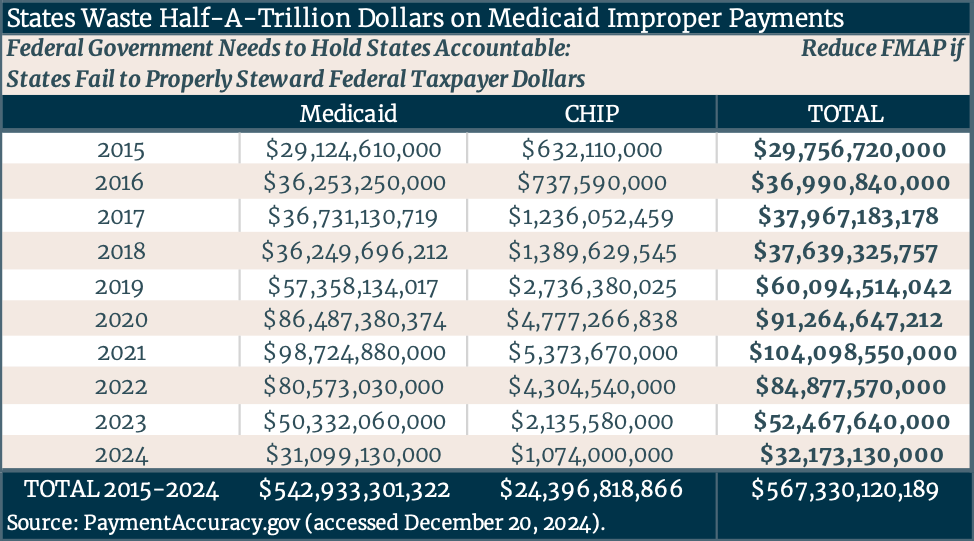
Over the past 10 years, state Medicaid programs sent out $567 billion in
improper payments which are payments sent to the wrong people or in the wrong amount. Those misspent Medicaid dollars equal $4,300 per U.S. household and are enough to provide private health insurance coverage to more than 2.2 million families or 6.3 million individuals. The
GAO’s 2024 report on improper payments in Medicare and Medicaid noted that 15 of its recommendations have not been implemented.
Incorporating Improper Payments in FMAP Would Improve Integrity & Reduce Federal Spending by Hundreds of Billions
The federal government currently pays about two-thirds of all Medicaid costs, but the exact percentage varies by state - between 50% and 83% - depending on each state’s average income. This is called the Federal Medicaid Assistance Percentage, or FMAP, and states with lower average incomes receive higher FMAPs.
To hold states accountable for excessive improper payments and improve program integrity, federal policymakers should reduce states’ FMAPs if they exceed reasonable improper payment rates. This would save taxpayers hundreds of billions of dollars.
Those savings could be used to reduce the deficit. It could also go towards
extending the 2017 tax cuts that saved the average worker $1,400 per year and the average family $2,900 per year.