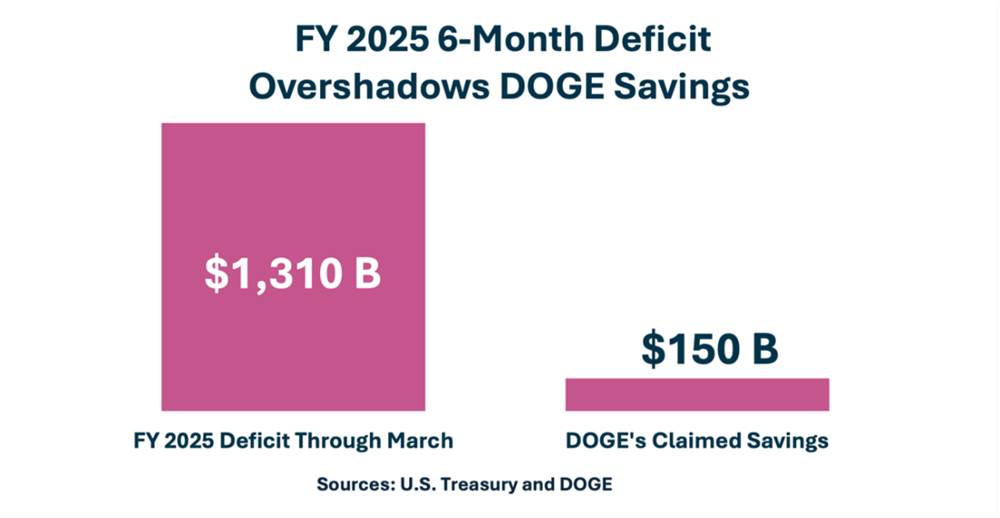
On Inauguration Day the Department of Government Efficiency (DOGE) began its mission to slash wasteful government spending. They claim to have saved an estimated $150 billion for American taxpayers so far.
But what do official spending stats show?
While results are still coming in, DOGE has been operating for two full months and may have helped produce savings in agencies listed on its
Agency Efficiency Leaderboard.
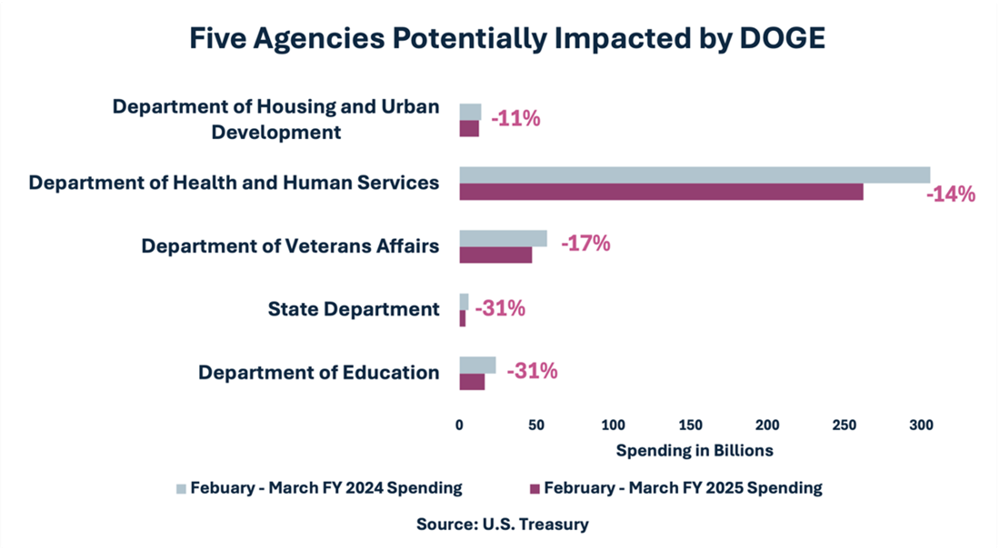
Compared to February and March of last fiscal year (FY), the monthly U.S.
Treasury Report shows that the Department of Education reduced spending by about 31%, the Department of Health and Human Services by 14%, the Department of Veterans Affairs by 17%, the Department of Housing and Urban Development by 11%, and the State Department by 31%.
While DOGE’s work is extremely important in highlighting government waste, fraud, and abuse, federal spending continues to skyrocket along with deficits and
net interest payments.
DOGE Cuts Alone Aren’t Enough to Counter Rising Running Deficits
DOGE estimates that it has saved billions through a combination of asset sales, contract cancellations, removal of fraud and improper payments, workforce reduction, etc.
However, DOGE’s purported savings are not enough to fully counter the rising tide of federal debt facing Americans. The FY 2025 6-month deficit stands at
$1.31 trillion and contributes to an overall debt level not seen since
World War II.
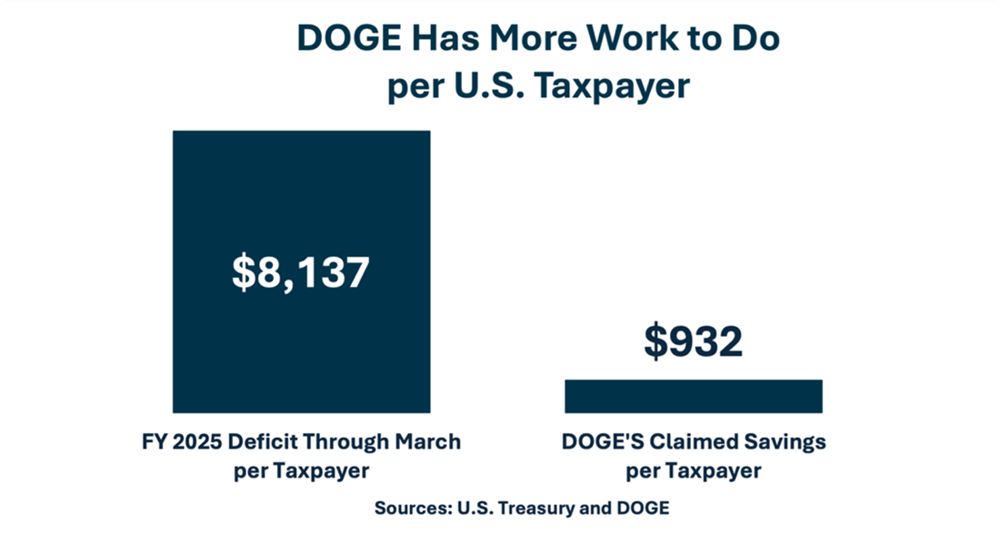
To put this in perspective, the FY 2025 deficit through March comes to a massive $8,137 dollars per American taxpayer. Meanwhile, DOGE
estimates to have saved one-tenth of that at $931 per taxpayer. This is significant progress, but shows how much more work is yet to be done.
Congress Can Enact Long-Term Changes
DOGE has done an important job of drawing attention to wasteful spending in the federal government and should continue their work. But now it’s time for Congress to step in and help continue the job.
Changes made administratively by DOGE do not carry the same potential for long-lasting changes as legislative actions do. Congress has an opportunity to partner with DOGE and use
rescissions and reconciliation to reduce wasteful government spending and avert a fiscal disaster.