PLEASE NOTE: This site is an archival resource, no longer updated as of June 1, 2026. Current questions: The Fiscal Lab.
The Federal Budget: Spending, Taxes, and Debt

The Biden COVID Credits Already Had a Three-Year Phase Down

The Federal Budget: Spending, Taxes, and Debt Policy Rapid Response BlogOctober 29, 2025 By Matthew Dickerson
The Biden COVID Credits temporarily expanded Obamacare by removing the income cap and allowing larger subsidy amounts. These expanded payments to insurance companies are scheduled to expire at the end of this year. However, some lawmakers are now calling for another temporary extension of the Biden COVID Credits to provide a phase out of the subsidies. For example, Sen. Thom Tillis (R-NC) was recently quoted as saying, “We need to eliminate the Covid-era subsidies. We just can’t do it immediately. It’s too late into the cycle. I hope that people coalesce around maybe a one-year extension and then year two ramp down.” But the end of the subsidies should come as no surprise: the current phase down has been in law for years.

The Biden COVID Credits Already Had a Three-Year Phase Down

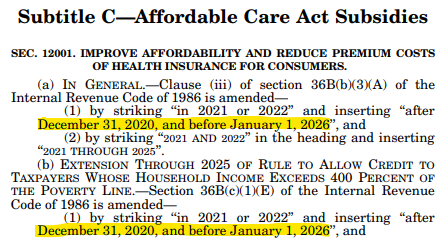
The Biden COVID Credits are already nearing the end of the three-year phase down period. The Biden COVID Credits were created by the American Rescue Plan Act of 2021 (ARPA) and were originally available for 2021 and 2022. The Inflation Reduction Act of 2022 (IRA) extended the subsidies for 2023 through the end of 2025, providing a predictable three-year phase out. Biden COVID Credit IRA Expiration 10.29.2025
Let Biden’s COVID Credits Expire as Scheduled

These payments were always meant to be temporary. The Biden COVID Credits were created on a partisan basis in 2021 and justified as pandemic era expense. Biden’s COVID Credits should expire as scheduled.  A ten-year extension would cost $410 billion including interest. Obamacare is rife with fraud, and Biden COVID Credits promote more fraud. The Biden COVID Credits controversially expand taxpayer funding for abortion and gender transition procedures. Furthermore, Obamacare premiums will increase, even if the expanded subsidies — which are sent to insurance companies, not patients — are extended.


Author

Matthew D. Dickerson

Matthew D. Dickerson

Director of Budget Policy

Matthew D. Dickerson is Director of Budget Policy at the Economic Policy Innovation Center (EPIC). Dickerson is recognized as an expert on fiscal policy issues, including the budget, appropriations, and entitlement reform. His articles have been featured in the Wall Street Journal , the Miami Herald , National Review , the Sacramento Bee , the Washington Times , the Baltimore Sun , The Hill , the Washington Examiner , and other outlets. Prior to joining EPIC, Dickerson served as Senior Policy Advisor on the staff of the House Budget Committee, where he helped lead development of the fiscal year 2024 budget resolution. He has a dozen years of experience on Capitol Hill, including as a senior staffer with the Republican Study Committee (RSC), the caucus of conservatives in the House of Representatives. Under four different RSC chairmen, Dickerson held senior level roles including Policy Director and Senior Policy Staff. Additionally, he served as Legislative Director and other policy positions for the late Congressman C.W. Bill Young (R-FL), a former Chairman of the powerful House Appropriations Committee. During his tenure at The Heritage Foundation, Dickerson was Director of the Grover M. Hermann Center for the Federal Budget. In this capacity, he oversaw a team of budget analysts and economists researching diverse subjects including spending, entitlements, budget process, tax, labor, pensions, and infrastructure issues. He has also been a Policy Manager at Americans for Prosperity, where he supervised a team of fellows and analysts covering a variety of federal and state policy issues. Dickerson is a graduate of the College of William and Mary in Virginia and holds a Bachelor of Arts in Government and History.

More from Matthew D. Dickerson →

← All work