Since the Founding, the federal government’s budget process has gradually evolved in response to contemporaneous events and challenges.
Today, the basic structure of the budget process is governed by the
Congressional Budget Act of 1974.
However, Congress and the Executive Branch have shed, either formally or informally, many aspects of the 50-year-old Congressional Budget Act.
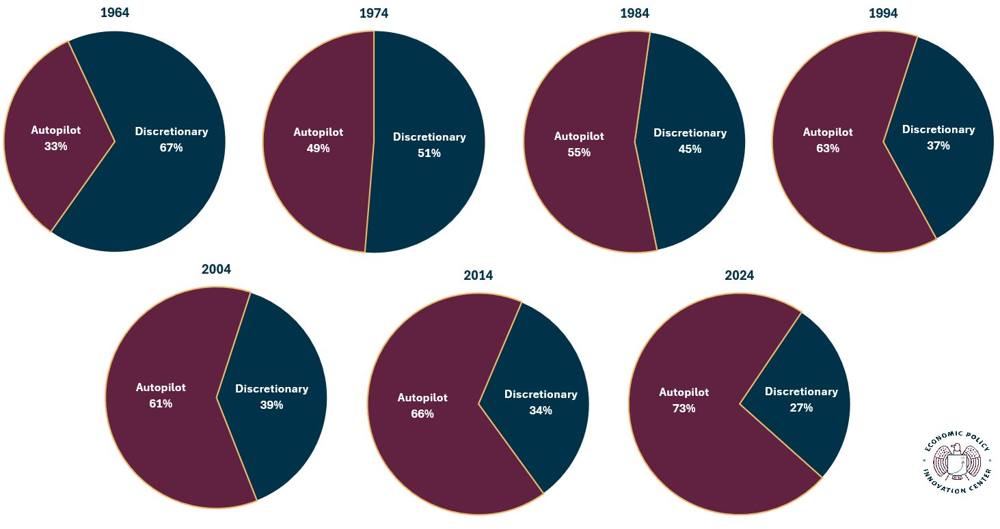
Notably, fiscal year 1974 was the last year where discretionary outlays comprised a majority of total spending. In the context of the experience of those who created the Budget Act, it was logical that the new process they were establishing would be
centered around completion of the regular appropriations bills.
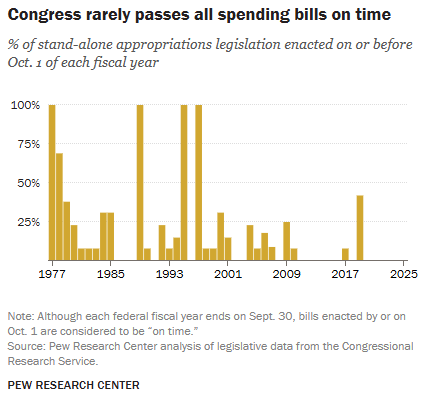
Despite the Budget Act’s driving focus on completing the annual appropriations process, Congress did not follow through. There was never some mythical time when the appropriations bills were consistently enacted on time. According to data compiled by the
Pew Research Center, all of the regular appropriations bills have been enacted by the start of the fiscal year only four times in the last five decades.
Moreover, appropriations spending has become less important in the context of the overall budget. Since 1974,
autopilot spending has exploded and is projected to continue growing under current law. Today, discretionary outlays make up less than a third of total spending.
An important lesson to be learned by budget process reformers is that overly prescriptive procedures, such as those in the 1974 Budget Act, are unlikely to be sustainable.
In general, the process by which budgeting occurs should be less prescriptive about the individual steps that must be followed by lawmakers. The modern legislative process is not a boardgame that will be orderly followed from square to square. Any budget process that relies on a complicated calendar or numerous required sequential steps is a process set up to fail.
As EPIC President and CEO Paul Winfree has
written, “When the budget process has been successful, the structure does not have material effects on the actual outcomes. As many budget analysts have said over a long time, process does not guarantee outcomes.”
The budget process may not be able to dictate detailed policy outcomes, or even predict all the steps necessary to arrive at the end goal. But a successful budget process should help point lawmakers towards a shared understanding of the north star that policymaking should strive towards.
The budget process should establish guardrails around the debate and light waypoints to help guide the way towards fiscal sustainability.
Rather than focusing on the exact steps that future Congresses would be expected to follow every year, today’s policymakers should be incentivized to address the unsustainability of federal spending.
Congress and the President should set responsible and enforceable budgetary targets. Policymakers should then have flexibility on how to use their time and resources for how to meet those overall targets.
Additional Resources: