The most recent data for July 2024 from the Bureau of Labor Statistics reveals 2.9 million missing workers. That is, if the employment-to-population ratio were the same today as it was before the COVID-19 pandemic in February 2020, 2.9 million more people would be employed today.
About 1.3 million of those missing workers are the result of increased unemployment, with a recent jump in the unemployment rate from 3.5 percent at the start of the pandemic—and where it was one year ago in July 2023—to 4.3 percent today.
The majority of missing workers, however, are neither working nor looking for work, and that does not seem to be caused by a lack of jobs. There are still about one million more job openings than there are unemployed people looking for work. Moreover, the
National Federation of Independent Businesses reports that 38 percent of small businesses have job openings that they are unable to fill, and 29 percent of small businesses say that labor quality (19 percent) or labor costs (9 percent) are their top business problems.
So, who are these missing workers?
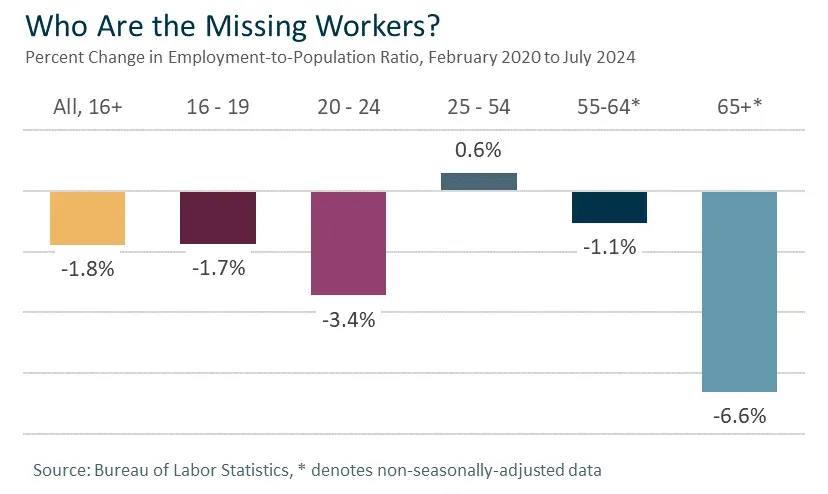
Workers 65 and older have experienced the largest percentage point decline in employment.
A study that examined home prices and labor force participation concluded that “the Great Resignation among older workers can be fully explained by increases in housing wealth.”
While some workers have been retiring earlier than expected, many young people are failing to launch into the workforce. Employment among Americans ages 20 to 24 is 3.4 percent lower today than in February 2020. Combined with the fact that post-secondary education enrollment is
still down 4.2 percent compared to the spring of 2020, this increase in apparent idleness among young Americans who should be gaining education and experience is particularly troubling.
Employment among prime-age workers (ages 25 to 54) is up 0.6 percent since February 2020. Compared to the peak employment at the turn of the 21
st Century, primage-age employment today is about 1.1 million lower than in 2000.
After about 1.5 years of positive employment trends for individuals ages 55-64, older workers’ employment turned negative in recent months, with the 55-64 population’s employment currently 1.1 percent lower than in February 2020.
Some of the reasons for employment declines are societal, including problems like the opioid epidemic and physical and mental health issues limiting individuals’ work capacity, and shifts from productive to non-productive activities resulting from
technology-enabled distractions.
Other reasons include poor government policies that restrict education and employment opportunities, and which discourage work instead of helping people gain independence and empowerment through work. The consequences of these poor policies are multifold, reducing personal and societal wellbeing, and exacerbating government’s fiscal imbalances.
As explained in
a recent EPIC report, a typical working American pays about $1,400 per month in employment-based taxes while a non-working individual without dependents can consume about $2,800 per month in welfare payments. Combined, that’s $4,200 per month in lost work-related tax revenues and additional government spending.
Considering the demographics of missing workers, policymakers should focus on expanding alternative education opportunities, like
apprenticeships—including reversing the Biden-Harris Administration’s
three strikes against apprenticeships—and allowing flexible work opportunities to grow and flourish.
As the Federal Reserve’s actions to reverse
government deficit-induced inflation are contributing to an increase in unemployment, policymakers should get the
federal government’s fiscal house in order.
And policymakers can improve personal and societal wellbeing and the government’s fiscal situation by making work pay. That includes
more effective work-oriented welfare and workforce systems, and reforming particularly egregious programs like
expanded food stamps that simultaneously drive up government spending and discourage work.