The United States Department of Agriculture (USDA) issued a
memo to state Supplemental Nutrition Assistance Program (SNAP) agencies on October 10, 2025, stating “if the current lapse in appropriations continues, there will be insufficient funds to pay full November SNAP benefits for approximately 42 million individuals across the Nation.”
This situation results from the lapse in appropriations for the Food Stamp program. It is unrelated to the program integrity or work requirement enforcement provisions of the
One Big Beautiful Bill (OBBB).
Authorization and Appropriation
Spending programs are supposed to first be authorized. The authorization sets the program parameters, such as who is eligible for what types of benefits and which government agencies administer the program.
However, no are available to be spent until the agency receives an appropriation that provides budget authority. The
authorization for the Food Stamp program is “subject to the availability of funds appropriated.” The USDA is
required to limit benefit payments “to an amount not in excess of the appropriation for such fiscal year.”
Appropriated Entitlement
Food Stamps are
considered an “
appropriated entitlement” program. This means funding for benefits must be included in the annual appropriations bills.
The
FY 2024 appropriation for the program was included in the Consolidated Appropriations Act. The
FY 2025 appropriation was included in the full year continuing resolution (CR).
Because a CR for FY 2026 (or the normal FY 2026 Agriculture Appropriations bill) has not been enacted, the appropriation and the authorization for the Food Stamp program have lapsed.
Contingency Funds
The Food Stamp program has about $6 billion in contingency funds available. The
FY 2024 and FY 2025 full year appropriations bills each provided $3 billion that were “placed in reserve for use only in such amounts and at such times as may become necessary to carry out program operations.” The contingency funds are multi-year appropriations: the funds appropriated in FY 2024 are available through FY 2026 while the funds appropriated in FY 2025 are available through FY 2027.
A recent USDA
memo states:
“Contingency funds are not legally available to cover regular benefits… SNAP contingency funds are only available to supplement regular monthly benefits when amounts have been appropriated for, but are insufficient to cover, benefits. The contingency fund is not available to support FY 2026 regular benefits, because the appropriation for regular benefits no longer exists.”
Monthly Benefits Costs
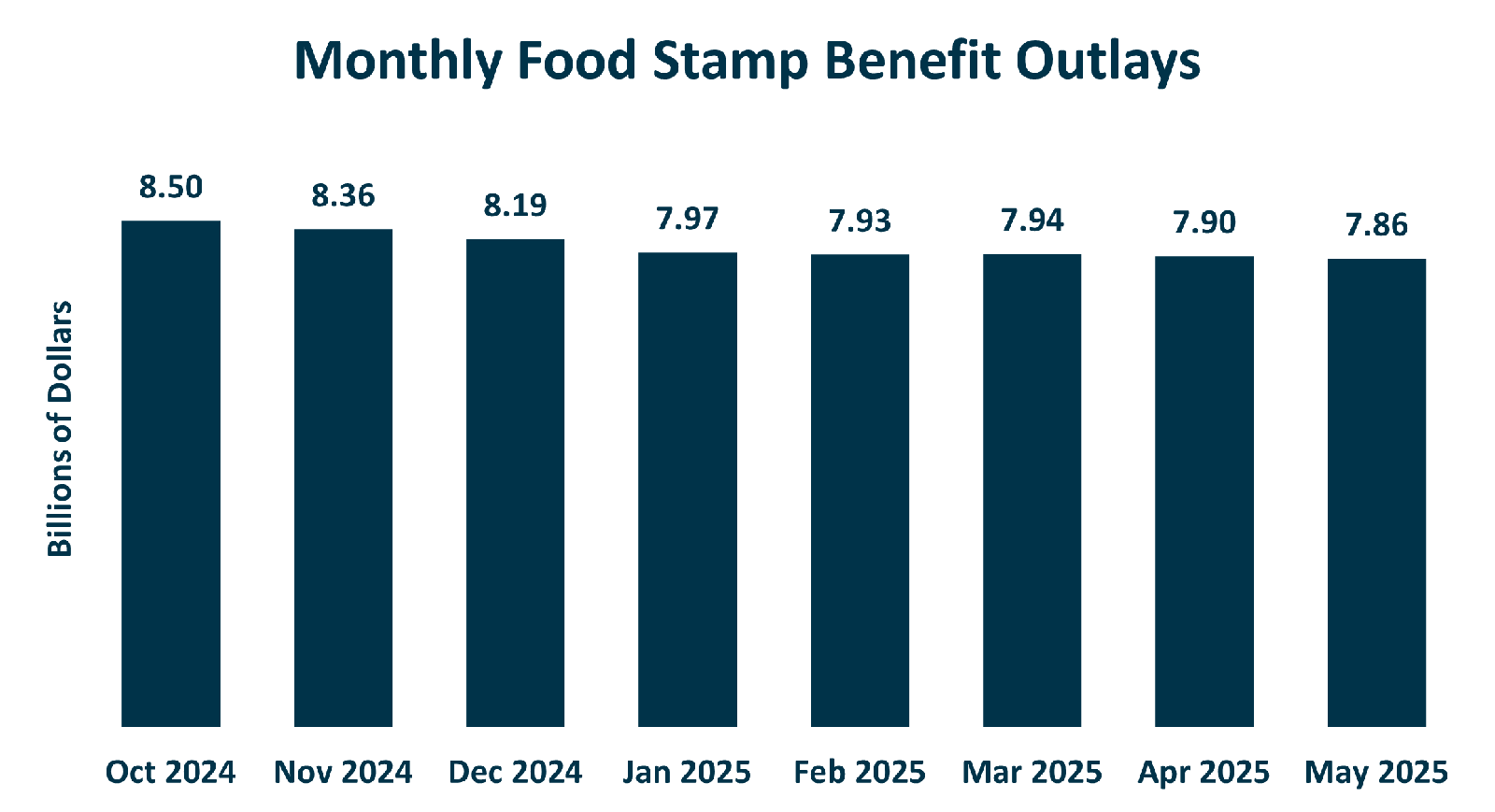
The Food Stamp program spent $106 billion in FY 2025. Monthly benefit outlays averaged $8 billion (through May 2025, the latest
data available from USDA). This means the available contingency funds would not cover a full month of benefits, even if they were available for that purpose.
Local Communities Providing for the Vulnerable
Charities, local governments, and states are stepping in to assist their communities during the shutdown.
For example,
Virginia Governor Glenn Youngkin has taken executive action to provide emergency hunger relief.
Louisiana Governor Jeff Landry announced a plan to invest $150 million of state funds to provide food assistance and signed an
emergency declaration responding to the Schumer Shutdown. The
San Antonio Food Bank and the
Central Texas Food Bank in Austin announced additional efforts to extend aid to those in need.
Second Harvest of the Big Bend in Tallahassee, Florida is preparing emergency food distribution efforts.
The USDA
said that states may not be reimbursed for benefit payments made in the absence of appropriations.
Sen. Josh Hawley (R-MO) has
introduced legislation to fund Food Stamp benefits during the FY 2026 shutdown.
For additional background on Food Stamps, see the EPIC Food Stamps Resource and the EPIC Report, Food Stamps: A Culture of Dependency.