WHAT ARE FOOD STAMPS?
Food stamps were first introduced as a means to combat food insecurity during the Great Depression. In the 1960s, food stamps were re-introduced. Subsequent years saw a significant expansion of the program. The food stamp program is now the second largest welfare program, trailing behind only Medicare.
In 2008, the program was officially renamed the “Supplemental Nutrition Assistance Program (SNAP).” What began as a temporary social safety net for the most vulnerable among us transformed into a bloated government welfare program that costs American taxpayers more than $110 billion a year, has created a significant welfare dependency problem, and continues to increase government spending to unsustainable levels.
WHAT DO WELFARE RECIPIENTS BUY WITH FOOD STAMPS?
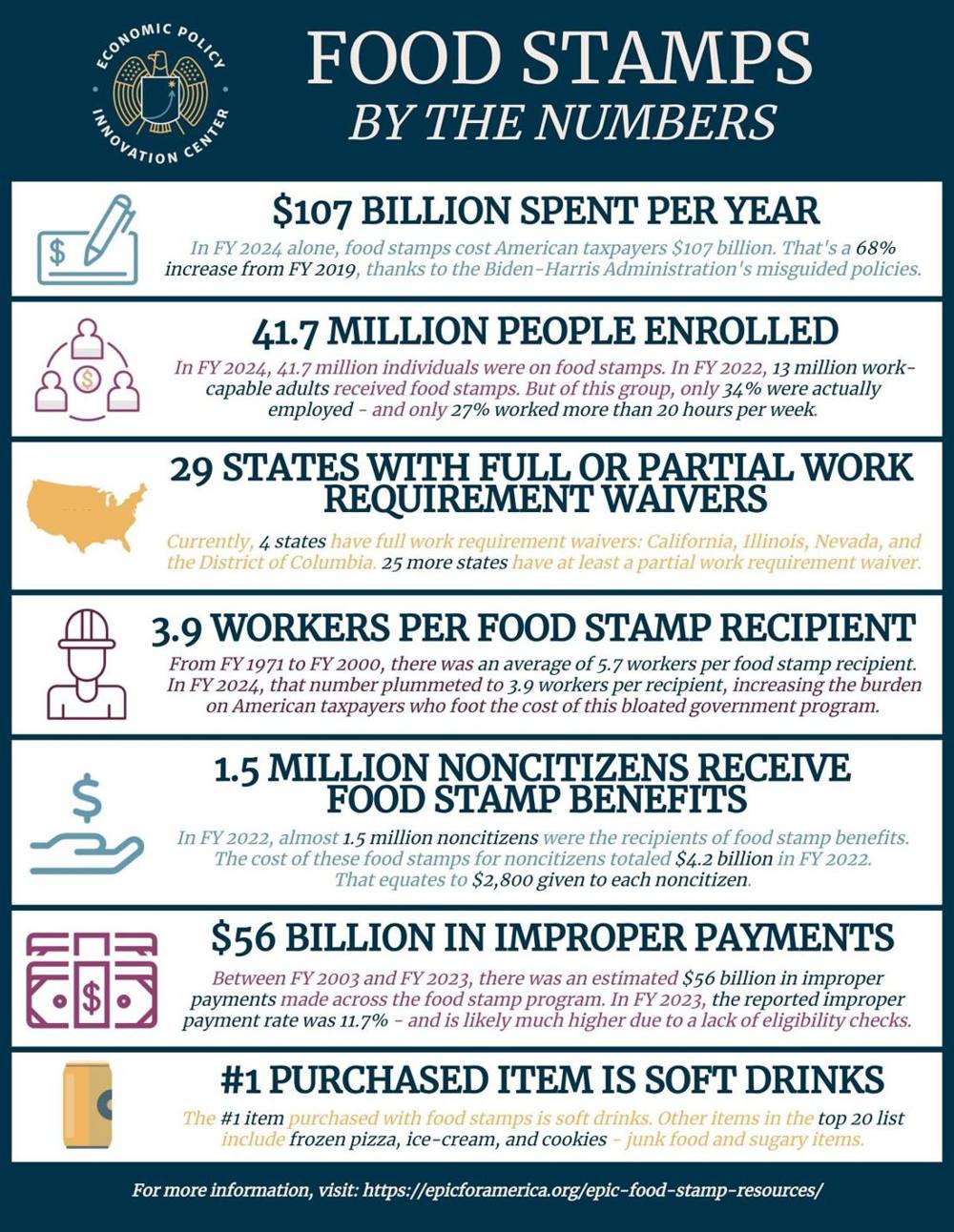
Although the official program title contains the word “nutrition,” food stamp purchases are often anything but nutritious. Many recipients utilize food stamps for what is widely considered to be “junk food.” Among the top twenty most-purchased items by food stamp recipients are bag snacks, candy, frozen pizza, ice cream, and cookies. The most purchased item with food stamps?
Soft drinks. This allowance for junk food negates the intent of the food stamp program to enable individuals to purchase food to nourish them in a time of need.
WHO RECEIVES FOOD STAMPS?
The food stamp program has
massively expanded since 2001. In 2001, 17.3 million individuals were enrolled in the food stamp program. By 2024, that number had surged to 41.7 million – a 141 percent increase. Further, as a percentage of the population, food stamp enrollment has more than doubled, from 6.1 percent in 2001 to 12.3 percent in 2024.
How did this happen? Eligibility requirements have been eased and benefit payments increased. The federal government has pushed states to enroll more recipients on food stamps, including by waiving requirements for work, income, and asset limits. As a result, more and more of the American population is reliant on food stamps, increasing the burden on American taxpayers. In FY 2022, 13 million work-capable adults received food stamp benefits. Of this group, 66 percent of these able-bodied adults did not work at all. Only 34 percent were employed.
Most notable is the growth in the participation rate of able-bodied adults aged 18-49 without dependents (ABAWDs). In 2002, 37.9 percent of eligible ABAWDs received food stamp benefits. The USDA now estimates that 100 percent of ABAWDs were on food stamps by FY 2022 (the latest data available).
Only
16 percent of the 3.6 million ABAWDS worked the 20 or more hours per week needed to satisfy the work requirement through employment in FY 2022 (the most recent data available). This means that 84 percent of those who are supposed to be subject to the work requirement did not work enough hours. Why aren’t the able-bodied recipients working? Because food stamp work requirements are limited and weak.
Between FY 1971 and FY 2000, there were an average of
5.7 workers for every food stamp recipient. By FY 2024, that number had diminished to 3.9 workers per recipient. This means that American workers are shouldering the expenses of those who, in many cases, are not working, while also struggling to support their own families.
While the sheer number of food stamp recipients is growing, so is the long-term dependency on this government benefit. For those on food stamps in 2017 and 2018, 58.6 percent had been receiving benefits for more than a year, with 47.6 percent for 20 or more months. Only 10.7 percent had been receiving food stamps for a short-term of four months or less. This is a troubling statistic that undermines that original purpose of the food stamp program as a way to help needy individuals get back on their feet.
WHAT DO FOOD STAMPS COST?
The Congressional Budget Office (CBO) projects that the number of impoverished people in the United States will increase by 14 percent between FY 2019 – FY 2025. In that same period, food stamp spending is expected to increase by a whopping 73 percent.
Again, much of this drastic increase can be directly attributed to the misguided welfare policies of the Biden-Harris Administration. In 2021, without explicit Congressional approval, the Biden-Harris Administration unilaterally increased food stamp benefit payments by increasing the “Thrifty Food Plan,” used to calculate allotments by 21 percent
above inflation. This was the
largest increase in monthly benefits since the inception of the program. Additionally, the American Rescue Plan Act increased the maximum food stamp benefit by 15 percent through September 30, 2021.
The result? Taxpayer costs skyrocketed from $19 billion to $107 billion between 2001 and 2024, or a $88 billion increase. Due to the Biden-Harris Administration, the federal government is projected to spend $110 billion on food stamps in FY 2025 under current policy. That’s a 73 percent increase from FY 2019. The CBO baseline is also now $394 billion higher than the FY 2025 to FY 2034 period than an extrapolation of the pre-Biden CBO baseline that was published in February 2012 - a 54 percent increase in spending on food stamps.
ELIMINATE WASTE, FRAUD, AND ABUSE IN FOOD STAMPS: KEY STEPS IN IMPLEMENTING REFORMS
Reforms are necessary to bring the food stamp program back to its original intent, promote opportunity, and eliminate the widespread waste, fraud, and abuse. Below are key areas where reforms would right-size the program and slow the growth unsustainable spending, thereby reducing the burden on American taxpayers and achieving better outcomes for the most vulnerable Americans.
Congress
Strengthen Work Requirements
Work requirements are currently waived in all or parts of 29 states across the country, with
full statewide waivers for these requirements in California, the District of Columbia, Illinois, and Nevada. The waivers are in effect despite modest unemployment rates and 7.6 million job openings.
Congress should
strengthen food stamp work requirements by including all work-capable adults, eliminating geographic waivers, expanding the age applicability, and phasing up the hours of expected effort. Eliminating waiver gimmicks would protect taxpayers, preserve limited resources for the needy, and, most importantly, help millions of work‑capable adults reconnect with the labor force.
Keep Food Stamps Only for the Needy by Ending the Loopholes
The
Broad-Based Categorical Eligibility (BBCE) loophole allows states to ignore the food stamp program's own income and asset eligibility guidelines. Ending BBCE would reserve food stamps for the truly vulnerable.
Prohibit Food Stamps for Noncitizens
The food stamp program provided benefits to 1.465 million noncitizens in fiscal year 2022. These nearly
1.5 million noncitizens collected a total of $4.2 billion in food stamp benefit payments.
Long-standing public charge policies of the United States have expected immigrants to be self-sufficient and not reliant upon government benefit programs when they enter our country. Despite the public charge doctrine, the federal government provides billions in benefits each year to noncitizens, including illegal aliens. The Biden-Harris Administration also abused loopholes in the food stamp program to confer “status” to millions of illegal aliens, enabling them to be qualified for welfare programs as part of their Administration’s catch-and-release agenda. The CBO estimated that the surge in illegal immigration from Biden’s border policies will cause $15 billion in food stamp benefits to be paid to illegal aliens and their children.
Implement a State Cost Share
Food stamps are fully funded by the federal government, but the program is administered by the states. Introducing
a matching requirement, whereby state governments eventually bear half of the program costs, would encourage states to take a more active role in reducing dependency and improving program management. A state cost sharing requirement would not reduce or change total benefit spending on food stamps, but the reform would achieve needed savings for the federal government as states begin to pay their fair share.
Prevent Permanent Dependency for Work-Capable Adults
A reasonable lifetime limit on the time that able-bodied adults can remain on food stamps should be implemented, similar to the cap under Temporary Assistance for Needy Families (TANF).
United States Department of Agriculture (USDA)
Curtail the Regulatory Loopholes
Regulations and guidance implemented by the Clinton, Obama, and Biden Administrations have created and expanded
loopholes in the food stamp program. These loopholes have weakened work requirements and even allow states to ignore statutory income and asset requirements. The USDA must work aggressively to roll back this Executive overreach and enforce the law.
Roll Back Biden’s Unilateral Benefit Increase
Because the Biden Administration’s 2021
“reevaluation” of the Thrifty Food Plan (TFP) was done unilaterally via executive action, the USDA can fix the problem independently. The USDA should rescind the Biden benefit increase and reset the TFP to what it would currently be had it grown only with inflation (as measured by the chained Consumer Price Index for Food at Home) since 2021.
Require States to Clean Up the Rolls
The USDA should hold states accountable for correctly administering the food stamp program.
Secretary Brooke Rollins has already announced guidance to restrict illegal aliens from receiving access to federal benefits including the food stamp program, which is a strong start to implementing necessary reforms within the program.
States
Enforce Work Requirements
States must enforce and strengthen work requirements to incentivize work and enable the food stamp program to be a temporary solution instead of a long-term dependency.
Enforce the Income and Asset Limits
In FY 2024, 44 states and territories provided
BBCE for food stamp eligibility. Many of these states allow participation for households with gross income of 200 percent of the federal poverty line (versus the 130 percent limit in the underlying law) and completely waive the asset limits. This can even allow lottery winners and
millionaires to receive food stamps. States should instead enforce the law’s eligibility requirements and reserve welfare for the most vulnerable.
Make Food Stamps Healthy
States can request waivers to control what can be purchased with food stamps, eliminating junk foods that can contribute to diet-related illnesses. Governors from West Virginia, Arkansas, Idaho, and Indiana have
recently announced they would be requesting waivers from the USDA to ban the purchase of candy and soft drinks with food stamps. Agriculture Secretary Brooke Rollins and Health and Human Services Secretary Robert Kennedy both applauded the move.
Stop Improper Payments
The food stamp program makes billions of improper payments each year. The USDA has reported more than $56 billion of improper payments between FY 2003 and FY 2023. The reported improper payment rate was 11.7 percent in 2023. The actual amount of improper payments is likely significantly higher than that reported amount, due to a lack of eligibility checks and pandemic-era expansion. The 2014 Farm Bill instructed USDA to ignore improper payments below a $54 “tolerance threshold.”
Many states have astonishingly large overpayment rates. In fiscal year 2023, overpayments accounted for 59.6 percent of food stamp payments in Alaska, 33.5 percent in New Jersey, and 21.9 percent in South Carolina. All states should take their responsibility to stop improper payments within the program seriously.