
Implementing a Food Stamp State Cost Share
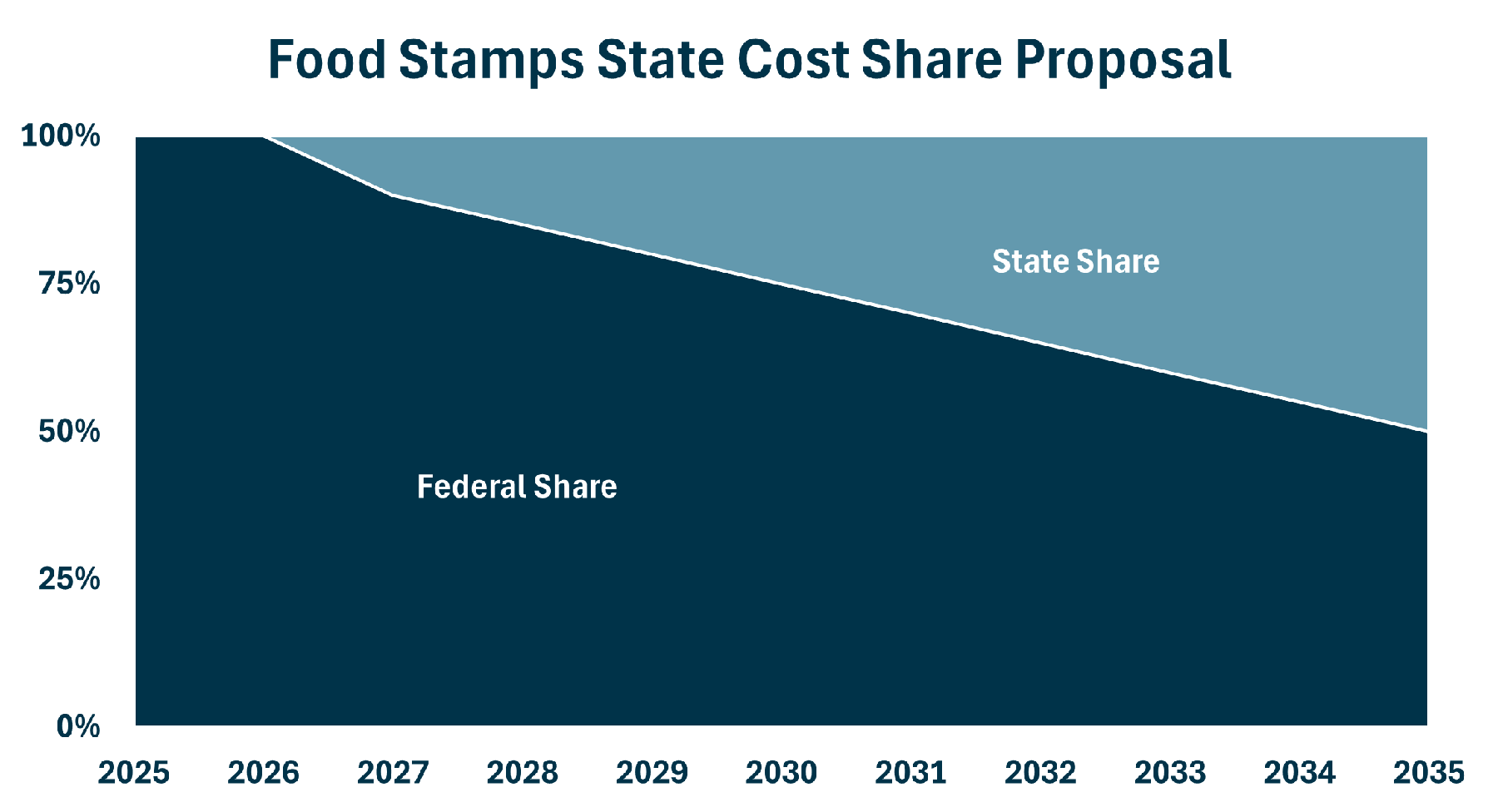
A state matching requirement should be slowly phased in starting in FY 2027. The state matching contribution would initially be set at 10 percent in FY 2027, increasing by 5 percentage points each year. By FY 2035, the federal and state shares would be equally divided at 50 percent each. This proposal is similar to a policy included in H.R. 2407 and S. 1197, the SNAP Reform and Upward Mobility Act of 2025, introduced by Rep. Josh Brecheen (R-OK) in the House and Sen. Mike Lee (R-UT) in the Senate.[1]Chart 1
Source: EPIC Calculations
Fiscal Effects of a State Cost Share
The Congressional Budget Office (CBO) projects a baseline assumption of $1.1 trillion in outlays for the Food Stamp program over the FY 2025 to 2034 period.[2] Total outlays for the Food Stamp program would remain unchanged under the proposed state matching requirement. However, the federal government would no longer foot the entire bill as states begin paying their fair share for program benefits and administration. Compared to the current baseline projection, the federal government would see savings of $249 billion over the FY 2025 to 2034 period, while state expenditures would increase by an equivalent amount. (see the nearby Table 1)Table 1
|
Food Stamps State Cost Share |
|||||||||||
| 2025 | 2026 | 2027 | 2028 | 2029 | 2030 | 2031 | 2032 | 2033 | 2034 | 2025 - 2034 | |
| Baseline Outlays | 110 | 107 | 110 | 111 | 111 | 111 | 112 | 115 | 115 | 116 | 1,117 |
| Federal Share | 100% | 100% | 90% | 85% | 80% | 75% | 70% | 65% | 60% | 55% | |
| State Cost Share Requirement | 0% | 0% | 10% | 15% | 20% | 25% | 30% | 35% | 40% | 45% | |
| Federal Outlays | 110 | 107 | 99 | 94 | 89 | 83 | 78 | 75 | 69 | 64 | 868 |
| State Outlays | 0 | 0 | 11 | 17 | 22 | 28 | 33 | 40 | 46 | 52 | 249 |
| Total Outlays | 110 | 107 | 110 | 111 | 111 | 111 | 112 | 115 | 115 | 116 | 1,117 |
| Total Outlays vs. Baseline | 0 | 0 | 0 | 0 | 0 | 0 | 0 | 0 | 0 | 0 | 0 |
| Federal Savings vs Baseline | 0 | 0 | -11 | -17 | -22 | -28 | -33 | -40 | -46 | -52 | -249 |
| Note: Figures in billions of dollars. Source: EPIC calculation based on Congressional Budget Office. | |||||||||||
- The federal government strengthens work requirements.
- States better enforce work requirements.
- States reduce improper payments.
- The federal government and states crack down on loopholes that expand participation and benefits beyond the intended scope of the program, such as broad-based categorical eligibility.
Fairness, Federalism, and Better Outcomes
States and their local taxpayers should pay their fair share for the benefits distributed to citizens in their states. A reasonable cost-sharing requirement would ensure accountability and ownership for the welfare programs operated by each state. The principle of subsidiarity suggests that the independent sector, communities, and local and state governments should be empowered to address issues directly, rather than the distant and bureaucratic central government. Implementing a state match funding requirement would localize efforts to manage issues like food insecurity. The state match would also strengthen the incentives for state governments to reduce poverty and achieve better outcomes for their neediest citizens. Too many welfare recipients become dependent for extended periods rather than provided opportunities to succeed and become self-sufficient again. [3] The 100 percent federal funding system perversely gives more money to states that keep more people on welfare longer, while a cost sharing system would provide the state with a benefit when people move off welfare and reenter the workforce. Many other welfare programs that are administered by states, such as Medicaid, have cost sharing requirements. Adding a state match would align the Food Stamp program with other similar programs.Skin in the Game to Reduce Improper Payments
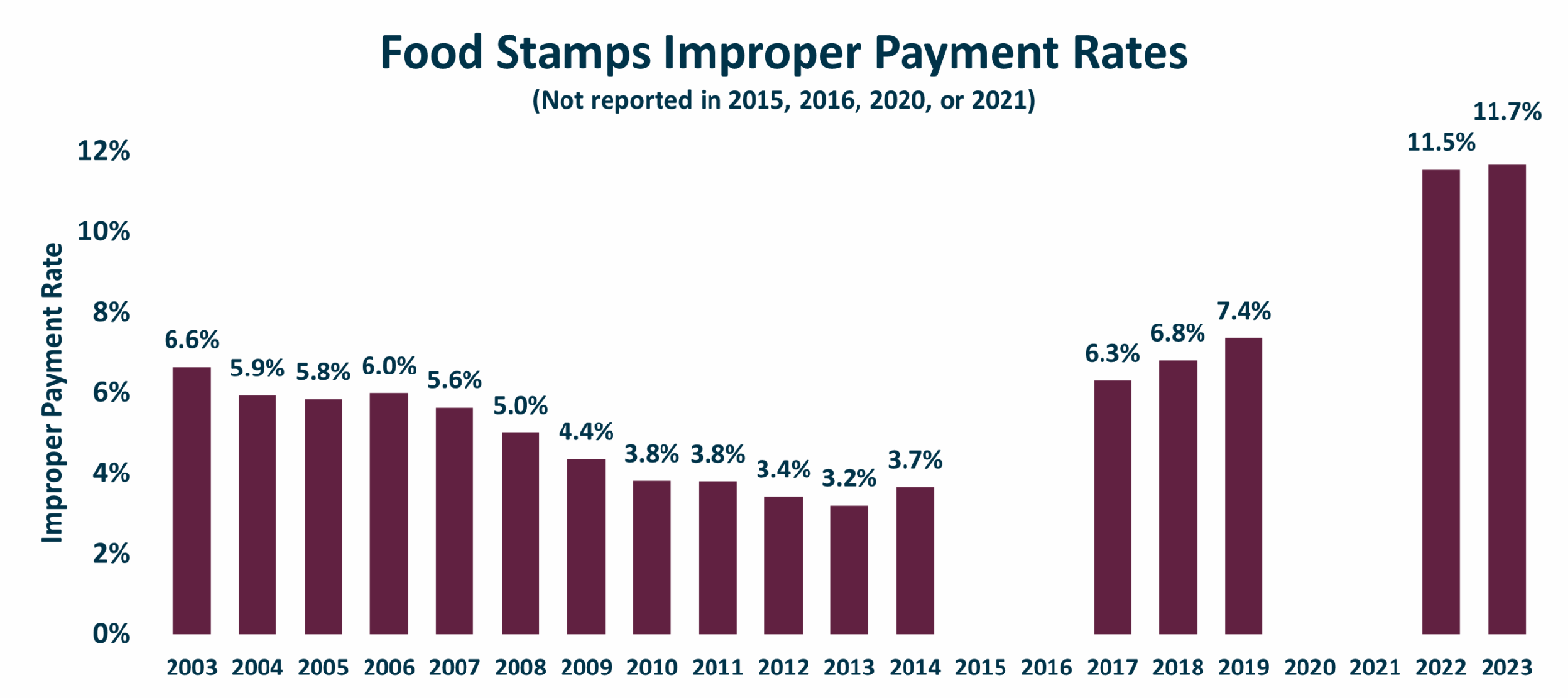
The food stamp program makes billions of improper payments each year. The USDA has reported more than $56 billion of improper payments between FY 2003 and FY 2023. The reported improper payment rate was 11.7 percent in 2023.[4] Improper payments are government outlays that should not have been made at all or were made in the wrong amount. These improper payments often include fraud, abuse, and waste, but are not always indicative of illegal activity. Improper payments can include underpayments as well as overpayments, but virtually all Food Stamp improper payments are overpayments. In FY 2023, 10 percent of Food Stamp payments were overpayments while just 1.6 percent were underpayments. Improper payments are likely significantly higher than the reported amounts. In fact, the 2014 Farm Bill instructed USDA to ignore improper payments up to a “quality control tolerance threshold.” This threshold was set at $37 in 2014 and increases with inflation each year. In 2023, the “tolerance threshold” was $54. Thus, any improper payment up to $54 was intentionally not reported.Chart 2
Source: USDA
The USDA reported data quality issues for FY 2015 and 2016 that prevented it from providing improper payment rates. In FY 2020 and 2021, the USDA suspended state error reporting requirements during the COVID-19 pandemic. One way that states avoid reporting improper payments is by ignoring the Food Stamp income and asset limit rules. An estimated five million Food Stamp recipients get benefits despite not actually qualifying under normal program rules.[5] States avoid the eligibility rules established in law by exploiting the "categorical eligibility" loophole.[6] The states like to use the loophole because otherwise the welfare agencies would be forced to verify the incomes and assets of Food Stamp applicants. By using the categorical eligibility loophole, states can draw down more federal Food Stamp funds. However, as a state cost sharing requirement is phased in, the state agencies would face a financial tradeoff for ignoring the statutory eligibility guidelines. Under this reform, states would be more likely to prioritize benefits for the most vulnerable.Table 2
|
Food Stamp Overpayment Rates |
|||||||
| State | Rate | State | Rate | State | Rate | ||
| Alabama | 5.4 | Kentucky | 6.3 | North Dakota | 7.8 | ||
| Alaska | 59.6 | Louisiana | 5.2 | Ohio | 5.4 | ||
| Arizona | 9.7 | Maine | 10.1 | Oklahoma | 9.6 | ||
| Arkansas | 8.8 | Maryland | 15.1 | Oregon | 15.3 | ||
| California | 11.6 | Massachusetts | 9.0 | Pennsylvania | 15.0 | ||
| Colorado | 6.5 | Michigan | 8.7 | Rhode Island | 9.8 | ||
| Connecticut | 7.3 | Minnesota | 5.0 | South Carolina | 20.9 | ||
| Delaware | 19.2 | Mississippi | 8.6 | South Dakota | 2.9 | ||
| District of Columbia | 15.7 | Missouri | 10.0 | Tennessee | 11.5 | ||
| Florida | 11.3 | Montana | 5.3 | Texas | 4.5 | ||
| Georgia | 9.1 | Nebraska | 6.0 | Utah | 4.3 | ||
| Hawaii | 20.0 | Nevada | 5.6 | Vermont | 2.8 | ||
| Idaho | 3.0 | New Hampshire | 9.8 | Virginia | 8.2 | ||
| Illinois | 8.0 | New Jersey | 33.5 | Washington | 5.7 | ||
| Indiana | 9.0 | New Mexico | 13.5 | West Virginia | 9.8 | ||
| Iowa | 4.4 | New York | 11.2 | Wisconsin | 4.7 | ||
| Kansas | 11.3 | North Carolina | 8.2 | Wyoming | 4.3 | ||
| Figures are overpayment rates in FY 2023. Source: USDA | |||||||
An Unsustainable Federal Budget and Welfare for State Budgets
The federal government is on an unsustainable fiscal trajectory. The federal government’s fiscal space, or its capacity to borrow without risking economic damage, is rapidly eroding.[8] One reason for the degradation of the federal budget is the withering of fiscal federalism in recent decades. State budgets have become more reliant on federal largess, as recent research from EPIC’s David Ditch shows.[9] Federal aid to state and local governments rose by 137 percent on an inflation-adjusted basis from FY 2000 to 2023. At the same time as federal transfers to states have skyrocketed, self-funded state and local spending has increased by 59 percent on an inflation-adjusted basis, while state rainy day funds are at record levels.Chart 3
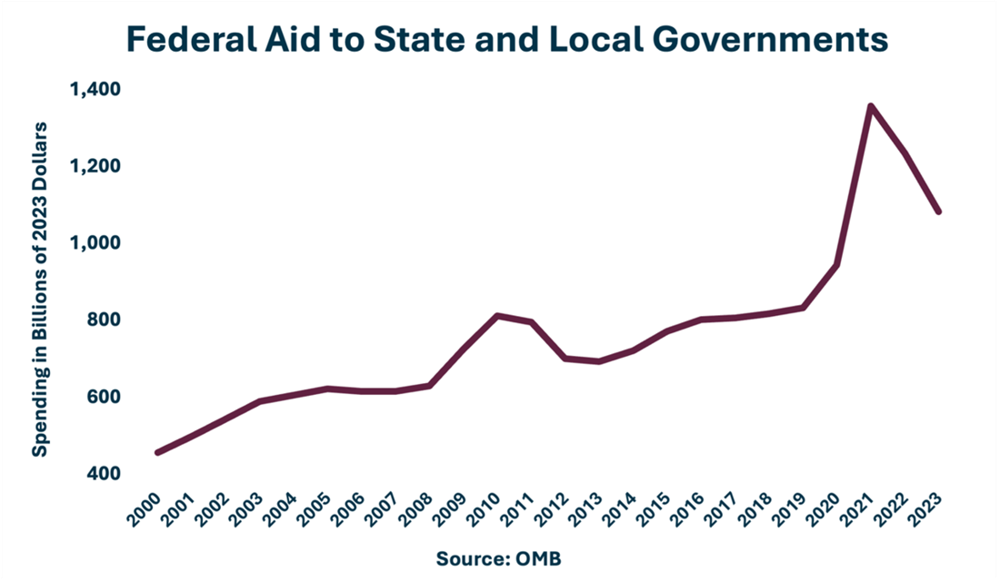 As Ditch concluded, “state and local politicians have a strong incentive to lobby for federal funding, since they are not held accountable for federal taxes or the national debt. Federal funding thus appears ‘free’ to them. However, the country can no longer afford to tolerate this ‘free money’ illusion.”[10] By requiring state governments to help funds programs that benefit them, it would restore a more balanced relationship between the federal and state authorities.