



State and Local Tax (SALT) Deduction
Under the 2017 Tax Cuts and Jobs Act (TCJA), taxpayers who itemize can deduct no more than $10,000 from their federal taxes for SALT. The SALT deduction provides a federal subsidy to states, which incentivizes higher taxes and bigger state and local governments. At the same time, the deduction forces federal tax rates to be higher across the board to raise the same amount of revenue. The SALT deduction disproportionately benefits high income individuals in high tax states.Medicaid Expansion Discriminates Against the Most Vulnerable
The costs of care for beneficiaries are split between states and the federal government. The federal share of the spending is based on a formula called the Federal Medical Assistance Percentage (FMAP). The average FMAP for the traditional Medicare population (the disabled, pregnant women, children, and low-income seniors) is about 57%. Obamacare expanded Medicaid eligibility to able-bodied, working age adults. To encourage states to participate in Medicaid expansion, the FMAP for the expansion population was set at 90%. For every $1 of state Medicaid spending on the vulnerable, the federal government contributes about $1.33. Meanwhile, the federal government pays $9 for every $1 of state spending on work-capable adults.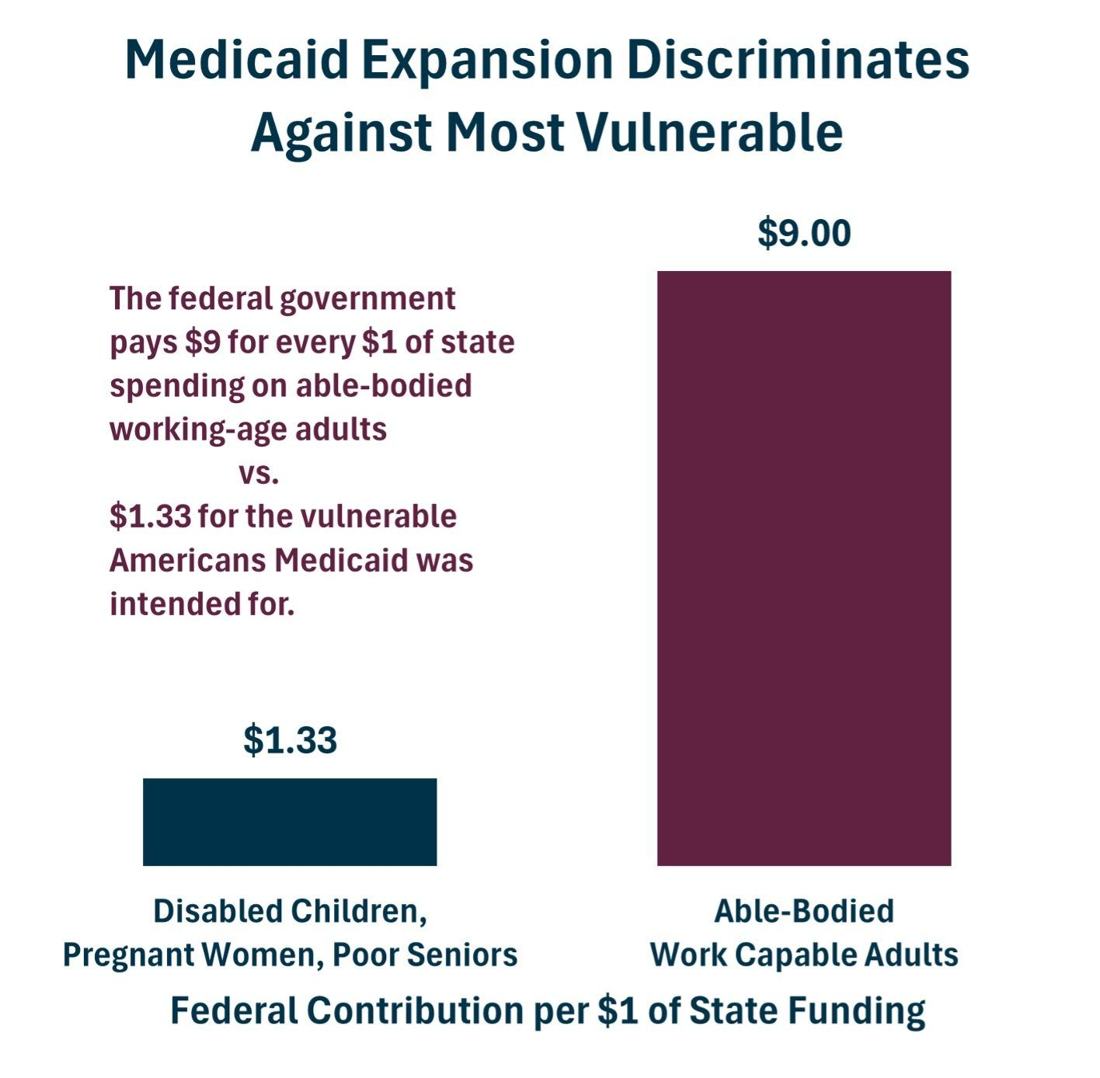
Medicaid FMAP Floor
The federal share of Medicaid funding for the traditional Medicaid population is set by a formula based on the state's per-capita income. However, there is also a statutory minimum FMAP that sets a 50% floor of the federal share of Medicaid spending, even if the formula would produce a lower rate. Ten high-income states benefit from the FMAP floor. Washington, D.C. is also subsidized by an FMAP floor, in a unique way. While every other state's FMAP is determined by a formula, D.C.'s FMAP is statutorily set at 70%. If the normal formula was followed, D.C.'s FMAP would fall to the 50% floor. This special subsidy for D.C. costs American taxpayers about $1 billion per year. If the 50% FMAP floor was not in place and the programmatic formula was used, the federal share of D.C.'s Medicaid spending would fall to practically 0%.|
High Tax SALT States Also Subsidized by Medicaid |
||||
| % of Taxpayers Subsidized by SALT | State Income Tax Rate | Uses 90% FMAP for Able-Bodied Adults | Subsidized by FMAP Floor | |
| District of Columbia | 20% | 10.75% | Yes | Yes |
| Maryland | 20% | 8.95% | Yes | Yes |
| California | 15% | 14.40% | Yes | Yes |
| Utah | 14% | 4.55% | Yes | No |
| Virginia | 14% | 5.75% | Yes | No |
| New Jersey | 13% | 11.75% | Yes | Yes |
| Colorado | 12% | 4.40% | Yes | Yes |
| Hawaii | 12% | 11.00% | Yes | No |
| Massachusetts | 12% | 9.00% | Yes | Yes |
| Oregon | 12% | 14.69% | Yes | No |
| Washington | 12% | 0.00% | Yes | Yes |
| Connecticut | 11% | 6.99% | Yes | Yes |
| Georgia | 11% | 5.39% | No | No |
| New York | 10% | 14.78% | Yes | Yes |
| Arizona | 9% | 2.50% | Yes | No |
| Delaware | 9% | 7.85% | Yes | No |
| Illinois | 9% | 4.95% | Yes | No |
| Minnesota | 9% | 9.85% | Yes | No |
| Florida | 8% | 0.00% | No | No |
| Idaho | 8% | 5.70% | Yes | No |
| Montana | 8% | 5.90% | Yes | No |
| Nevada | 8% | 0.00% | Yes | No |
| North Carolina | 8% | 4.25% | Yes | No |
| Rhode Island | 8% | 5.99% | Yes | No |
| South Carolina | 8% | 6.20% | No | No |
| Texas | 8% | 0.00% | No | No |
| Alabama | 7% | 4.15% | No | No |
| Kansas | 7% | 5.58% | No | No |
| New Hampshire | 7% | 0.00% | Yes | Yes |
| Oklahoma | 7% | 4.75% | Yes | No |
| Pennsylvania | 7% | 6.86% | Yes | No |
| Arkansas | 6% | 3.90% | Yes | No |
| Iowa | 6% | 3.80% | Yes | No |
| Louisiana | 6% | 3.00% | Yes | No |
| Maine | 6% | 7.15% | Yes | No |
| Michigan | 6% | 6.65% | Yes | No |
| Mississippi | 6% | 4.40% | No | No |
| Missouri | 6% | 5.70% | Yes | No |
| Nebraska | 6% | 5.20% | Yes | No |
| New Mexico | 6% | 5.90% | Yes | No |
| Tennessee | 6% | 0.00% | No | No |
| Vermont | 6% | 8.75% | Yes | No |
| Wisconsin | 6% | 7.65% | No | No |
| Alaska | 5% | 0.00% | Yes | No |
| Indiana | 5% | 5.02% | Yes | No |
| Kentucky | 5% | 6.20% | Yes | No |
| North Dakota | 5% | 2.50% | Yes | No |
| Ohio | 5% | 6.00% | Yes | No |
|
South Dakota |
5% | 0.00% | Yes | No |
| West Virginia |
5% |
4.82% | Yes |
No |
| Wyoming | 5% | 0.00% | No | Yes |
| Sources: SALT deductions in 2022, IRS. State income tax rates as of January 2025, Rich States, Poor States: ALEC-Laffer State Economic Competitiveness Index. Medicaid expansion and floor as of 2025, KFF. | ||||