The
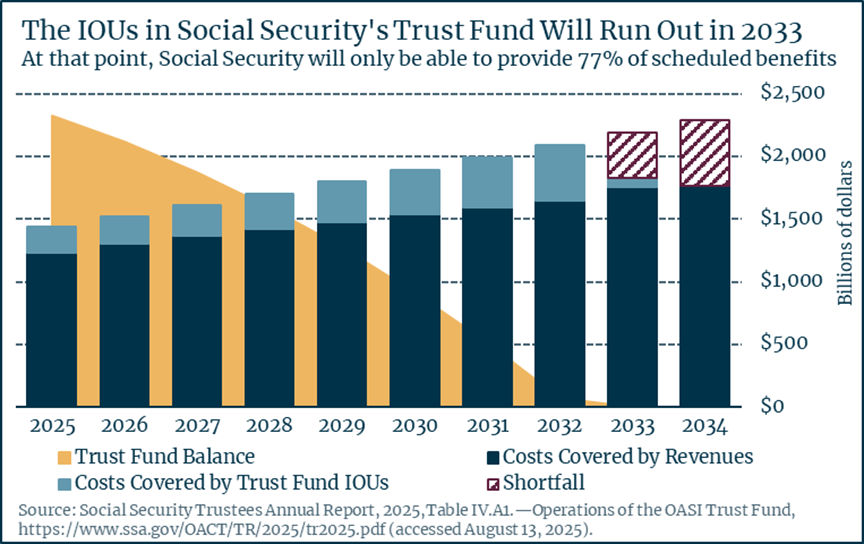
Social Security trust fund is projected to be
depleted in 2033. When that happens, the Social Security law says that the program can only pay out as much in benefits as it collects each year from payroll taxes. Those payroll taxes will cover only 77 percent of scheduled benefits.
A
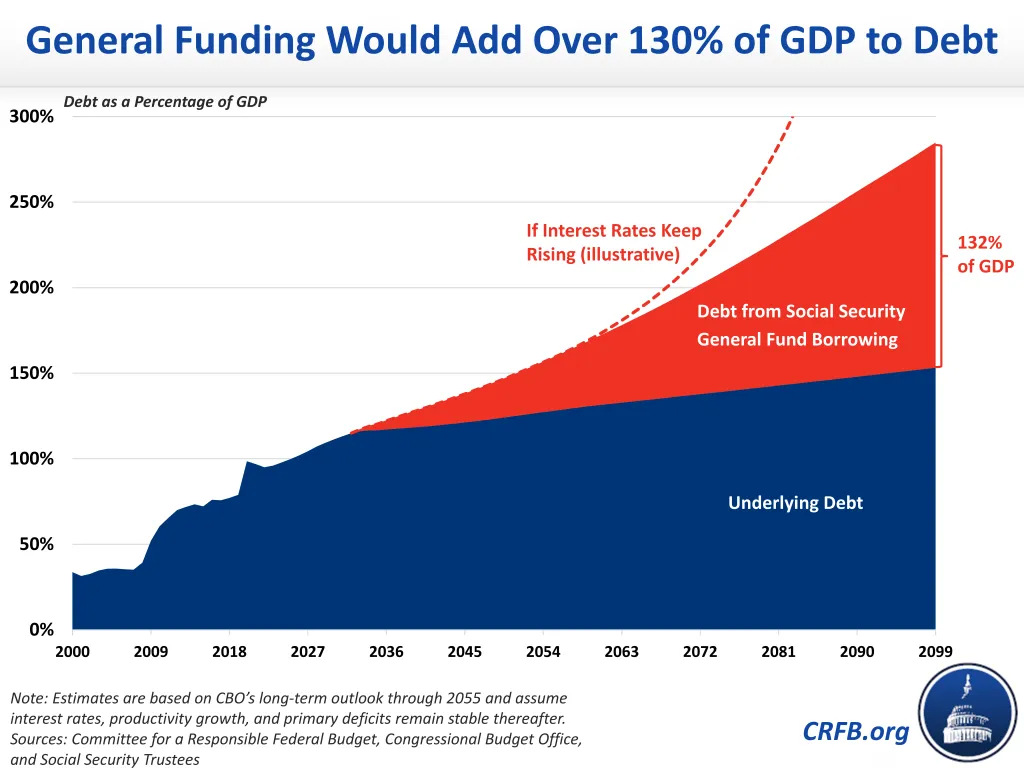
recent report from the Committee for a Responsible Federal Budget (CRFB) evaluates a proposal to fill the gap between payable benefits and scheduled benefits by issuing new debt and transferring funds from the Treasury’s general fund.
Calling the concept a “costly mistake,”
CRFB finds that “borrowing to fund Social Security could:
- Add over $150 trillion to the debt when adjusted for inflation, or over $700 trillion nominally
- Boost debt by over 130% of Gross Domestic Product (GDP) – doubling debt as a share of the economy and potentially triggering a debt spiral or fiscal crisis
- Cause interest rates to rise by 2.6 percentage points and slow income growth
- End Social Security’s current structure as a self-financed contributory program
- Erode one of the last remaining fiscal rules.”
[caption id="" align="aligncenter" width="1024"]
Source: CRFB[/caption]
The Social Security Shortfall Exposes a Massive Flaw in the CBO Budget Baseline
The costs of borrowing to fund the promised Social Security benefits above what would be paid under current law are staggering.
Many lawmakers would be shocked to learn that these costs
are hidden inside the Congressional Budget Office’s (CBO) official budget baseline.
The CBO baseline is often described as reflecting current law, but
this is a myth. The CBO is required under
Section 257 of the Balanced Budget and Emergency Deficit Control Act of 1985 to distort the baseline using assumptions that make spending look much higher than it would actually be if Congress made no further changes in law.
One such distortion is that entitlement programs, such as Social Security, are assumed to make all scheduled benefit payments regardless of whether the trust fund and financing are inadequate.
In other words, CRFB projects that the CBO’s official baseline adds more than $500 trillion to the debt over 75 years compared to actual current law due to this distortion.
The Baseline Bias Means Lawmakers Don’t Get the Full Picture
The CBO baseline is important because it is used as the official benchmark against which legislative proposals are scored.
As
CBO itself has stated, “CBO’s baseline is not intended to be a forecast of budgetary outcomes; rather, it is meant to provide a neutral benchmark that policymakers can use to assess the potential effects of policy decisions.”
The biases built into the baseline allow the true costs of legislation to be hidden from the public and Members of Congress.
The broken baseline would allow Congress to issue trillions of dollars in new debt to bail out the Social Security trust fund, and the CBO would be forced to score it as having $0 cost. Meanwhile, if Congress does
nothing on Social Security and follows existing law — including limiting Social Security benefits to Social Security revenues — CBO would score that as a large spending cut.
What if Congress wanted to mitigate the impact of the depletion of the trust fund by
increasing Social Security benefits by 10%
above what could otherwise be paid? The CBO would be required to score that as a 13%
reduction in benefits, even though those higher benefits could never legally be paid under current law.
End the Baseline Bias
As
CBO Director Phil Swagel testified before the House Budget Committee, the official CBO baseline is “not a neutral benchmark.” Thankfully, reforms have been proposed to end the baseline bias and provide more transparency to CBO scoring.
The
No Bias in the Baseline Act, introduced by Congressman Ben Cline (R-VA-06) in the 118th Congress, would remove distortions from the baseline. This legislation would provide more consistent, transparent, and realistic cost estimates for legislative proposals.
The
Save Our Seniors Act, introduced by Rep. Randy Feenstra (R-IA-04) and Sen. Joni Ernst (R-IA), would require CBO to include a simple and easy-to-understand graph in the annual
Budget and Economic Outlook report depicting the true outlook for the Social Security trust fund.
Additional Background on the Baseline Bias