The Federal Workforce
The federal government employed about 2.4 million full-time equivalent civilian workers (excluding the Postal Service) at the end of fiscal year 2024.
[1] The average federal worker earns a salary of more than $106,000,
[2] plus a generous benefits package that includes a defined benefit pension plan, a defined contribution retirement plan health insurance, disability insurance, life insurance, and four types of paid leave benefits. These benefits are worth on average 43 percent more than the typical private sector package.
[3]
One way to reduce agency budgets and long run federal liabilities is to reduce the size of the federal workforce. This report provides estimates of a policy that would reduce the size of the federal workforce by 10 percent, including certain effects on the budget and the potential for such a policy that might be included in reconciliation legislation.
As most would anticipate, a reduction in the workforce would have significant fiscal implications, producing changes in revenues, direct spending outlays, and discretionary spending. These effects would be realized both within the 10-year budget window and over the long run. These significant changes to the budget make a reduction in the federal workforce force a strong candidate for the budget reconciliation process.
Changes in Direct Spending and Revenues
Pensions
Most civilian federal employees are eligible for one of two defined benefit pension programs. Employees hired before 1984 were eligible for the Civil Service Retirement System (CSRS). Beginning in 1984, federal employees became eligible for the Federal Employees’ Retirement System (FERS). Most current employees are FERS participants.
[4]
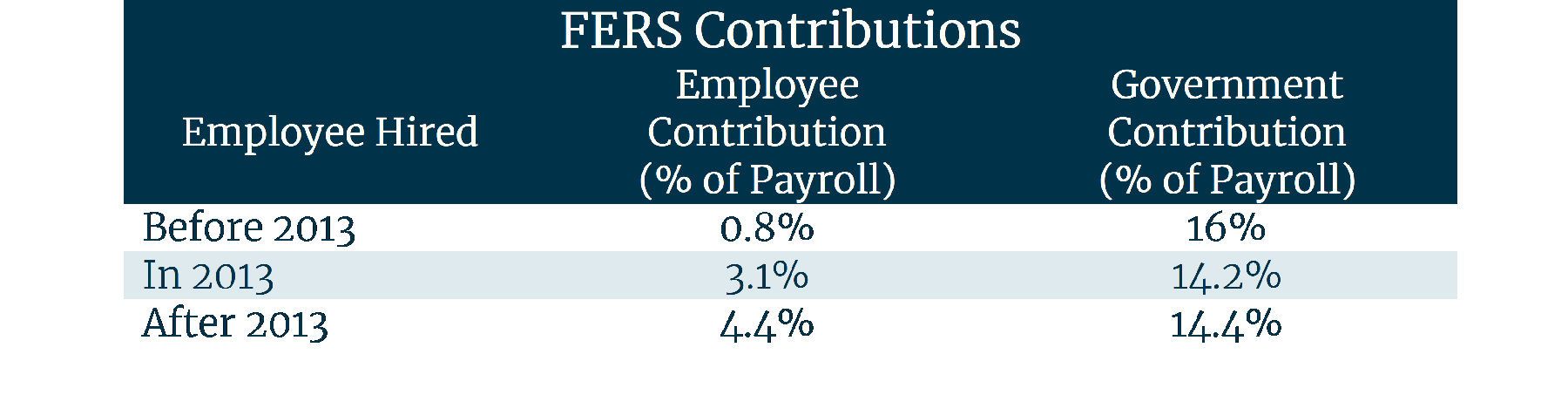
FERS benefits are funded by contributions made by both the employee and the government. The level of FERS contributions as a percentage of the employee’s salary made by the employee and the government depend on when the employee was originally hired.
[5]
 Note
Note: The change in 2013 was made by the Middle Class Tax Relief and Job Creation Act of 2012 (P.L. 112-96) that extended the payroll tax cut and unemployment insurance among other policies. The post-2013 changes were enacted as a part of the Bipartisan Budget Act of 2013 (P.L. 113-67).
The amount of the federal worker’s retirement benefit is determined by his length of service and the highest three years of base salaries earned.
The contributions made by employees and the government to the pension fund and the payment of benefits to retirees all have different budgetary classifications:
- Employees contributions are considered revenues to the federal government, which reduces the deficit.
- The government’s contributions are considered an intragovernmental transaction, which are recorded as a direct spending payment to the Civil Service Retirement and Disability Fund and a corresponding offsetting receipt by the Civil Service Retirement and Disability Fund. These offsetting transactions are not considered to affect the deficit on net at the time they are made.[6]
- Payment of benefits to retirees are classified as direct spending outlays, which increase the deficit.[7]
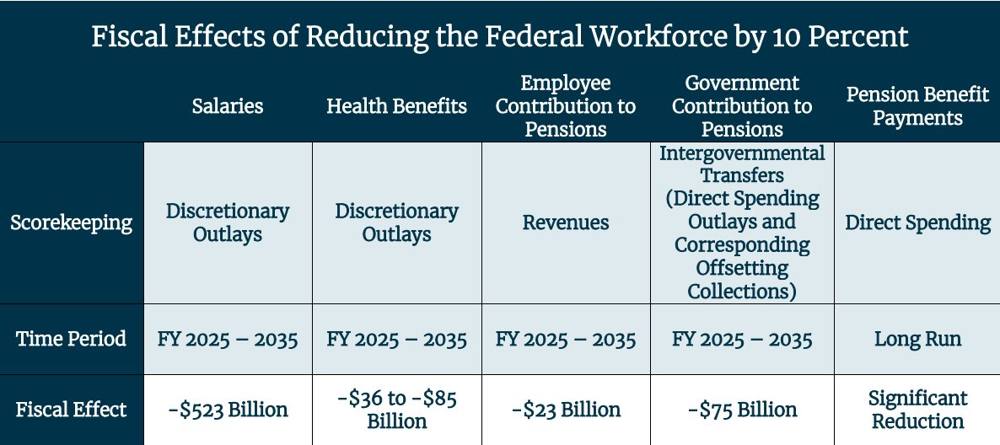
Reducing the federal workforce by 10 percent would reduce revenues by $23 billion over the FY 2025 – 2035 period as contributions made by employees under FERS are reduced. Over that same period, intergovernmental transactions (both direct spending outlays and corresponding offsetting collections) would be reduced by $75 billion as the government makes fewer contributions under FERS.
Over a longer period, direct spending outlays would be significantly reduced as lower FERS benefits are paid out to federal retirees as a result of shorter lengths of credible service and lower base earnings.
Discretionary Spending
Salaries
The salaries for most federal workers are provided in annual appropriations bills and are classified as discretionary spending.
Reducing the federal workforce by 10 percent would allow discretionary spending appropriations for salaries to be reduced by $523 billion over the FY 2025 – 2035 period.
Healthcare
Most federal workers are eligible for the Federal Employees Health Benefits Program (FEHBP). Employees can choose from a wide range of health insurance plans, with coverage for the employee (self), the employee and one additional family member (self + one), or for the employee’s immediate family. The federal government pays 71 percent of the cost of FEHB premiums, on average.
[8]
The government’s contribution for health benefits for active federal employees is classified as discretionary spending, while government contribution for health benefits for federal retirees is classified as direct spending.
Reducing the federal workforce by 10 percent would allow discretionary spending appropriations for health subsidies to be reduced by $36 to $85 billion over the FY 2025 – 2035 period, depending on the levels of coverage that would have been chosen by those workers.
Application to Reconciliation
The reconciliation process is a fast-track legislative tool to make changes in the federal budget. The Senate’s Byrd Rule ensures that provisions of reconciliation bills are focused on changing outlays and revenues.
[9]
A provision of a reconciliation bill that requires a reduction of the federal workforce clearly complies with the Byrd Rule.
One of the largest expenses of the federal government is employee compensation. In particular, retirement benefits for federal workers are a significant component of direct federal spending, totaling more than $100 billion annually.
[10] A common sense way to make changes to the budget is to make changes to the federal workforce.
Policymakers have previously used the reconciliation process to add to the federal workforce. For example, the Inflation Reduction Act created a $79 billion slush fund that the Biden Administration intended to use to add 87,000 new agents for the Internal Revenue Service (IRS).
The first test of the Byrd Rule is the requirement that provisions in reconciliation legislation “produce a change in outlays or revenue.”
[11] This test does not necessarily require the change in outlays or revenue to reduce or increase the
deficit. Furthermore, the test does not specify
when the change in outlays or revenue must occur.
As described in the analysis above, reducing the size of the federal workforce would produce changes to direct spending and revenues. These changes to the budget flow directly from the policy change.
If the Chair of the Senate Budget Committee is able to guide the Senate’s Presiding Officer that fiscal effects are attributable to the provision, the Byrd Rule test can be satisfied. The CBO’s inability to provide a score of the provision is not dispositive. As described by the Senate Budget Committee, “provisions that have budgetary effects that the Congressional Budget Office cannot estimate do not necessarily violate” the Byrd Rule test.
[12]
Application of Scorekeeping Guidelines
The CBO is bound by scorekeeping guidelines, which have been agreed to by the House and Senate Budget Committees, the CBO, and the Office of Management and Budget.
[13]
Some may argue that legislation reducing the federal workforce might not be scored as changing outlays or revenues due to Scorekeeping Guideline 10, regarding Contingent Legislation, which reads:
“If the authority to obligate is contingent upon the enactment of a subsequent appropriation, new budget authority and outlays will be scored with the subsequent appropriation. If a discretionary appropriation is contingent on the enactment of a subsequent authorization, new budget authority and outlays will be scored with the appropriation. If a discretionary appropriation is contingent on the fulfillment of some action by the Executive branch or some other event normally estimated, new budget authority will be scored with the appropriation, and outlays will be estimated based on the best information about when (or if) the contingency will be met. If direct spending legislation is contingent on the fulfillment of some action by the Executive branch or some other event normally estimated, new budget authority and outlays will be scored based on the best information about when (or if) the contingency will be met. Non-lawmaking contingencies within the control of the Congress are not scoreable events.”
Those opposed to reducing the size of the federal workforce may argue that future appropriations bills could provide funding for additional federal employees, reversing the required reduction in the workforce, and therefore the scorekeeping is contingent upon the future appropriations laws.
Taken to the extreme, such an interpretation of Guideline 10 could lead to absurd outcomes that prevent any changes to direct spending programs or changes to the tax code from ever being scored. All benefit programs require a federal employee to administer them, and tax revenues require a tax collector. Should the CBO be forced to say that changes to the formula for a transfer program or changes to a tax form are contingent on future appropriations bills for those bureaucrats?
The application of Guideline 10 should depend on how the policy is written, but a provision in a reconciliation bill that
requires changes to the size and nature of the federal workforce should be scored as producing changes in direct spending and revenues.
This is simply a case of common sense: everyone knows that reducing the number of federal employees would reduce government spending. Only Washington math would attempt to say otherwise. Of course, future Congresses can change any policies, in appropriation bills and other legislation, and the Executive branch implementation of policies always matters.
Notably, the CBO and the Joint Committee on Taxation (JCT) have drastically miscalculated certain provisions of reconciliation legislation when it comes to anticipating the actions taken by the Executive branch.
For example, the Inflation Reduction Act included green energy tax credits that were scored at $270 billion. In reality, the cost of those subsidies is now estimated to be more than double that, exceeding $660 billion, in large part due to how the Treasury has administered eligibility for credits.
[14] If the CBO and JCT had gotten the scoring correct at the time the legislation was considered, it would not have complied with its reconciliation instructions and would have been subject to points of order.
The Inflation Reduction Act also included billions for additional employees at the IRS, which the CBO estimated would allow for the collection of additional revenue to reduce the deficit. However, through the end of FY 2024, the IRS had collected just 18 percent of the revenues that the CBO projected would be raised by that point.
[15]
The most fundamental aspects of the budget process are biased in favor of larger government. The CBO is required by law to distort the budget baseline in favor of higher spending and taxes.
[16] The scorekeeping guidelines should not also be misinterpreted to allow the budget reconciliation process to be a one-way ratchet that allows government employees to be added to the books (as with the aforementioned IRS expansion) but not removed from the federal workforce. Clearly both policies would produce changes to direct spending and revenues.
Conclusion
Reducing the federal workforce by 10 percent would produce significant changes to direct spending and revenues, both today and in the future. This makes the policy a strong candidate for inclusion in reconciliation legislation.
To ensure the savings described above are sustainable, Congress must also reduce the size and scope of the government. The fiscal trajectory of the federal government is on an unsustainable course, driven by spending that is growing faster than the economy. This spending has already pushed the national debt to World War II levels.
[17] The growing debt is reducing the government’s fiscal space and ability to respond to future crises.
[18]
Appendix: Data and Methodology
The data that underly the assumptions for this analysis are all derived from publicly available government sources.
The policy that is modeled would phase in a reduction of the federal workforce by 10 percent relative to the number of employees at the end of FY 2024. The reduction would phase in by the end of FY 2027. After FY 2027, the total number of federal employees would be capped. At the end of FY 2035, the total number of FTEs would be about 500,000 below the baseline projection.
The baseline projection of the federal workforce over the FY 2025 – 2035 period is conservatively assumed to grow by 1 percent per year from the level reported by the U.S. Bureau of Labor and Statistics at the end of FY 2024.
[19] (Greszler and Sherk found that federal FTEs grew an average of 1.59 percent between 2007 and 2017.)
[20]
Baseline average wages for federal workers are assumed to grow from the current level at a rate equivalent to the CBO’s baseline projections of the Employment Cost Index.
[21]
Average FEHBP premiums for 2025 are reported by the U.S. Office of Personnel Management.
[22] Baseline average FEHB premiums are assumed to grow over the FY 2026 – 2035 period by the historical average of the consumer price index for medical services over the previous decade.
[23]
For the purpose of simplifying the analysis, the model assumes that employees affected by the reduction in force are all post-2013 hires. This means the assumed employee FERS contribution is 4.4 percent, rather than the lower amounts for employees hired in 2013 or before. If employees hired prior to 2014 are removed, then the projected reduction in revenues over the FY 2025 – 2035 period would be lower while the intergovernmental transactions would be higher.
A number of caveats apply to this analysis. Actual fiscal effects could be higher or lower depending on which federal employees are reduced.
For example, if employees at agencies related to national security were exempted from the reduction in force, fiscal effects would be much lower than the scenario modeled in this report. About 68 percent of civilian federal workers are employed by the Department of Defense, the Department of Veterans' Affairs, the Department of Homeland Security, or the Department of Justice. If these agencies were exempted from the 10 percent reduction in force, the resulting federal employment would be about 165,000 FTEs below the baseline projection in FY 2035. Discretionary outlays for salaries could fall by $167 billion, and revenues would be $7 billion lower as a result of fewer FERS contributions from employees over the FY 2025 - 2035 period compared to the baseline projection.
[1] U.S. Bureau of Labor Statistics, All Employees, Federal, Except U.S. Postal Service [CES9091100001], retrieved from FRED, Federal Reserve Bank of St. Louis;
https://fred.stlouisfed.org/series/CES9091100001, (accessed January 25, 2025).
[2] Office of Personnel Management, “Federal Workforce Data,”
https://www.fedscope.opm.gov/ (accessed January 25, 2025).
[3] Congressional Budget Office, “Comparing the Compensation of Federal and Private-Sector Employees in 2022,” April 25, 2024,
https://www.cbo.gov/publication/59970 (accessed January 25, 2025).
[4] Less than 2 percent of current federal employees were covered by CSRS as of FY 2022.
[5] Congressional Research Service, “Federal Employees’ Retirement System: Benefits and Financing,” November 13, 2019,
https://crsreports.congress.gov/product/pdf/RL/98-810 (accessed January 25, 2025).
[6] Offsetting receipts are a considered to be “negative spending” and are recoded as outlays.
[7] Discretionary spending is provided in appropriations bills, while direct spending (also called autopilot or mandatory spending) is proved by legislation other than appropriations bills; Amelia Kuntzman “EPIC Explainer: Discretionary v Autopilot Spending,” Economic Policy Innovation Center, August 29, 2024,
../../federal-budget/epic-explainer-discretionary-v-autopilot-spending/
[8] Congressional Budget Office, “Comparing the Compensation of Federal and Private-Sector Employees in 2022,” April 25, 2024,
https://www.cbo.gov/publication/59970 (accessed January 25, 2025).
[9] Matthew Dickerson, “Understanding the Byrd Rule,” Economic Policy innovation Center, October 9, 2024,
../../federal-budget/understanding-the-byrd-rule/.
[10] Congressional Budget Office, “Options for Changing the Retirement System for Federal Civilian Workers,” August 29, 2017,
https://www.cbo.gov/publication/53003 (accessed January 25, 2025).
[11] Section 313(b)(1)(A) of the Congressional Budget Act of 1974.
[12] Senate Committee on the Budget, “Byrd Rule Annotated,” October 2005,
https://budgetcounsel.com/wp-content/uploads/2016/12/byrd-rule-annotated-preliminary-draft-october-2005.pdf (accessed January 26, 2025).
[13] Congressional Budget Office, “CBO Explains Budgetary Scorekeeping Guidelines,” January 28, 2021,
https://www.cbo.gov/publication/56507 (accessed January 25, 2025).
[14] William McBride and Daniel Bunn, “Repealing Inflation Reduction Act’s Energy Credits Would Raise $663 Billion, JCT Projects,” Tax Foundation, June 7, 2023,
https://taxfoundation.org/blog/inflation-reduction-act-green-energy-tax-credits-analysis/ (accessed January 25, 2025).
[15] Matthew Dickerson, “IRS Enforcement Spending Has Not Reduced the Deficit,” Economic Policy Innovation Center, November 13, 2024,
../../federal-budget/irs-enforcement-spending-has-not-reduced-the-deficit/.
[16] Matthew Dickerson, “How The Budget Baseline Is Biased,” Economic Policy Innovation Center, January 21, 2025,
../../federal-budget/how-the-budget-baseline-is-biased/.
[17] Mathew Dickerson, “CBO Sounds The Alarm At The Beginning Of The 2025 Fiscal Cliff,” Economic Policy Innovation Center, January 17, 2025,
../../federal-budget/cbo-sounds-the-alarm-at-the-beginning-of-the-2025-fiscal-cliff/.
[18] Paul Winfree, “The Fiscal Red Line: How Close is the U.S. to Its Borrowing Limit?,” Economic Policy Innovation Center, January 17, 2025, ../../federal-budget/the-fiscal-red-line-how-close-is-the-u-s-to-its-borrowing-limit/.
[19] U.S. Bureau of Labor Statistics, All Employees, Federal, Except U.S. Postal Service [CES9091100001], retrieved from FRED, Federal Reserve Bank of St. Louis;
https://fred.stlouisfed.org/series/CES9091100001, (accessed January 25, 2025).
[20] Rachel Greszler and James Sherk, “Why It Is Time to Reform Compensation for Federal Employees,” Heritage Foundation backgrounder No. 3139, July 27, 2016,
https://www.heritage.org/jobs-and-labor/report/why-it-time-reform-compensation-federal-employees (accessed January 25, 2025).
[21] Office of Personnel Management, “Federal Workforce Data,”
https://www.fedscope.opm.gov/ (accessed January 25, 2025); and Congressional Budget Office, “The Budget and Economic Outlook: 2025 to 2035,” Economic Projections, January 17, 2025,
https://www.cbo.gov/system/files/2025-01/51135-2025-01-Economic-Projections.xlsx (accessed January 25, 2025).
[22] Office of Personnel Management, “Premiums,”
https://www.opm.gov/healthcare-insurance/healthcare/plan-information/premiums/ (accessed January 25, 2025).
[23] U.S. Bureau of Labor Statistics, Consumer Price Index for All Urban Consumers: Medical Care Services in U.S. City Average [CUSR0000SAM2], retrieved from FRED, Federal Reserve Bank of St. Louis;
https://fred.stlouisfed.org/series/CUSR0000SAM2,(accessed January 26, 2025).