The House recently passed its
One Big Beautiful bill that makes great progress in enhancing Food Stamp program integrity. It strengthens work requirements for able-bodied adults and introduces a state cost sharing program based on improper payment rates. Now it’s time for the Senate to build off of this progress and secure more savings in reconciliation.
Preserving House Wins on Work Requirements
The House’s bill makes important progress in
strengthening work requirements for able-bodied adults on Food Stamps. It would require at least one parent of school age children to work and extend work requirements to adults up to the normal retirement age—more than doubling the number of individuals subject to these provisions.
This change promotes self-sufficiency and leads to better long-term outcomes for work-capable recipients.
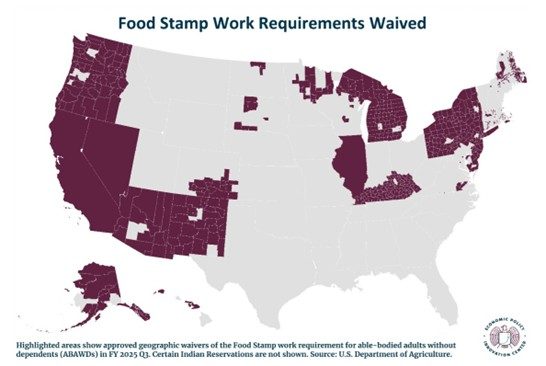
The House’s bill closes long-abused loopholes. Four states have entirely waived work requirements, while 25 others maintain partial waivers despite low unemployment and more than 7 million open jobs nationwide. This reform ensures accountability and restores the original intent of work incentives in welfare.
Work requirements as a condition of welfare benefits for able-bodied adults helps move people off welfare and into the workforce. These reforms address waste, fraud, and abuse while safeguarding assistance for the truly needy.
State Cost Share Brings Savings
The House’s bill kickstarts a critical reform to Food Stamps that will help restore balance between state and federal responsibilities. Implementing a
state cost sharing requirement for the Food Stamp program represents a pragmatic approach to addressing both fiscal responsibility and the effectiveness of welfare programs. This reform would align the Food Stamp program with other state-administered welfare programs that already operate under cost-sharing arrangements.
Because states are administering a program that is completely funded by the federal government, they have little incentive to control overpayments. As a result, many states have astonishingly large overpayment rates.
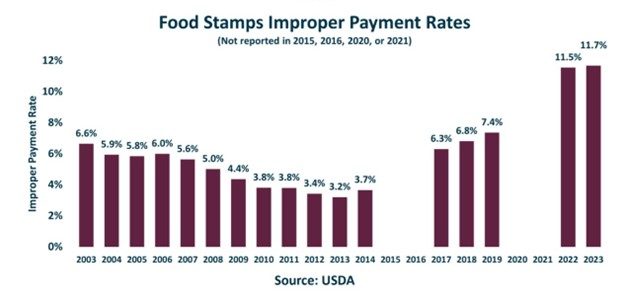
The House legislation calls for the federal share of Food Stamp funding to modestly decrease from 100% to 95%. If improper payment rates are at or above 6%, states would be penalized for wasteful spending by having to pay an increased share of the cost.
By restoring more balance between federal and state governments, it fosters fairness and accountability—ensuring taxpayer dollars are spent effectively while empowering states to provide more efficient, targeted assistance to those in need.
Build on Reforms to Biden’s Food Stamp Binge
President Biden
unilaterally increased Food Stamp allotments by “reevaluating” the Thrifty Food Plan (TFP) used to
calculate benefit levels without Congress’s explicit approval. The Congressional Budget Office (CBO) confirmed that Biden’s 21 percent above-inflation increase to the TFP will cost $300 billion over the next decade while also reducing workforce participation.
The House bill bans executive actions to increase the TFP to prevent executive overreach from occurring again. The Senate should use this reconciliation opportunity to strengthen the good work done by the House and freeze benefits until the pre-Biden formula catches up or rescind Biden’s increase.
Still on the To-Do List: BBCE Loophole Repairs
The House’s bill does not address the
Broad-Based Categorical Eligibility (BBCE) loophole, which allows states to bypass federal eligibility requirements and provide benefits to individuals with an unlimited amount of assets and income of up to twice the federal poverty threshold. States can also use the BBCE loophole to avoid an accurate calculation of improper payment rates, which the House’s proposed cost sharing program is based on.
Since its expansion in the early 2000s,
39 states and D.C. have adopted the BBCE policy and eliminated the federal asset limits for Food Stamp recipients entirely.
The Senate should use reconciliation to eliminate the BBCE loophole and reinstate the federal requirements for all Food Stamp applicants, while preserving the functionality of the House’s state-cost share.