The
House Agriculture Committee's reconciliation recommendations make important progress in strengthening work requirements for able-bodied adults on Food Stamps.
Work requirements as a condition of welfare benefits for able-bodied adults help move people off welfare and into the workforce. However, the current Food Stamp work requirements are limited, weak, and often rendered ineffective by loopholes. Consequently, the food stamp program has fostered a
culture of dependency.
13 million able-bodied adults received benefits in
2022 (the latest data available), but 66% of these work-capable welfare recipients did not work at all.
However, because of the loopholes and exceptions, the current food stamp work requirements apply to a fraction of the able-bodied welfare recipients: fewer than 3.6 million able-bodied adults without dependents (ABAWDs). Only 16 percent of these work-capable adults worked the 20 hours per week required to satisfy the work requirement.
Expanding Work Requirements
The reconciliation recommendations would expand the applicability of the work requirements to more able-bodied adults. These important reforms would more than double the number of people subject to work requirements,
promoting self-sufficiency and better outcomes for work-capable welfare recipients.
Exceptions would continue for pregnant women, disabled individuals, and those participating in a drug or alcohol treatment program.
Expanding the Age Applicability
The work requirement would apply to able-bodied adults aged 18 through 64. Under current law, only adults through age 54 are subject to work requirements.
Earnings between ages 45 and 64 represent some of the most important over the course of a typical worker’s career. A growing share of the workforce consists of older workers, who benefit from remaining engaged in work and bolstering their financial wellbeing headed into later retirement years.
Requiring Work by at Least One Parent of School Age Children
Current work requirements except those who have any dependents. This represents a massive loophole, excepting about 4 million parents of school-age children and 3.8 million parents of pre-school age children.
The reconciliation recommendations would limit the loophole and apply work requirements to parents of children aged 7 and older.
The recommendations would also provide an exception for a person who is responsible for a dependent child aged 7 or older and is married to (and resides with) an individual who is in compliance with the work requirement.
Promoting work for parents is an important pro-family reform. Households with children should have at least one worker to provide for the family and set a positive example for the next generation. The best way to reduce child poverty is not through government handouts, but by helping parents get on an upwardly mobile trajectory.
As
Pope John Paul II taught, “Work constitutes a foundation for the formation of family life, which is a natural right and something that man is called to… In a way, work is a condition for making it possible to found a family, since the family requires the means of subsistence which man normally gains through work.”
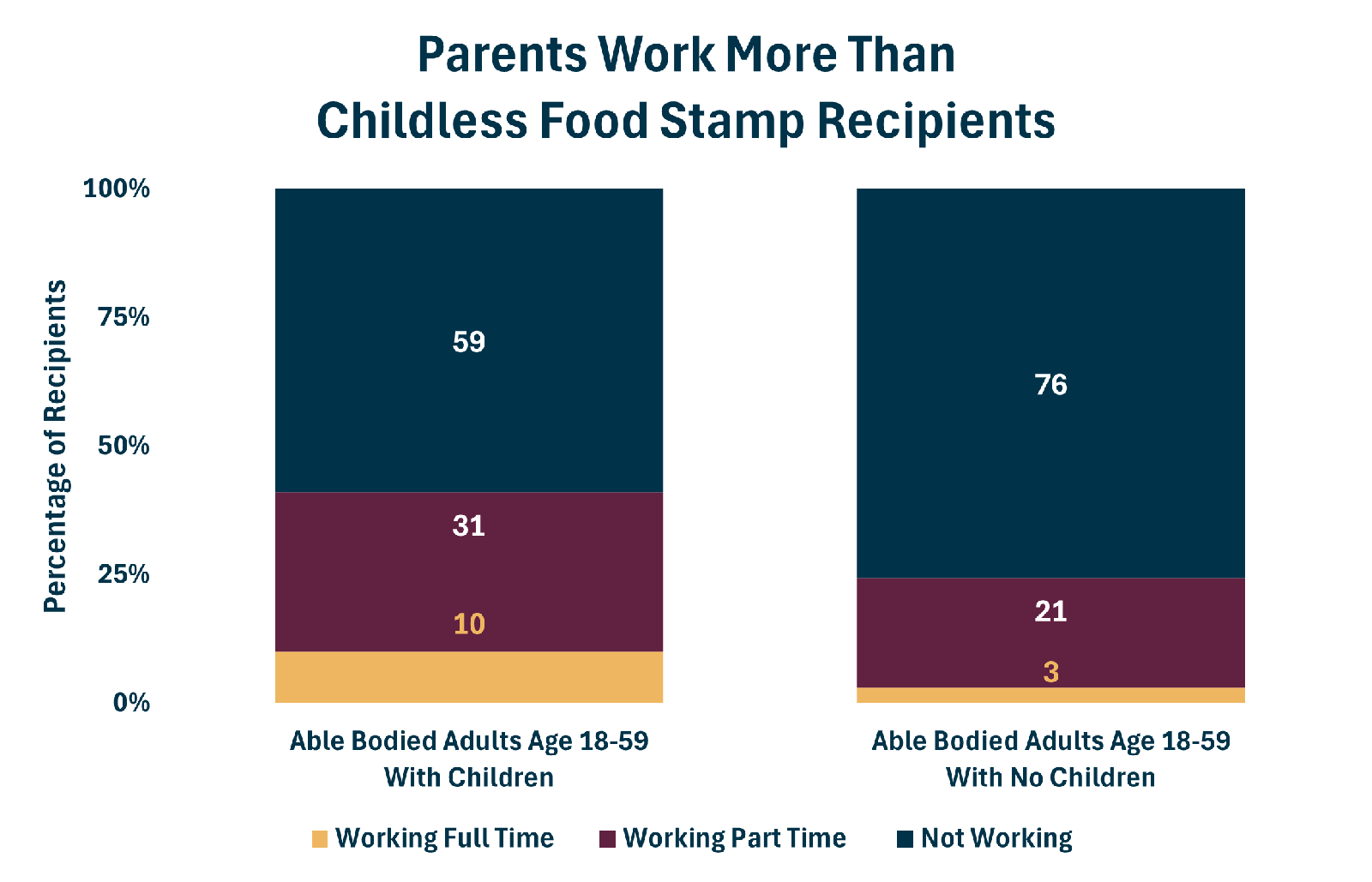
Although parents are currently excepted from the work requirements, they actually work more than the childless adults who are subject to the work requirement. Parents naturally want to work to provide a better future for their families rather than remain dependent solely on government welfare.
In
2022, 41 percent of able-bodied adults on food stamps with children worked, compared to just 24 percent of childless able-bodied adults. The difference in full-time employment is particularly stark, with more than three times the percentage of parents working full-time compared to non-parents.
Keeping the FRA Exceptions
Unfortunately, the reconciliation recommendations would continue temporary exceptions to the work requirements that were added by the
Fiscal Responsibility Act (FRA) of 2023. These new exceptions from Food Stamp work requirements for homeless individuals, veterans, and former foster care children would be continued through FY 2030.
These exceptions add more than $8 billion in costs to taxpayers over the budget window. Even worse, they weaken the work requirements and trap work-capable adults in dependance rather than help them become the self-sufficient members of society they could be.
One improvement on the FRA expansions is updating the definition for the homeless exception to require the person to be "currently homeless."
Regulations from the Biden Administration expanded this exception to include people who are not actually experiencing homelessness, but could be homeless in the future.
Limiting Waivers
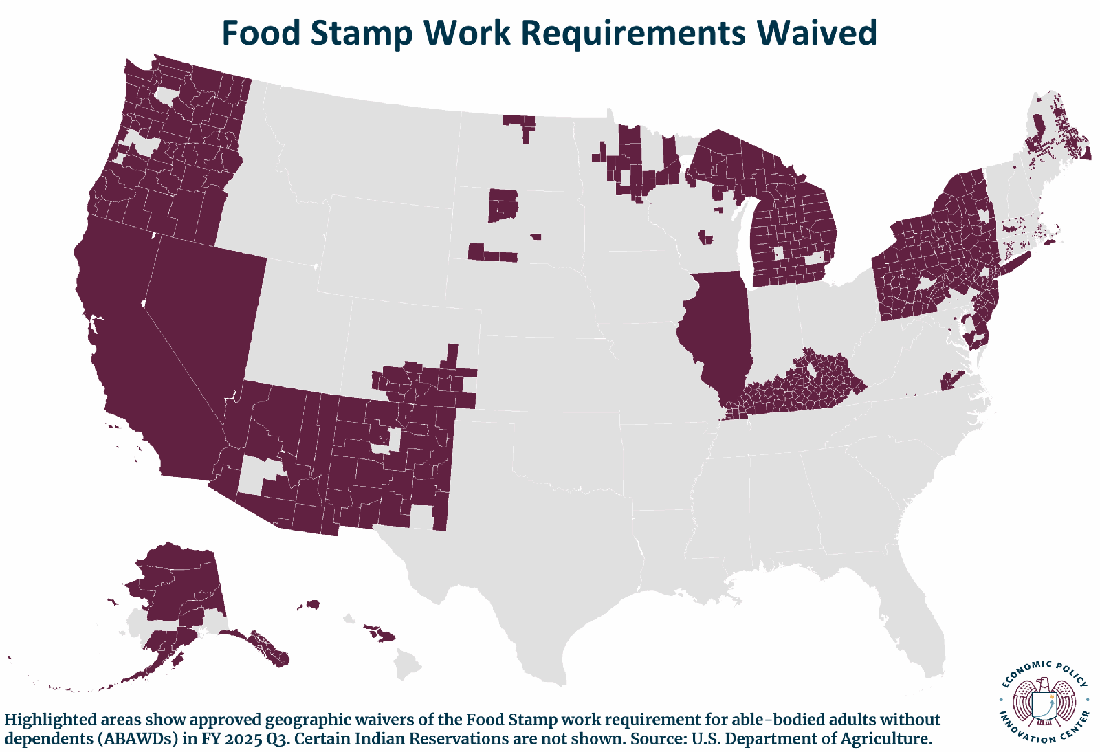
Waivers of the work requirement for able-bodied adults are a loophole that has gutted the work requirement, allowing millions of work-capable adults to receive Food Stamps without working.
States may request waivers of the work requirements for geographic “areas” deemed to lack a “sufficient number of jobs.” However, states and the USDA exploit these loosely defined terms and expansive regulations to gerrymander boundaries and use outdated data to exempt millions of able-bodied welfare recipients from work.
This loophole has allowed four states to waive work requirements statewide and 25 other states to implement partial waivers despite
modest unemployment rates and more than 7 million job openings.
Stopping Gerrymandering
The reconciliation recommendations would end gerrymandering by eliminating the subjective lack of "sufficient number of jobs” criteria. Instead, states would only be able to request a geographic waiver for a county (or county equivalent) that has an unemployment rate of over 10%.
This reform is critically important to enforce work requirements and limit abusive waivers.
Current
regulations allow states to support a claim of unemployment over 10% by showing "a recent 12 month average unemployment rate over 10 percent; a recent three month average unemployment rate over 10 percent; or an historical seasonal unemployment rate over 10 percent." While the definition could be tightened, this regulation avoids some of the worst abuses that allowed states to use years-old data to obtain a waiver for a lack of "sufficient number of jobs.”
Restricting Excessively Long Waivers
The reconciliation recommendations would also limit waivers to no more than 12 months. This limitation would prohibit waivers like
California's unusual two-year waiver that was approved by the lame-duck Biden USDA just five days before President Trump was sworn into office.
Limiting Discretionary Exemptions
After the exceptions and waivers, states are also allowed to apply a limited number of monthly
discretionary exemptions to individuals who are expected to, but nonetheless fail to satisfy the work requirement. These can be referred to as a “no good cause exemption.”
The FRA reduced the number of discretionary exemptions that states can provide each year to 8% of the caseload subject to the work requirement.
The reconciliation recommendations would further limit the discretionary exemptions to 1%.
Important Progress in Promoting Work
Work requirements as a condition of welfare benefits for able-bodied adults help move people off welfare and into the workforce.
The reforms included in the reconciliation recommendations represent important progress in addressing waste, fraud, and abuse. Eliminating these loopholes would restore Food Stamp program integrity while safeguarding assistance for the truly needy.