As Congress begins work on a new Highway Bill reauthorization, it is important to evaluate the provisions of the previous Highway Bill, the
Infrastructure Investment and Jobs Act (IIJA).
Costing $1.2 trillion, the IIJA was rife with
wasteful spending, including funding for
overpriced sidewalk projects purportedly for carbon reduction,
“equitable” electric vehicle charging stations, and grants to a
social justice community garden to remove a “racist” highway off-ramp. The bill also spent hundreds of millions of dollars on larger infrastructure projects of similarly questionable value to Americans under the
Mega Program.
Under the National Infrastructure Project Assistance Program in the IIJA (the “Mega Program”), state and local governments could receive federal funding for certain major infrastructure projects. Eligible projects included bridges, highways, and railroads. The program also allowed less vital infrastructure such as pedestrian crosswalks, bus lanes, and bike paths with bloated price tags.
Mega Spending on Equity Projects
In the section of the IIJA establishing the program, the law requires the U.S. Department of Transportation to pay special consideration to the “environmental benefits” of a proposed project, and whether it benefits “a historically disadvantaged community or population” or “an area of persistent poverty.” Many of the awards are measured on criteria such as “equity” or “climate change,” alongside factors such as “safety” and “economic impacts.” This distracts policymakers from what actually matters in determining the worth of a project.
Prioritization of resources should be toward projects that provide the most economic value relative to their cost, and federal funding should be focused on projects with high expected usage. Additionally, it would be prudent for federal infrastructure spending to skew toward national priorities first, benefitting all Americans rather than a particular subgroup.
With the federal government
rapidly approaching $39 trillion in gross debt, Congress must rein in spending. Large structural deficits leave the government with
little fiscal space to react to any emergencies that may arise, such as recent U.S. military actions in Iran. Federal infrastructure funding for highly localized projects that state and local governments could, and indeed should, handle themselves is not a key priority in this fiscal environment.
Below are a few examples of some concerning projects funded by the federal government under the Mega Program.
$78 Million - Racial Equity Boulevard, Philadelphia, PA
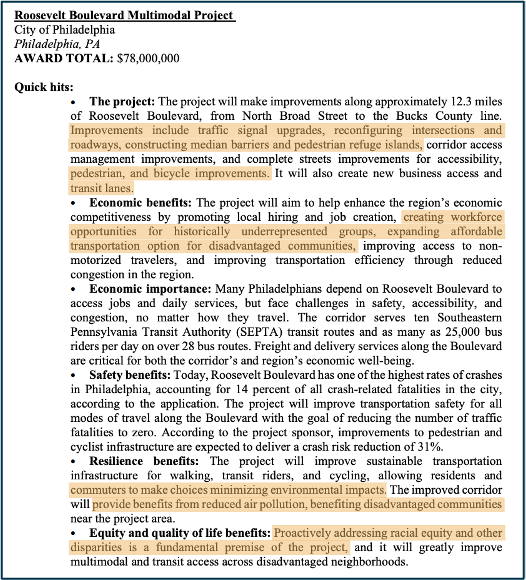
The City of Philadelphia received $78 million in fiscal year (FY) 2022 via the Mega Program to make improvements to a 12-mile stretch on Roosevelt Boulevard. These improvements consist of improving traffic signals, widening pedestrian sidewalks, and replacing vehicle lanes with bus and bike lanes. This project is highly localized in one city, makes relatively minor changes that reduce vehicle capacity and throughput, and demonstrates low national benefit.
According to the award, “
[p]roactively addressing racial equity and other disparities” was a “fundamental premise” of the project. The award also highlights some other ways “disadvantaged communities” and “underrepresented groups” will benefit from the project, seen below.
What all of that has to do with infrastructure of national importance is difficult to ascertain.
If the City of Philadelphia or the State of Pennsylvania believe Roosevelt Boulevard needs these improvements, they can fund this project themselves, even if they decide to prioritize racial equity as a “fundamental premise.” However, a local project aimed at helping particular “historically underrepresented groups” instead of all Americans should not be funded by the federal government, and a program funding them should not continue in future Highway Bills.
$54.5 Million - A Track Record of Failure, Madera County, CA
High speed rail (HSR) may seem like worthwhile infrastructure, but California’s HSR project has been continuously riddled with problems and delays. The project first broke ground in 2015, seven years after California voters first approved funding for it back in 2008. Construction cost estimates have ballooned from an initial $40 billion to $135 billion (over three times the original amount). Yet not a single line of track has been laid at the time of writing. For comparison, Japan’s successful HSR project, the Shinkansen,
took five years to be completed in the early 1960s.
The original goal of California’s HSR was to connect San Francisco and Los Angeles, but the scope has been
dramatically reduced. The current plan is to first connect the closer, smaller, and less economically significant cities of Merced and Bakersfield, and the current start date they hope to achieve for this limited line is 2033 — 25 years after this proposal was first approved by California voters. The California High Speed Rail Authority (CHSRA) itself has said that it is “
unlikely” that it will open even by that deadline.
The federal government
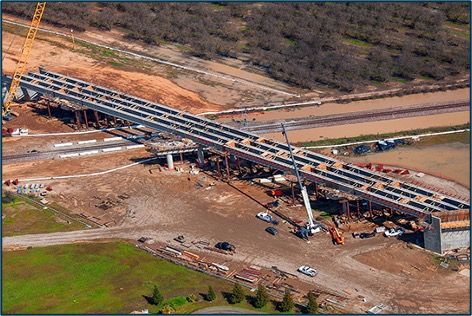
awarded Madera County over $54 million via the Mega Program to fund a train station for this failed HSR project in FYs 2025 and 2026. After 17 years of failure, delays, and budget overruns, it should have been apparent that giving more funding to this project would be throwing good money after bad. Unfortunately, the Biden Administration decided to award the project these funds. The grant award for this station in Madera County, a county with a total population of
around 165,000, mentioned that the project is “strong in Equity [sic],” and will build out bike lanes near the new station.
The Trump Administration has
terminated more than $4 billion dollars
in federal funding for California’s “train to nowhere.” While this is a great first step, it cannot recover the
billions of dollars the federal government already sunk into the California rail
boondoggle over the last decade. Policymakers would be wise to learn from these mistakes and not waste more money on projects with a consistent pattern of delays and a high likelihood of failure.
$96 Million - A Bike Path, Sidewalks, and Lighting, New York, NY
New York City is infamous for its
expensive public construction projects, with examples like
$1 million dollar public toilets. The final IIJA expenditure highlighted here is no exception. A project in New York City to reconstruct 1.35 miles of roadbed with a grade-separated bike path, curb extensions, raised crosswalks, and improved lighting
received $96 million via the Mega Program in FYs 2025 and 2026.
That is more than $71 million per mile of road in federal spending alone on the initiative. A similar project in Houston, TX, with improvements to a half-mile stretch of road is
estimated to cost $17.9 million, coming out to about $36 million per mile of road — half that of the New York City project.
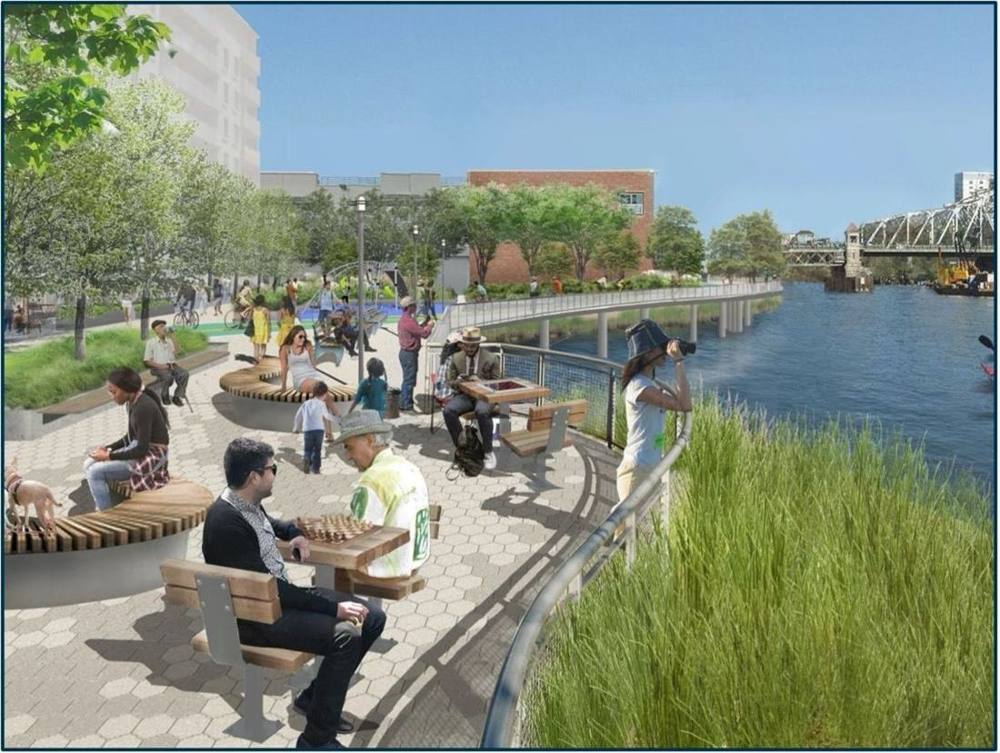
The NYC project another example of highly localized infrastructure that does not have clear benefits to the nation as a whole. The government of New York City, if it so chooses, could fund this project to “provide safer and more efficient transportation options for pedestrian/bicycle traffic,” rather than federal taxpayers footing the bill for what amounts to an overpriced bike path and curb extension.
The New York City Economic Development Corporation said in a press release
that the project will also “address traffic safety equity in Inwood, delivering a host of safety upgrades in an underserved area.” This calls into question if the purpose of the IIJA’s funding is for truly critical infrastructure needs, or advancing woke concepts like equity.
Out of Step Priorities
Even the potentially viable projects funded by the Mega Program couched their proposals in equity and environmental language. For example, Massachusetts bureaucrats wasted valuable time and resources arguing that replacing a
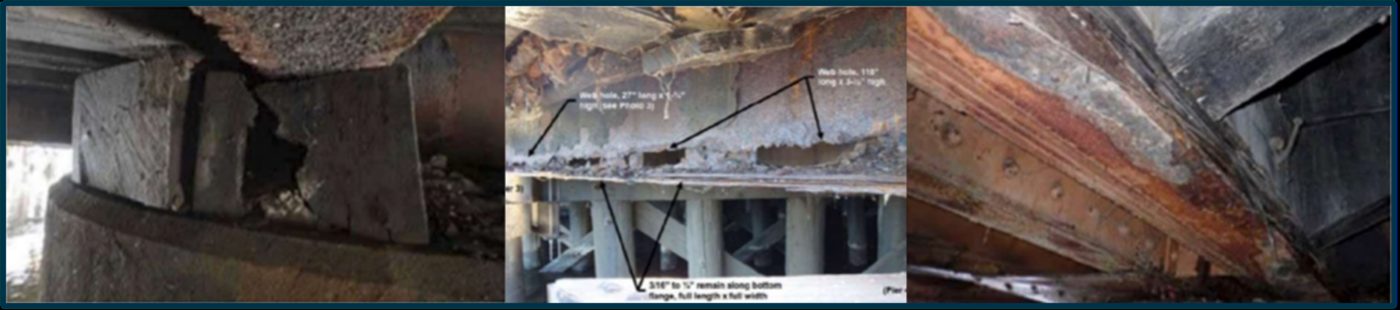
dilapidated Amtrak drawbridge would improve “climate change” and “environment,” instead of simply making the case that the drawbridge is in dire need of replacement. If the bridge is not replaced and the Amtrak train stops running in Boston, more people will switch to driving in cars and generate more carbon emissions. That is a secondary, or even tertiary effect to consider. Meanwhile, the main reason a project like this should be funded is clear given the erosion of its physical infrastructure. Pictured below is the bridge with holes, cracks, and rust throughout its structure.
This is a clear example of how including ideologically left-leaning language in infrastructure legislation misdirects attention from more immediate, important factors. Infrastructure should be evaluated based on its economic impacts, not ideological metrics that do not provide a measurable material benefit to the nation. It only distracts and delays the government from funding projects that do align with national priorities.
How Infrastructure Should Be Funded
The Mega Program has been infused with language that diminishes the importance of factors that are relevant to assessing the value of infrastructure. “Racial equity” and “climate change” should not be weighted equally to critical infrastructure maintenance for safety, improvements of national economic value, or other long-standing highway-related criteria.
This is especially the case given in the nation’s precarious fiscal state. There is no room for federal spending on projects with an ideological focus.
Projects funded by Congress should be measured with an eye on the economic benefit they will have regionally and nationally, and those that will have the most outsized and well-distributed benefits should be prioritized. Local projects, on the other hand, should be left to the cities and states. Policymakers should consider the lessons learned from the IIJA carefully in any future Highway Bill.