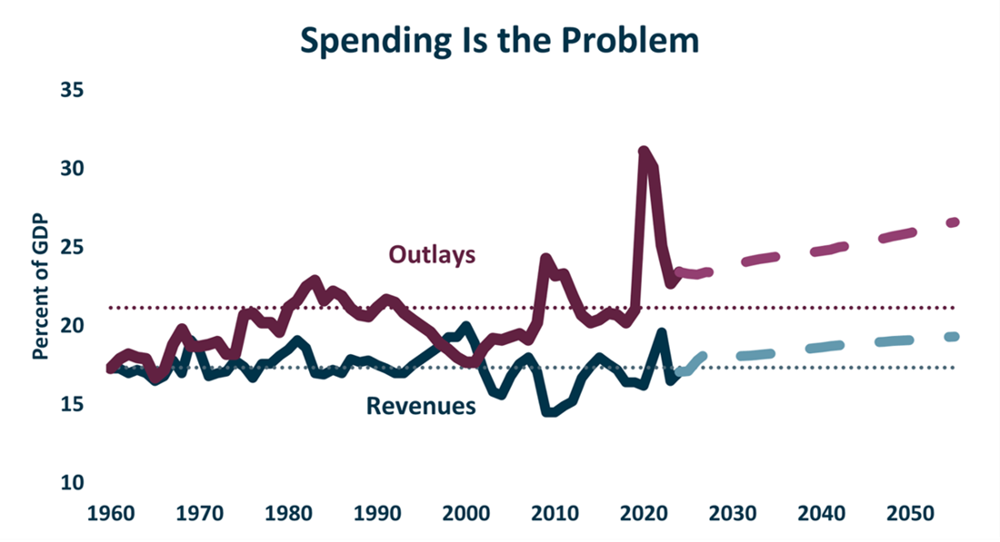
The fiscal state of our nation is deteriorating, and unsustainable spending is the underlying problem. The Department of Government Efficiency (DOGE) has done the important work of identifying billions of dollars in taxpayer savings. It is now Congress’s job to deliver on these reductions using its many legislative tools.
A Debt Disaster
Government spending that grows faster than the economy is inherently unsustainable over the long run. Excessive and irresponsible government spending has eroded Americans’ purchasing power and eroded public trust.
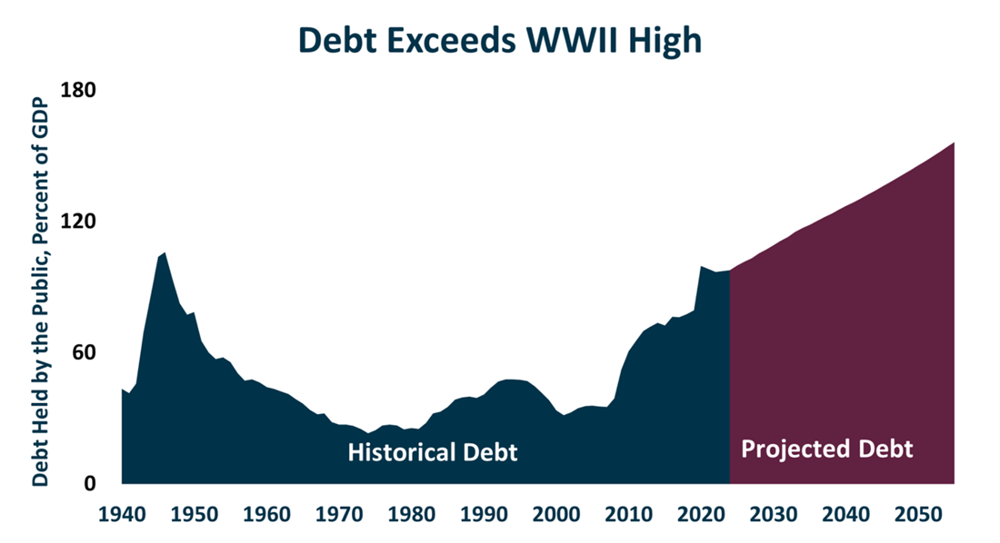
The national debt stands at its
highest level since World War II, and it will soon eclipse the record high. Federal debt held by the public is currently equivalent to the size of the economy. After WWII, debt declined sharply as government spending receded. However, the CBO projects debt to rise to 156 percent of GDP over the next three decades, under a baseline that assumes steady economic growth, no recessions, no significant natural disasters, and no wars.
President Biden’s executive actions added more than $2 trillion in spending without explicit approval from Congress, according to
calculations from the House Budget Committee. The Biden Administration spent hundreds of billions transferring student loan debt to the taxpayers from borrowers, unilaterally increasing Food Stamp benefits, gutting Medicaid eligibility verification, and more.
The growing debt risks evaporating the government’s fiscal space, which is its capacity to borrow without undermining debt sustainability or risking a loss of market confidence. When the fiscal limit is approached, a debt spiral can occur.
In contrast to the $2 trillion in costs added by the Biden Administration executive actions, President Trump has focused on reducing costs for the taxpayers. In just five months, DOGE claims to have
saved $180 billion, as of June 16, 2025, which amounts to $1,118.01 per taxpayer. These savings have been accomplished through a combination of asset sales, contract cancellations, and fraud and improper payment reduction.
Although DOGE’s savings are a good start, there is more work to do to correct the budget. Changes made administratively do not carry the same potential for long-lasting changes as legislative actions do. Congress has an opportunity to
partner with DOGE and continue using rescissions and reconciliation to reduce wasteful government spending and avert a fiscal disaster.
Legislative Paths to a Prosperous Future
Appropriations: The most straightforward way to control waste, fraud, and abuse is by controlling agency budgets through the annual
appropriations process. As part of this annual process, the House and Senate Appropriations Committees consider adjustments to thousands of spending accounts. Discretionary outlays are projected to total $1.8 trillion this year and $21 trillion over the next decade under CBO’s modest growth projections.
Reducing the Federal Workforce: Another method of reducing federal debt and long-term federal liabilities is to
reduce the size of the federal workforce. The federal government employed about
2.4 million full-time equivalent civilian workers (excluding the Postal Service) at the end of fiscal year 2024. The average federal worker earns a salary of
more than $106,000, plus a generous benefits package that includes a defined benefit pension plan, a defined contribution retirement plan, health insurance, disability insurance, life insurance, and four types of paid leave benefits. These benefits are worth on average
43 percent more than the typical private sector package.
Authorizations: While the Appropriations Committee takes the lead in reducing the funds provided to woke and wasteful agencies, the Congressional authorizing committees have an important role to play as well. The scope of authorized agency activities should also be properly limited to what is necessary and proper to carry out core programs.
Rescissions: One important opportunity to reduce wasteful government spending is the power to rescind unneeded appropriations. Budget authority that has not yet been obligated by an agency can be canceled by new laws passed by Congress, preventing the funds from being obligated and spent. This cancellation of budget authority is called a
rescission. DOGE has already identified billions in waste, fraud, and abuse of the taxpayers’ money. Rescinding unneeded and harmful appropriations is the natural next step to follow up on the important work that has been done.
Reconciliation: One of the most important tools at Congress’s disposal to achieve budget savings is the reconciliation process. Reconciliation is a powerful fast track procedure that can be passed by simple majorities in the House and Senate, bypassing the 60-vote filibuster. The purpose of reconciliation is to align spending and tax laws with the adopted Congressional budget resolution.
America’s fiscal trajectory is unsustainable, but not irreversible. DOGE has demonstrated that meaningful savings are achievable. By exercising its Constitutional power of the purse, controlling appropriations, workforce reforms, rescissions, and reconciliation, Congress can lock in the DOGE cuts, safeguard taxpayers, and avert a fiscal crisis.