My name is Rachel Greszler, and I am a Visiting Fellow in Workforce at the Economic Policy Innovation Center (EPIC) and a Senior Fellow in Workforce and Public Finance at the Heritage Foundation. The ideas I express in this testimony are my own and do not necessarily represent an official position of EPIC or the Heritage Foundation.
In my testimony today, I will: (1) provide a snapshot of younger Americans’ employment trends; (2) identify government policies that are holding back better education options, (3) highlight positive education momentum and offer further solutions; and (4) note the high stakes that demographic and fiscal challenges pose for younger Americans.
1. America’s Younger Workforce is Lacking and Education is Part of the Problem
Today, fewer than half of young Americans are working—a sharp decline from the turn of the 21
st century. At the same time, K-12 education has languished across many states, and students are leaving college with more debt and fewer skills.
Troubling trends in youth employment and work preparedness. Since 2000, the employment-to-population ratio of younger Americans ages 16 to 24 has declined by 11.2 percentage points, from 58.9 percent in January 2000 to 48.6 percent in August 2025. This represents a loss of nearly 4.5 million younger workers.
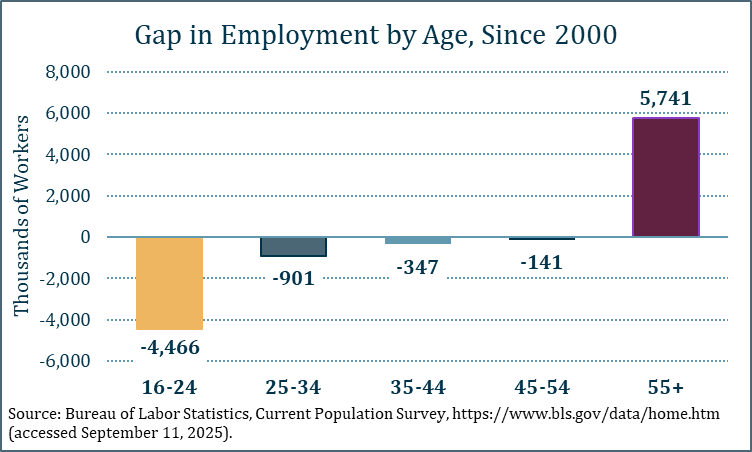
The decline in teen employment has been especially pronounced, falling by 15.6 percentage points between 2000 and 2025 (from 45.6 percent in January 2000 to 30.0 percent in August 2025). This is regrettable as teen employment provides experience and life lessons that teach youth the importance of key skills like: showing up on time; demonstrating respect and kindness to co-workers and customers; staying on task even when it is difficult or boring; and disconnecting from screens and interacting face-to-face.
These troubling trends in youth employment come alongside some troubling trends in K-12 education, including grade inflation, weakened accountability, and stagnant or declining test scores.
[1] Moreover, studies have documented a decline in other personal characteristics that contribute to success in school, work, relationships, and overall well-being.
[2]
For example, scholar Samuel J. Abrams said that, over the past two decades, we have been witnessing “the quiet unraveling of a trait that built civilization.”
[3] That trait is conscientiousness, and it is generally associated with tendencies to be careful, disciplined, persistent, and dependable. As Abrams noted,
“Between 2014 and 2024, conscientiousness scores among Americans aged 16–39 dropped more sharply than any personality shift in recorded history. Younger cohorts report feeling 20 percent more distracted and careless than just a decade ago. They demonstrate less tenacity, make fewer commitments, and struggle to follow through on the ones they do make. Most alarming: the steepest declines occur during the transition from adolescence to early adulthood—precisely when character traits typically solidify for life.”[4]
While families play the most important role in shaping children’s outcomes, most children spend a large portion of their lives in K-12 schools, which consequently have a significant impact on their futures. Weakened rigor and lack of discipline in K-12 schools—often associated with “social-emotional learning” and “restorative justice”—are contributing to less educated, less disciplined, and less resilient young adults.
This decline in work preparedness is not just a cultural trend or K-12 educational problem; it is compounded by federal policies that create barriers to better education options and that discourage, rather than encourage, work.
2. Government Policies Are Holding Back Opportunity and Growth
Education is central to developing workers’ knowledge and skills and matching them to a changing economy. Yet, instead of fostering innovation and opportunity, government policies have too often created barriers and harbored lackluster education systems. Through its near-monopoly on student lending, crowding out of education alternatives, and regulatory strings, Washington has driven up education costs, narrowed choices, and left students with fewer skills.
While states and local governments have room to improve K-12 education—by raising standards, focusing on proven teaching methods and civics education, and expanding career and technical education pathways—the focus of my testimony is on what the federal government should do to expand post-secondary education options outside of four-year degree programs.
Current barriers to better education options include:
Perverse federal higher education subsidies. The federal government has a near-monopoly on student lending, holding more than 90 percent of outstanding debt, and spending hundreds of billions of dollars annually on subsidies. These subsidies have distorted the market for higher education, driven up the cost of college, enabled low-and negative-return programs, and encouraged too many students to pursue higher education and to take longer to complete it.
Between 1994 and 2024, federal student aid nearly tripled in real terms and in-state tuition and fees at public four-year universities more than doubled in real terms.
[5] A Federal Reserve Bank of New York study directly ties costs increases to government subsidies, estimating that each $1 in federally subsidized loans leads to a 60-cent tuition increase.
[6] Instead of increased value, however, the additional dollars have gone towards bigger education bureaucracy, with instructional staff accounting for only 40 percent of full-time employees at non-doctoral colleges, and a mere 28 percent at doctoral universities.
[7]
By shifting costs from students to taxpayers, federal subsidies have also propped up irrelevant programs and reduced on-time graduation rates. Preston Cooper of the Foundation for Research on Equal Opportunity estimates that 37 percent of undergraduate and more than 40 percent of master’s programs have a negative return on investment.
[8] Moreover, fewer than half of students earn a degree in the expected four years, and only three in five earn a degree in six years.
[9]
Federal policies crowding out alternative secondary education options. By making it easier and less costly for students to pursue four-year degree programs, federal policies have crowded out more efficient education options. For example, performance-based educational programs like the Flatiron School and other bootcamp-style programs are teaching a growing number of people, many of whom have no technical background, the skills they need to succeed in high-demand jobs, such as data scientist, software engineer, and cybersecurity engineer, in only 15 weeks.
[10] Many of these programs offer the option of an income share agreement (ISA) whereby, instead of paying tuition up front, students can instead pay a small percentage of their post-graduation salary for a fixed amount of time upon graduation.
[11] Under ISAs, the incentives are aligned: since tuition payments are directly tied to students’ future jobs and incomes, programs have a direct incentive to provide education for in-demand occupations and to teach students skills that are highly valued in the labor market.
Burdensome federal regulations limit apprenticeships. Apprenticeships are a proven pathway for students to gain on-the-job education and training for successful careers—and to get paychecks in the process, instead of paying tuition. Yet, the combination of higher education subsidies and the federal government’s monopoly on apprenticeships—through exceedingly bureaucratic and burdensome Registered Apprenticeship Programs—has prevented apprenticeships from expanding to meet evolving workforce needs. A 2017 Harvard study estimated that the number of occupations commonly filled through apprenticeships could nearly triple (from 27 to 74), that the number of job openings filled through apprenticeships could expand eight-fold (to 3.2 million), and that the occupations ripe for apprenticeship expansion could offer 20 percent higher wages than traditional apprenticeship occupations.
[12]
In 2017, the first Trump Administration created a new and simplified Industry Recognized Apprenticeship Program (IRAP) to expand apprenticeships and better align them with industry needs. Within a few years, about 130 IRAPs were created with many focused on developing workers for the nursing profession, which continues to face shortages. Despite the promise of IRAPs, the Biden Administration cancelled them and instead issued hundreds of pages of proposed new apprenticeship regulations that—had the Biden Administration finalized them before leaving office—could have had devastating impacts on apprenticeships and career and technical education in America.
[13]
Failed federal job training programs. The federal government spends billions of dollars each year on more than 40 job training programs that span nine different agencies.
[14] These programs consistently fail to provide workers with the education and experience that helps them to find and retain jobs. Even a gold-standard evaluation of the federal government’s Workforce Investment Act, which is supposed to provide training for in-demand services, found that only 32 percent of participants found occupations in their area of training, and those who received the full workforce training had lower household incomes and were more likely to be on food stamps than participants who received minimal services. The National Job Corps Study, which evaluated the federal government’s primary program for youth, found that a federal taxpayer investment of $25,000 per Job Corps participant resulted in participants being less likely to earn a high school diploma and no more likely to attend or complete college.
[15]
Federal welfare without work discourages employment. For an ample and engaged workforce, it must pay to work, and it cannot pay to
not work. Excessive welfare-without-work benefits are increasingly tipping the scales away from work by making it easier for able-bodied individuals to get by, or even live comfortably, without meaningful work. In 2024, the federal government spent over $1.6 trillion on transfer payments, which equals $12,200 for every household in America (this excludes Social Security and Medicare payments). Policies like expanded Obamacare tax credits for the well-to-do and the federal government paying nearly seven times as much in Medicaid benefits for work-capable adults as it does for pregnant women, the elderly, and the disabled defy the purposes of welfare. Welfare is meant to aid those who cannot aid themselves and to provide temporary assistance for those who need a bridge to independence.
[16]
Regulatory barriers impede jobs and rising wages. Regulations are a hidden tax that holds back job creation and limits compensation. The Competitive Enterprise Institute estimates that regulations impose an annual burden of $2.155 trillion, which amounts to over $16,000 per U.S. household.
[17] Money that is spent—primarily by employers—complying with regulations is money they cannot go to workers in the form of higher pay and benefits, or to additional jobs.
Regulations have a particularly high cost in some industries, such as manufacturing. According to a study commissioned by the National Association of Manufacturers, the average regulatory costs for manufacturing employers equal $29,100 per employee.
[18] Among small manufacturers who have fewer than 50 employees, regulatory costs equal an estimated $50,100 per employee.
[19]
In addition to regulations, government mandates on employers—such as minimum wages, health insurance mandates, and paid leave requirements, increase employers’ costs to levels that prevent certain people—predominantly teenagers and individuals with low education, limited English, or criminal histories—from getting the first jobs they need to climb the career ladder. A yet-unpublished economic analysis that I am conducting finds a significant negative relationship between states’ minimum wage levels and their youth employment rates and hours of work (youth are defined as between ages 16 to 24).
3. Positive Momentum and Continued Reforms Offer Hope for Good Jobs, Rising Incomes, and the Dignity of Work
The good news is that states and communities are showing what works and new federal policies will open more doors to better education opportunities.
Expansion of K-12 school choice in the states.
States like Florida and Arizona have led the way by—beginning decades ago—providing parents with a choice in their children’s schools, and now they and other states are improving education options and outcomes by reviving civics education, ensuring teacher freedom and academic transparency, and expanding school choice. According to the Heritage Foundation’s 2025 Education Report Card, the number of students benefitting from private K-12 school choice more than doubled between 2020 and 2025.
[20] And as a result of increasing state school choice legislation, half of all students in the United States are now eligible for a private choice program.
[21]
Phone-free K-12 schools. Cell phones distract from learning, exacerbate students’ anxiety, and can create intimidating and inhospitable social environments—even increasing school violence. Florida was the first state to pass a school-day ban on cell phones in 2023, and now 17 additional states and the District of Columbia have passed such laws.
[22] Another seven states ban them during instructional time, and 11 others require that local districts implement cellphone policies. Students learn better when they are not distracted by or anxious about what is happening on their and other students’ cell phones. Phone-free zones also encourage face-to-face interactions, enable healthier friendships, and improve student safety.
Building bridges from K-12 education to careers: West Alabama Works. One example of how local areas are coordinating their educators and employers is West Alabama Works. This regional workforce development organization, which operates across nine counties in Alabama, establishes partnerships to ensure that local schools align their education with the needs of regional industries. This includes providing students with clear pathways and hands-on training opportunities, such as programs that combine 2 days of education with 3 days of on-the-job paid training. And to increase awareness of career options, West Alabama Works holds a 2-day, interactive Worlds of Work, or WOW, career expo, including more than 100 employers, that is mandatory for all ninth graders. For seniors, WOW 2.0 provides an opportunity for students to secure contingent job offers before graduation.
Expanded use of 529 plans. The One Big Beautiful Bill Act (OBBBA) doubled the amount that families can withdraw—from $10,000 to $20,000 annually—to pay for private K-12 education and expanded the definition of qualified expenses. Families can also now use their 529 accounts to pay for many non-traditional or homeschooling expenses, as well as postsecondary credentialing costs.
[23]
Expansion of Pell Grants for workforce education. The OBBBA created a new category of Workforce Pell Grants that can be used for shorter-term job training programs. This expansion will increase students’ options for effective job-focused training, including allowing them to complete more than one program.
Student loan limits. The combination of phasing out the Grad Plus loan program, reducing overall graduate program lending, and imposing lifetime loan limits across all federal student loans will reduce the number of students who take out loans to pursue low- and negative-return investments.
Imposing accountability on low-earning outcome programs. The OBBBA will improve students’ educational returns by preventing federal subsidies from going towards four-year degree programs in which the average graduate does not earn more than the average high school graduate. This will improve the quality of existing degree programs and deter students from pursuing low-return programs.
Work requirements in SNAP. Enrollment in and spending on the Supplemental Nutrition Assistance Program (SNAP) increased in recent years to a record 42 million Americans receiving food stamps at a cost of $100 billion in FY 2024.
[24] The OBBBA includes basic work requirements such that able-bodied individuals without dependents under age 14 must participate in 80 hours per month (20/week) of “community engagement” that can include work, volunteering, or education. This commonsense requirement will help put more able-bodied and non-working Americans on a path to self-sufficiency and success.
Work requirements for Medicaid. The availability of free health insurance serves as a deterrent to work. Similar to the new SNAP work requirements, the OBBBA requires states to establish 80 hours/month “community engagement” requirement for able-bodied adults without dependents under age 14. As with SNAP, this requirement will help more Americans achieve higher incomes and realize the dignity of work
Growth in employer-driven education. Employers have responded to skills gaps and worker shortages by providing their own skills-based education programs. Among some of the many employer-driven programs include: Google Career Certificates, Amazon Technical Academy, IBM training programs,
[25] Bank of America’s Pathways Program,
[26] and Mazda’s education initiative at its Alabama manufacturing plant.
[27] Employer-driven education can be a win-win; instead of sacrificing years of earnings potential and paying tens of thousands of dollars, on-the-job education programs provide opportunities for workers to get a free education (often while being paid) and opportunities for employers to attract and retain workers with the skills they need.
Growth in industry-driven education. The Federation for Advanced Manufacturing Education, or FAME, is an “earn-and-learn” apprenticeship program that was founded by Toyota in 2010 and is now managed by the Manufacturing Institute. Through this two-year program, students spend two days a week in community college classes and at least three days a week in a paid position at a sponsoring manufacturer. Students graduate with an associate’s degree in Advanced Manufacturing Technology, little or no debt (their wages are high enough to cover tuition and other expenses), and a 90 percent job placement rate (usually with their sponsoring employer). In addition to boasting graduation rates 2.5 times as high as their non-FAME peers, FAME participants earned 60 percent more than their non-FAME peers one year after completion and 86 percent more five years after completion.
[28]
Room to Grow: Opening More Doors to Education Opportunities
While significant progress is underway, there is still much that can be done to expand education opportunities, along with the jobs, rising incomes, and dignity that education yields. Specifically, federal policymakers should:
Expand apprenticeships. Apprenticeships are a proven alternative to degree programs, but a government monopoly on burdensome Registered Apprenticeship Programs prevents apprenticeships from expanding outside a small number of trades. The Apprenticeship Freedom Act
[29] and the Training America’s Workforce Act
[30] would allow apprenticeships to expand across more industries, resulting in more young people receiving on-the-job, paid education on the path to a successful career
.
Reform federal accreditation. Current accreditation requirements for federal student loans and grants crowd out alternative, and often more effective, education options. The Higher Education Reform and Opportunity (HERO) Act would expand the use of federal aid to include state-credentialed institutions and individual courses, allowing students to have a more customized higher education experience and to enter the labor market sooner and with less debt.
Phase down federal subsidies for higher education. Federal subsidies for higher education inflate total costs, reduce the returns to higher education, and enable higher education institutions to fail at providing relevant education. Lack of preparedness for the workforce is an increasingly common complaint among employers of new graduates. Policymakers should phase down federal subsidies for higher education to shift financing to more effective private financial institutions and to schools that will only finance effective education programs.
Replace failed government job training with employer-led education. Federal workforce programs have an unfailing record of failure. Meanwhile, many employers are eagerly providing education and training—often with no experience or degree—to meet their own workforce needs.
[31] Without the welfare complex funneling individuals into failed federal job training programs, more people would pursue successful employer-provided job training. Policymakers should wind down federal job training programs by offering state and local governments the opportunity to take over their funding and operations. Any remaining federal job training programs should have their funding tied to proven outcomes of success.
[32]
Require work-oriented welfare. Welfare for work-capable adults should be temporary and empower people, through work, to earn a living and pursue their goals. Utah’s “One Door” system provides an effective model for integrating work-oriented welfare and workforce support, resulting in significantly higher employment rates. But federal rules currently prohibit other states from enacting similar models.
[33] Federal policymakers should allow all states to pursue Utah’s successful “One Door” welfare and workforce model.
[34] The One Door to Work Act (H.R. 2651) would give states demonstration authority to pilot “One Door” systems.
[35]
Limit welfare to the welfare-eligible. Each year, federal programs issue upwards of $150 billion in improper payments, with most of those payments stemming from welfare programs. The biggest culprits of wrong payments include Medicaid and child-related programs in which individuals claim benefits on behalf of children who are not their dependents. Federal policymakers should enhance secure data sharing, tighten eligibility verification, and hold federal agencies and states accountable for their improper payments.
[36]
Reduce costly regulations. Regulations are a hidden tax on education alternatives, entrepreneurship, job creation, and workers’ compensation. A 2025 analysis by Bill Beach and Parker Sheppard found that simply freezing regulations would increase real GDP by 2.1 percent in 2035. Actually reducing regulations—including the Trump Administration’s initiative to eliminate 10 regulations for each new regulation issued—would result in significantly greater growth, including greater job creation and higher income growth.
[37]
4. Demographic and Fiscal Challenges Create High Stakes For Younger Generations
A decline in life skills and work readiness, and barriers to better education options are particularly troubling in light of America’s demographic and fiscal outlook. According to a 2020 report by the U.S. Census Bureau, “[b]etween 2016 and 2060, the population under age 18 is projected to grow by only 6.5 million people, compared with a growth of 45.4 million for the population 65 years and over.”
[38] And beginning in 2034, older Americans will outnumber children for the first time ever in U.S. history.
Today’s young Americans will have to meet the workforce needs of an increasingly aging population. Their failure to do so will result in a smaller economy and further deterioration in the U.S. fiscal outlook. According to a March 2025 report by the Congressional Budget Office, a 0.1 percentage point reduction in labor force growth over the next 10 years would reduce real GDP by 0.7 percentage points and increase federal deficits by 0.8 percent in 2035.
[39]
The same younger generations who will face increasing workforce demands will also have to confront the federal government’s unsustainable spending and debt. According to the CBO’s most recent projections, federal debt is expected to rise from $37 trillion or $280,000 per household today to $59 trillion or roughly $420,000 per household in 2035. That makes the federal debt equivalent to the cost of a second mortgage for today’s younger generations.
[40] And it increases the threat of a fiscal crisis. According to Economic Policy Innovation Center President Paul Winfree’s analysis of the United States’ fiscal space, the current fiscal trajectory is likely to trigger a debt spiral—meaning economic growth cannot keep pace with exponentially rising debt—within a decade.
[41]
The current demographic and fiscal outlook make it all the more important that America’s youth have access to education that fosters capable and resilient adults and equips them with the skills and experience needed for careers that strengthen the economy and provide dignity in work.
Summary
America’s young workforce faces serious challenges as millions fewer young people are working today than in the past. Many K-12 schools are failing to instill the discipline, knowledge, and skills needed for success. At the same time, federal higher education subsidies have fueled tuition inflation and low-return programs while crowding out better alternatives. And federal welfare policies have discouraged work.
Encouragingly, positive reforms in the private sector and at the state and federal level are pointing the way forward. Employers are investing in focused education to improve workers’ skills and compensation. States like Florida and Arizona lead the way on K-12 education opportunities and outcomes, and regional partnerships like West Alabama Works are giving students hands-on pathways into well-paying careers. The OBBBA builds on this momentum by expanding 529 educational accounts, creating new Workforce Pell Grants, limiting excessive federal student loan subsidies, preventing loans for low-return programs, and restoring work requirements in key welfare programs.
Federal policymakers should build on these positive reforms by expanding apprenticeships, phasing down distortionary higher education subsidies, replacing failed federal job training programs, enabling states to adopt “One Door” welfare models, and reducing costly regulations. These actions will open doors to education opportunities that can provide Americans with the knowledge and experience they need to obtain good jobs, rising incomes, and the dignity of work. With looming demographic and fiscal challenges, ensuring that young Americans are equipped for meaningful work is not only vital for their dignity and purpose, but for the nation’s long-term economic strength and stability.
[1] Stagnant and declining test scores are based on the National Assessment of Educational Progress, or NAEP.
[2] “Understanding America Study,” USC Dornsife Center for Economic and Social Research,
https://uasdata.usc.edu/index.php (accessed September 15, 2025).
[3] Samuel J. Abrams, “The Quiet Crisis: Why Conscientiousness Matters More Than Ever,” American Enterprise Institute, August 11, 2025,
https://www.aei.org/society-and-culture/the-quiet-crisis-why-conscientiousness-matters-more-than-ever/ (accessed September 12, 2025).
[4] Ibid.
[5] Jennifer Ma, Matea Pender, and Meghan Oster, “Trends in College Pricing and Student Aid 2024,” The College Board,
https://research.collegeboard.org/https://epr-creations.github.io/epic-media/pdf/Trends-in-College-Pricing-and-Student-Aid-2024-ADA.pdf (accessed September 12, 2025).
[6] David O. Lucca, Taylor Nadauld, and Karen Shen, “Credit Supply and the Rise in College Tuition: Evidence from the Expansion in Federal Student Aid Programs” Federal Reserve Bank of New York Staff Report No. 733, July 2015, revised February 2017, p. 19,
https://www.newyorkfed.org/medialibrary /https://epr-creations.github.io/epic-media/research/staff_reports/sr733.pdf (accessed September 12, 2025).
[7] Preston Cooper, “Why College Is Too Expensive—and How Competition Can Fix It,” The Foundation for Research on Equal Opportunity, March 5, 2021, https://freopp.org/why-college-is-too-expensive-and-how-competition-can-fix-it-cb2eb901521b (accessed September 15, 2025).
[8] Preston Cooper, “Is College Worth It? A Comprehensive Return on Investment Analysis,” The Foundation for Research on Equal Opportunity, October 19, 2021, https://freopp.org/is-college-worth-it-a-comprehensive-return-on-investment-analysis-1b2ad17f84c8 (accessed September 15, 2025), and Preston Cooper, “Is Grad School Worth It? A Comprehensive Return on Investment Analysis,” The Foundation for Research on Equal Opportunity, March 31, 2022, https://freopp.org/is-graduate-school-worth-it-a-comprehensive-return-on-investment-analysis-a84644f29f9 (accessed September 15, 2025).
[9] National Center for Education Statistics, Digest of Education Statistics, 2021, Table 326.10, “Graduation rate from…” https://nces.ed.gov/programs /digest/d21/tables/dt21_326.10.asp (accessed April 7, 2022).
[10] Liz Eggleston, “All About ISAs: Income Share Agreements and Deferred Tuition at Coding Bootcamps,” Course Report, updated March 30, 2022, https://www.coursereport.com/blog/deferred-tuition-and-isas-at-coding-bootcamps (accessed September 15, 2025).
[11] Mary Clare Amselem, “Income Share Agreements Have the Potential to Revolutionize College Financing,” Heritage Foundation Issue Brief No. 4910, October 19, 2018, https://www.heritage.org/education/report/income-share-agreements-have-the-potential-revolutionize-college-financing.
[12] Joseph B. Fuller and Matthew Sigelman, “Room to Grow: Identifying New Frontiers for Apprenticeships,” Harvard Business School and Burning Glass Technologies, November 2017, https://www.hbs.edu/managing-the-future-of-work/Documents/room-to-grow.pdf (accessed September 15, 2025).
[13] Rachel Greszler, “Three Strikes Against Apprenticeships,” Economic Policy Innovation Center, April 29, 2024,
../../education-workforce-retirement/three-strikes-against-apprenticeships/ (accessed September 15, 2025).
[14] U.S. Government and Accountability Office, “Employment and Training Programs: Department of Labor Should Assess Efforts to Coordinate Services Across Programs,” March 28, 2019,
https://www.gao.gov/products/gao-19-200, (accessed September 15, 2025).
[15] David B. Muhlhausen, “Job Corps: An Unfailing Record of Failure,” Heritage Foundation
WebMemo No. 2423, May 5, 2009,
https://www.heritage.org/jobsand-labor/report/job-corps-unfailing-record-failure (accessed September 15, 2025).
[16] Matthew Dickerson, “Washington Pays More to Cover Medicaid for Healthy Adults than the Vulnerable,” May 7, 2025,
../../social-programs/washington-pays-more-to-cover-medicaid-for-healthy-adults-than-the-vulnerable/ (accessed September 15, 2025), and Matthew Dickerson, “Let Biden’s COVID Credits Expire,” Economic Policy Innovation Center, August 13, 2025,
../../federal-budget/let-bidens-covid-credits-expire/ (accessed September 15, 2025).
[17] Clyde Wayne Crews, “Ten Thousand Commandments, 2025,” April 24, 2025,
https://cei.org/studies/ten-thousand-commandments-2025/ (accessed September 13, 2025).
[18] Nicole V. Crain and W. Mark Crain, “The Cost of Federal Regulation to the U.S. Economy, Manufacturing and Small Business,” A Study Conducted for the National Association of Manufacturers, October 2023,
https://nam.org/wp-content/uploads/2023/11/NAM-3731-Crains-Study-R3-V2-FIN.pdf (accessed September 13, 2025).
[19] Ibid.
[20] Heritage Foundation, “Education Freedom Report Card: State Rankings for Parents,” September 4, 2025,
https://www.heritage.org/educationreportcard/ (accessed September 15, 2025).
[21] Ibid.
[22] In Florida and Georgia, the “bell-to-bell” bans are only mandatory for grades K-8. Jeff Amy, “Students face new cellphone restrictions in 17 states as school year begins,” Associated Press, August 21, 2025,
https://apnews.com/article/schools-cellphone-bans-social-media-parents-d6464fbfdfae83189c752fe0c40fd060 (accessed September 13, 2025).
[23] Sarah Wagoner, “School Choice Wins Deserve Celebration in the OBBB,” Economic Policy Innovation Center, August 28, 2025,
../../education-workforce-retirement/school-choice-wins-deserve-celebration-in-the-obbb/ (accessed September 15, 2025).
[24] USDA, “Supplemental Nutrition Assistance Program (SNAP) - Key Statistics and Research,” Economic Research Service, July 24, 2025, https://www.ers.usda.gov/topics/food-nutrition-assistance/supplemental-nutrition-assistance-program-snap/key-statistics-and-research (accessed September 14, 2025).
[25] Amazon, “Amazon Helps Employees Become Software Engineers in 9 Months,” updated February 2, 2022, https://www.aboutamazon.com/news /workplace/amazon-helps-employees-become-software-engineers-in-9-months (accessed September 15, 2025), and Sonia Malik, “Start on the Path to Lifelong Learning and Employability with IBM,” IBM Training and Skills Blog, June 1, 2021, https://www.ibm.com/blogs/ibm-training/start-on-the-path -to-lifelong-learning-and-employability-with-ibm/ (accessed September 15, 2025).
[26] Bank of America, “Career Development,” https://careers.bankofamerica.com/en-us/join-us/career-development (accessed September 15, 2025).
[27] TRANSFRVR, “Training the Next Generation of Workforce at Mazda Toyota Manufacturing,” https://resources.transfrvr.com/training-the-next -generation-of-workforce-at-mazda-toyota-manufacturing (accessed September 15, 2025).
[28] Tamar Jacoby and Ron Haskins, “Kentucky FAME: Fulfilling the Promise of Apprenticeship,” Opportunity America and Brookings, October 2020,
https://opportunityamericaonline.org/wp-content/uploads/2020/10/KY-FAME-final-final.pdf (accessed September 15, 2025).
[29] H.R. 9509, Apprenticeship Freedom Act, 117th Congress,
https://www.congress.gov/bill/117th-congress/house-bill/9509/text/ih?overview=closed&format=txt (accessed September 15, 2025).
[30] S. 1213, Training America’s Workforce Act, 118th Congress,
https://www.congress.gov/118/bills/s1213/BILLS-118s1213is.pdf (accessed September 15, 2025).
[31] Rachel Greszler and John Schoof, “Blanket Loan Forgiveness, Loan Subsidies, and Failed Job-Training Programs Are Not the Answer to Worker Shortages and Inflation,” Heritage Foundation
Backgrounder No. 3707, June 1, 2022,
https://www.heritage.org/education/report/blanket-loan-forgiveness-loan-subsidies-and-failed-job-training-programs-are-not (accessed September 15, 2025).
[32] Leslie Ford and Robert Rector, “Pay-for-Outcomes: Transforming Federal Social Programs to Expand Individual Well-Being,” Heritage Foundation
Backgrounder No. 3550, November 5, 2020,
https://www.heritage.org/sites/default/files/2020 -11/BG3550.pdf (accessed September 15, 2025)
[33] Mason M. Bishop, “Utah Department of Workforce Services: A System Integration Model,” American Enterprise Institute, August 2020,
https://www.aei.org/wp-content/uploads/2020/08/Utah-Department-of-Workforce-Services.pdf?x91208 (accessed September 15, 2025).
[34] Rachel Greszler and Rachel Sheffield, “With Bipartisan Measure, Congress Could Expand Successful ‘One Door’ Policy on Welfare, Workforce,” The Daily Signal, February 11, 2024,
https://www.dailysignal.com/2024/02/11/this-bipartisan-measure-provides-opportunity-for-congress-to-expand-successful-one-door-policy-on-welfare-and-workforce/ (accessed September 15, 2025).
[35] H.R. 2651, 119
th Congress, “One Door to Work Act,”
https://www.congress.gov/bill/119th-congress/house-bill/2651/text (accessed September 15, 2025).
[36] Rachel Greszler, “How Congress Can Help DOGE Reduce Improper Payments: Hundreds of Billions of Taxpayer Dollars Wasted on Improper Payments,” February 3, 2025,
../../social-programs/how-congress-can-help-doge-reduce-improper-payments/ (accessed September 15, 2025)
[37] The White House, “Fact Sheet: President Donald J. Trump Launches Massive 10-to-1 Deregulation Initiative,” January 31, 2025,
https://www.whitehouse.gov/fact-sheets/2025/01/fact-sheet-president-donald-j-trump-launches-massive-10-to-1-deregulation-initiative (accessed September 15, 2025).
[38] Jonathan Vespa, Lauren Medina, and David M. Armstrong, “Demographic Turning Points for the United States: Population Projections for 2020 to 2060,” U.S. Census Bureau, Issued March 2018 and Revised February 2020,
https://www.census.gov/content/dam/Census/library/publications/2020/demo/p25-1144.pdf (accessed September 12, 2025).
[39] CBO, “How Changes in Economic Conditions Might Affect the Federal Budget: 2025 to 2035,” March 2025, https://www.cbo.gov/publication/61249 (accessed September 13, 2025).
[40] The median home price in the U.S. was $410,800 in the second quarter of 2025. A down payment between 10 percent and 20 percent would result in a mortgage amount of between $329,000 and $370,000. Federal Reserve Bank of St. Louis, “Median Sales Price of Houses Sold for the United States,” July 24, 2025,
https://fred.stlouisfed.org/series/MSPUS (accessed September 12, 2025).
[41] Paul Winfree, “ The Looming Debt Spiral: Analyzing the Erosion of U.S. Fiscal Space,” March 5, 2024,
../../the-economy/the-looming-debt-spiral-analyzing-the-erosion-of-u-s-fiscal-space/ (accessed September 12, 2025).