While the federal government is currently mired in a
shutdown of
non-essential activity, Congress will eventually need to determine a solution for funding agencies in fiscal year (FY) 2026, which began on October 1.
To date, the House Appropriations Committee has marked up the full set of 12 regular appropriations bills while its Senate counterpart has marked up eight. The Senate bills
spend more across the board.
In turn, the House and Senate bill-by-bill spending gaps are the result of differences in individual spending accounts. It is worth examining the details, since funding differences can reveal diverging policy choices.
This post compares FY 2026 Agriculture appropriations bills proposed by the House and Senate alongside FY 2025 levels and the
President’s Budget.
Agriculture Appropriations: Account Funding & Policy Implications
The House’s draft
Agriculture bill would spend a total of $25.5 billion, while the
Senate bill would spend $27.1 billion. The final
FY 2025 level was $26.6 billion.
The Senate bill keeps funding for most accounts flat. The President’s Budget request includes many reductions. The House alternates between flat funding, the President’s requested level, and somewhere in between, with a few notable exceptions. The following table highlights some key account-level differences.
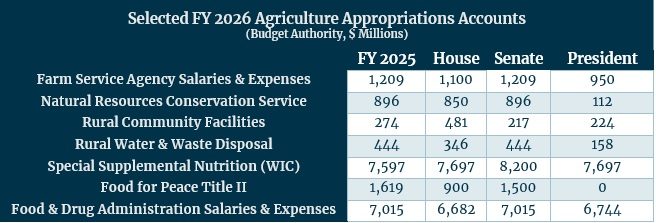
Most Agriculture appropriations go to just two accounts: the Special Supplemental Nutrition Program (WIC) and operational costs of the Food & Drug Administration.
While WIC is a welfare program and thus has some similarities to entitlements, it is operated by state governments using appropriated federal grants rather than having uncapped
autopilot funding.
Agency Staffing
The President’s Budget calls for reducing the staffing of many federal agencies and bureaus. In preparation for the shutdown, each agency was required to
evaluate their staffing so that employees essential to protect life and property and keep necessary operations running would be retained while non-essential bureaucrats would be furloughed. The U.S. Department of Agriculture (USDA)
deemed 42,256 employees, 49% of the workforce, as non-essential.
For the
Food & Drug Administration (FDA) and the Farm Service Agency (FSA), the primary reason for the administration’s lower budget request is plans to reduce headcount and spend less on compensation. More than two-thirds of the FSA employees were deemed non-essential in the
USDA’s shutdown plan, while
14% of the FDA staff were deemed non-essential.
House appropriators are comfortable with some level of savings at FSA, but in the
committee report they express concern about adequate staffing levels. The Senate’s
committee report does not address FSA staffing levels directly. In contrast, the Senate report
complains about a hiring freeze at the FDA, while the House report does not weigh in on the subject.
Earmarks
The House seeks a significant increase for the Rural Community Facilities (RCF) program, which funds housing and “economic development” projects in rural areas. In contrast, both the Senate and the President’s request would reduce this account.
Nearly all funding for the account in both chambers is set aside for earmarks, and the difference is that the House bill contains more earmark spending. This is textbook
pork barrel activity, as the RCF program funds projects of purely local concern rather than national priorities.
The House also has earmark project funding in the Rural Water & Waste Disposal account. While the Senate does not have earmarks for the account, it provides more funding than the House.
Public Costs, Private Benefits
The Natural Resources Conservation Service’s primary function is operating the Conservation Technical Assistance Program (CTA), which provides conservation and aesthetic guidance to private landowners. The Senate would keep funding flat and the House would modestly reduce this account, while the President’s Budget eliminates discretionary CTA funding and folds the program into mandatory Farm Bill spending.
The federal government spends tens of billions of dollars per year on conservation and land maintenance, including vast holdings of public land and subsidies for farmland preservation. The CTA is the least defensible aspect of conservation activity, providing free services for private parcels.
Food Aid
Title II of the Food for Peace Act involves purchasing commodities from U.S. agricultural producers and distributing them abroad. The President’s Budget recommends eliminating this program and the House would significantly reduce funding.
Title II activity has been plagued with
policy flaws for
decades. International food aid programs not only include wasteful mandates such as domestic shipping requirements (which tremendously increases costs) but also undercut poor foreign farmers who compete with U.S. handouts.
Global poverty reduction over the last century is not linked to “aid” deliveries but instead to the expansion of
economic freedom. Nations still suffering from regular food shortages 71 years after the passage of Food for Peace are victims of misgovernance (which the program cannot solve) rather than a lack of deficit-funded aid from America.
All Waste Matters
Some policymakers in Washington D.C. are openly dismissive of budgetary concerns such as these. With federal spending now exceeding
$7 trillion per year, differences worth billions of dollars are considered trivial.
From a moral perspective, $1 billion represents the economic output of thousands of middle-class households. Concerns about misusing that much money should not be treated as an afterthought.
From a budgetary perspective, the federal government operates more than
2,600 programs. Tolerating marginal programs and bureaucratic bloat for years and even decades at a time is a contributing factor to the gross federal debt recently breaching the
$38 trillion threshold.
The costs of carrying a large nonessential workforce are staggering. The average salary of a USDA employee is
$84,102 per year (higher than the
median household income in the United States), with the costs of pensions and other benefits adding much more over the long term. Congress should seriously review the staffing at these agencies and
stop funding nonessential government employees.
If Members of Congress do not have the stomach to scrutinize bureaus and programs that most Americans have never heard of, it will be nearly impossible for them to tackle
larger challenges facing universally known programs.
Reducing spending on Agriculture appropriations for FY 2026 as proposed by the President and the House would not balance the budget on its own, but it would still be worthwhile. At the very least, Congress should not mindlessly approve spending on non-essential activities.