The Congressional Budget Office (CBO) has released its
preliminary analysis of spending, revenue, and deficits for fiscal year (FY) 2025. CBO’s report illuminates several concerning trends that should prompt legislative action to rein in reckless spending and reduce deficits as soon as possible.
Strong Revenue Growth Fails to Prevent Disturbing Deficit
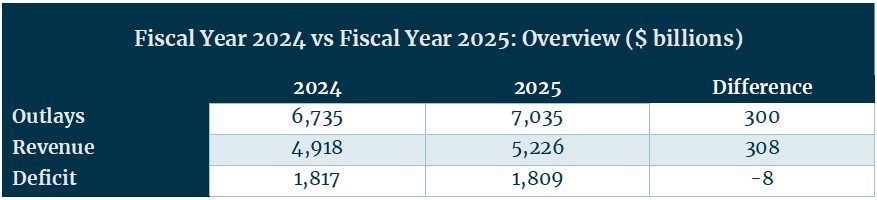
CBO estimates that the federal government brought in a record $5.23 trillion of revenue in FY 2025. This would have been enough to generate a substantial surplus in any fiscal year prior to 2020. However, because the federal government spent a record $7.04 trillion, the deficit was a cavernous $1.81 trillion.
Deficits of this size (roughly 6 percent of the economy) have historically been linked to major events such as war or recession. However, the current cause of large deficits is now structural.
Most federal spending is on
autopilot, meaning that the spending occurs automatically year after year unless it is actively changed by new legislation. Several major autopilot programs are growing at an
unsustainable rate. This means that inaction by Congress all but guarantees continuing to run dangerously large deficits.
Revenue in 2025 increased by 6.3 percent from 2024. While spending did not grow as rapidly in percentage terms, it still swelled by enough to consume 97 percent of the revenue growth and leave a nearly identical deficit.
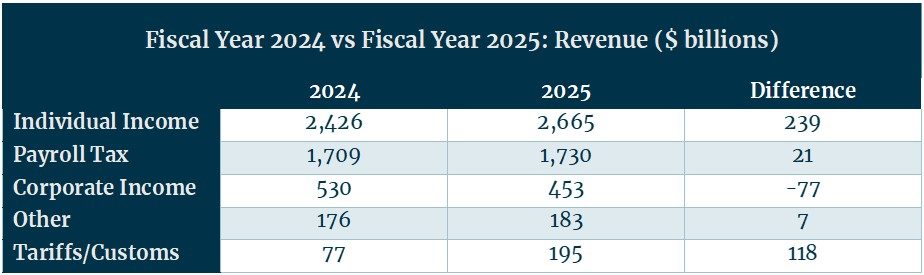
The bulk of the revenue increase came from individual income taxes, which grew by $239 billion (just under 10 percent) from 2024 to 2025.
The $118 billion increase in tariff revenue is also noteworthy. President Trump’s dramatic moves on trade policy did not begin until February, meaning that tariff revenue was concentrated in the second half of the fiscal year.
Education Savings & Dangerous Growth in Major Spending Categories
Breaking out spending in different programs and categories highlights one area of progress and several areas of concern.
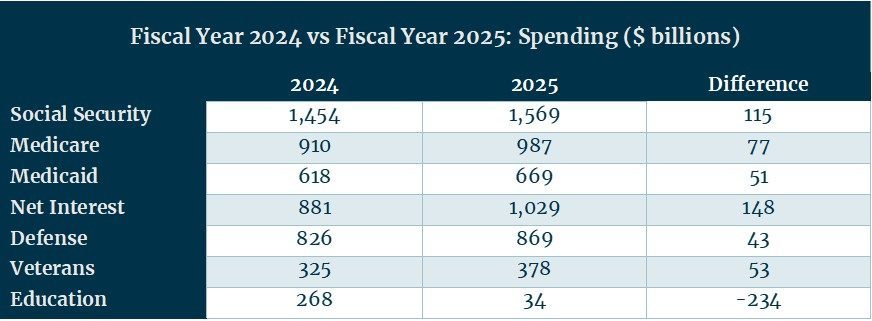
While CBO estimates that federal spending increased by $300 billion in FY 2025, there is a significant caveat. The One Big Beautiful Bill Act (OBBB) reconciliation package included reforms to federal
student loan programs. Based on CBO’s accounting practices the savings were immediately credited to fiscal year 2025, leading to a one-time $131 billion reduction in education spending.
Setting aside those savings, total outlays would have increased by $431 billion, or 6.4 percent –a slightly higher rate than the 6.3 percent revenue increase and $123 billion more in absolute terms.
Worse, four of the largest parts of the federal budget all had spending increases of 8 percent in 2025: Social Security, Medicare, Medicaid, and net interest on the national debt. These account for $4.25 trillion in spending and are growing at more than twice the rate of the economy. While Medicaid reforms in the OBBB will
slow its growth in future years, there is nothing to brake the growth in the other three areas.
FY 2025 contained a dubious milestone: net interest spending cracked the $1 trillion threshold and is now 18 percent larger than
spending on national defense.
Spending by the Department of Veterans Affairs has also grown at a brisk pace, from $218 billion in 2020 to $378 billion in 2025. The
PACT Act of 2022 was a turning point, as a variety of medical conditions are now presumed to be service-related for veterans of Iraq and Afghanistan. At the current rate of growth, the Veterans Affairs budget would exceed half a trillion dollars in 2028.
Legislative Action Can Preserve America’s Future
From September 30, 2024, to September 30, 2025, the
gross national debt increased by $2.17 trillion. The nation’s fiscal space is rapidly eroding, which increases the risk associated with potential destabilizing events. Additionally, the large debt burden and rising interest costs act as a significant drag on economic growth.
The question for legislators is not whether to retain America’s commitment to its veterans, maintain a strong national defense, or keep faith with retirees who contributed payroll taxes for decades. Rather, it is whether Congress is willing to make reforms that
prioritize core federal responsibilities and rein in handouts to
special interest groups and
corporate cronies.
The 119
th Congress has opportunities to reduce deficits over the coming year.
- FY 2026 appropriations legislation is currently at a stalemate. There will be tremendous pressure in the coming weeks for the House to accept the Senate’s broadly higher spending levels. Not only would this increase spending in FY 2026, but it would also bloat the baseline and promote hundreds of billions in additional spending over the next decade. Congress should instead view FY 2024 spending levels as a ceiling rather than a floor and find ways to add savings.
- A second reconciliation package can build on reforms passed in the OBBB. Potential options include ending Medicaid’s funding bias in favor of healthy working-age adults, eliminating remaining Green New Deal handouts, and repaving the Highway Trust Fund.
While this work will not be easy, legislators have an obligation to make tough choices for the sake of ensuring America’s future greatness.