The largest domestic policy appropriations package is the Labor, Health and Human Services, and Education (LHHSED) bill. These agencies, none of which existed for most of America’s history, are rife with wasteful and contentious spending.
For
Fiscal Year (FY) 2026, the
House bill would spend $184.5 billion and the
Senate bill would spend $197 billion, a difference of $13.7 billion or 6.8%.
As Congress moves forward with full year appropriations, legislators should consider not just the package by itself but also how best to handle specific accounts. The $13.7 billion spending difference between the House and Senate is caused by divergent policy choices. If Congress intends to spend a 12-figure sum, it should do so with deliberation.
This post compares funding for selected accounts in the FY 2026 LHHSED appropriations bills proposed by the House and Senate alongside FY 2025 levels and the
President’s Budget.
Labor Department, CNCS
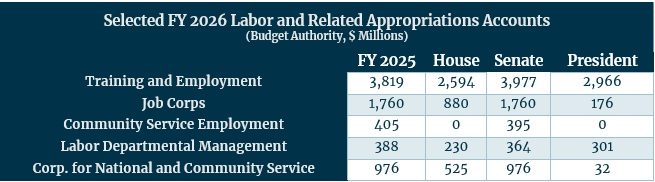
The U.S. Department of Labor’s discretionary budget focuses on programs claimed to promote employment, including job training and the Job Corps. Yet the historical track record has been
lackluster, with programs having higher
economic costs than benefits.
The Senate LHHSED bill would slightly increase this spending, while the House would reduce it. The
President’s Budget calls out the underperformance of these programs, seeking both an overhaul in the policy area and a reduction in spending.
The Community Service Employment for Older Americans program (CSE, part of Labor) and the Corporation for National and Community Service (CNCS, an independent agency) are promoted as ways to provide fulfillment for participants while helping neighborhoods. This is not an appropriate role for the federal government, and these initiatives have failed to produce commensurate results with billions of dollars in funding. The President’s Budget calls for ending both initiatives. The House bill would eliminate CSE and reduce CNCS. The Senate bill maintains CNCS funding and barely reduces CSE.
Prior to the government shutdown, the Department of Labor’s
contingency plan deemed 9,775 employees (76%) as non-essential.
Health & Human Services
The U.S. Department of Health and Human Services (HHS) contains 15 bureaus and oversees at least 433
programs. It is riddled with waste, duplication, and handouts to
state and local governments. Despite this, its budget has surged decade after decade.
The
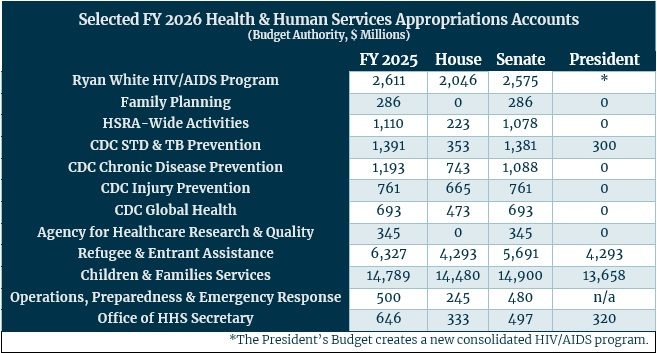
President’s Budget calls for a dramatic reorganization of HHS, eliminating many bureaus and programs while consolidating functions into a new Administration for a Healthy America. On net this would entail a meaningful reduction in appropriations. While the House bill is not positioned to overhaul HHS (being appropriations rather than authorizations), it generally moves in the same direction by eliminating or significantly reducing many bureaus and programs. The Senate bill only makes modest reductions.
Both the House bill and the President’s Budget would reduce spending on HIV/AIDS programs. Legislators who are wary of such a move should understand that spending on HIV/AIDS is high despite sustained
progress in reducing death and infection rates. Further, the drivers of infection are behavioral choices that have been established for decades. Bringing HIV/AIDS funding in line with other diseases is appropriate.
The Title X Family Planning program has at times subsidized
abortion providers, and it provides contraceptive services that violate the conscience of millions. Both the House bill and the President’s Budget eliminate it while the Senate bill retains funding.
The Senate bill increases funding for Health Resources and Services Administration solely to facilitate earmarks, some of which go to facilities that perform
abortions and pediatric gender transitions.
Refugee and Entrant Assistance funding exploded in FY 2022 due the Biden Administration’s
deliberate failure to control the border or enforce immigration law. While the Trump Administration has prioritized
border security and immigration enforcement, there are still many refugee status claimants and unaccompanied children. The President’s Budget would focus this account on children. The House bill matches the President’s funding, while the Senate reduces the account by roughly 10%.
Prior to the government shutdown, the HHS
contingency plan deemed 32,460 employees (41%) as non-essential.
The House and Senate LHHSED bills preserve
Hyde Amendment protections against taxpayer funding of abortions. This is not just a win for conservative values, but also for pluralism and basic human decency.
Education
The U.S. Department of Education has been an
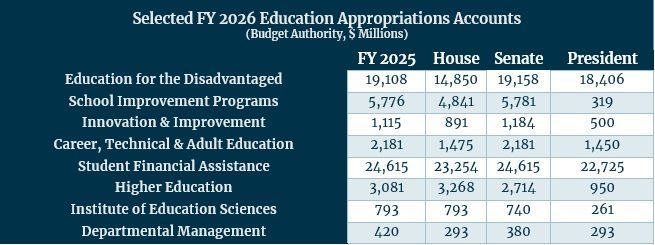
abject failure. Despite more than $3 trillion in total outlays since 1980, America’s K-12 schools have not made progress in teaching fundamentals and higher education costs have exploded in the name of “affordability.”
President Trump seeks to
close the agency, though the
President’s Budget retains most of its programs and bureaus while reducing spending. The House bill also reduces most key accounts, while the Senate bill generally retains the wasteful status quo.
The Senate bill also contains dubious education earmarks, such as one for the
Jacob’s Pillow Dance Festival in Massachusetts.
Prior to the government shutdown, the Department of Education’s
contingency plan deemed 2,117 employees (87%) as non-essential. In other words, the federal department is
not necessary for the continuing education of America’s children.
CFPB Remains Defunded
Neither of the LHHSED bills contain funding for the
Corporation for Public Broadcasting (CFPB), which has been a funding source for the Public Broadcasting Service (PBS) and National Public Radio (NPR). This summer’s
rescissions package defunded the CFPB. Assuming that FY 2026 appropriations pass without adding CFPB funding, PBS and NPR will learn to fully rely on funding sources such as
private donations.
Stand for Civil Society and Fiscal Sanity
Legislators who seek increases to LHHSED appropriations often rely on blunt demagoguery, casting conservatives as heartless for opposing limitless spending on healthcare, welfare, and education. Such hectoring misses the mark.
Besides the fact that the federal government is not in a
financial position to be responsible for addressing every want and need in these areas, it is also not the proper agent for action. Civil society groups such as religious institutions and charities are better positioned to help those in need, along with private networks of friends, family, and communities.
The federal government’s “value” is cutting deficit financed checks rather than providing solutions to social and individual problems. Congress should recognize that big government is not a solution, which includes ending its habit of sending good money after bad in the appropriations process.