It remains to be seen when Congress will come to an agreement on ending the partial
government shutdown which began on October 1, 2025, due to a lapse in appropriations. Since the first step will likely be a
Continuing Resolution, legislators would then need to reach agreement on full-year discretionary spending bills for fiscal year (FY) 2026.
Among the bills that the House and Senate Appropriations Committees have reported is the package covering Transportation, Housing and Urban Development (THUD).
THUD is the fourth-largest appropriations bill from a
spending perspective. The
House bill appropriates $89.9 billion for THUD, while the
Senate bill provides $100 billion, a difference of $10.3 billion or 11.5%.
Legislators should not only restrain total spending in the THUD bill but also spending on problematic accounts. There is significant dysfunction in federal housing programs, and many infrastructure programs provide little value for taxpayers.
This post compares funding for accounts in the FY 2026 THUD appropriations bills proposed by the House and Senate, alongside FY 2025 levels and the
President’s Budget.
Transportation
The U.S. Department of Transportation (DOT) funds many types of infrastructure projects along with controlling operations for a handful of transportation networks, notably in the aviation sector. There are many disagreements between the House, Senate, and
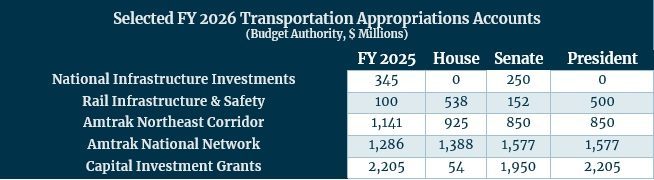
President’s Budget regarding how to prioritize DOT funding, with a mixture of increases and decreases to accounts relative to FY 2025 levels.
The National Infrastructure Investments (NII) program was created as part of the 2009 stimulus package. The NII began at a time when Congress had implemented a ban on earmark spending, and some legislators wanted a new funding mechanism for local projects such as streetcars and promenades. As a result, it has functioned as a slush fund for
low-value projects rather than improving national networks. The President’s Budget and the House bill seek to eliminate the NII (which makes little sense following the
return of legislative earmarks), while the Senate bill merely reduces it.
The Consolidated Rail Infrastructure and Safety Improvements program provides grants for passenger and freight rail. The House bill and President’s Budget seek a significant increase, while the Senate bill provides a more modest boost. To the extent that this increase is a response to the 2023 derailment and chemical spill in East Palestine, Ohio, legislators should be aware that insufficient federal spending was
not to blame.
The National Passenger Railroad Corporation, better known as Amtrak, was created when the federal government took over several failing regional railroads. The most important part of Amtrak is the
northeast corridor (Boston to Washington, DC), which carries the most passengers per mile of track. The rest of the Amtrak national network requires heavy subsidization per passenger due to lower ridership per mile. Policymakers should rethink the value of increasing national network subsidies, which is unfortunately what the House and Senate bills and the President’s Budget propose.
The Capital Investment Grants program funds new mass transit projects. This approach is wrongheaded: transit ridership has been stagnant for decades despite more than
$1 trillion in cumulative subsidies. Transit agencies receiving “free” federal dollars for expansion projects are saddled with operations and maintenance costs, but political incentives mean a preference for ribbon-cutting ceremonies rather than long-term thinking. The House bill wisely reins in this wasteful program.
The House and Senate bills, along with the President’s Budget, largely maintain the status quo for aviation policy. In the wake of widespread
problems for aviation caused by the shutdown, Congress should consider overhauling
air traffic control.
Both the House and Senate bills contain a multitude of infrastructure earmarks, ranging from reasonable federal highway improvements to ridiculous boondoggles. Examples of the latter include nearly $7 million for a
shared use path in Hawaii (a “highway” expenditure) and $1.1 million for
wi-fi internet service on a lightly used section of commuter rail in central California.
Prior to the government shutdown, the DOT’s
contingency plan deemed 12,213 employees (23%) as non-essential.
Housing & Urban Development
The U.S. Department of Housing and Urban Development (HUD)’s discretionary budget primarily funds
welfare programs, the largest of which are for rental assistance. The
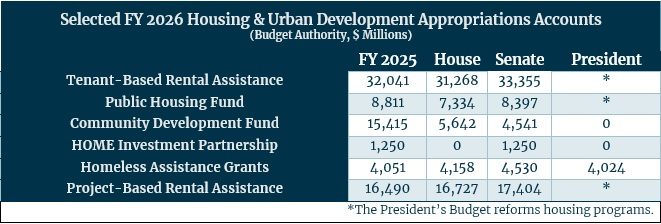
President’s Budget seeks significant reforms, folding many of these programs together while reducing the overall appropriation. The House and Senate bills maintain the status quo organizationally, though the Senate spends billions of dollars more in aggregate.
The Community Development Fund (CDF) facilitates
local pork projects and is heavily earmarked by both the House and Senate. Notably, the account is larger in the House bill than the Senate due to the larger dollar volume of earmarks. This does not excuse the Senate, which seeks CDF earmarks for the
New York Metropolitan Opera and many
left-wing activist groups. Further, if both House and Senate earmarks are merged in the final THUD legislation, CDF funding would increase relative to the House bill to accommodate the additional earmarks. In contrast, the President’s Budget fully defunds the CDF.
While homelessness is a genuine policy concern, Congress should consider the wisdom of the federal government spending billions of dollars per year on homelessness grants. The problem is unevenly distributed, is worse in
poorly governed areas (meaning federal grants are a de facto subsidy for dysfunctional choices such as tolerating homeless camps), and much of the funding is captured by the
Homeless Industrial Complex.
Prior to the government shutdown, the HUD
contingency plan deemed 4,359 employees (71%) as non-essential.
$40 Trillion Debt Is Coming
The culture of Congress is to ignore the fiscal implications of most pieces of legislation (such as appropriations), since any one bill only has a fractional effect on the full budget. This myopic approach ignores the fact that the current
$38 trillion gross debt accumulated one dollar at a time. Each bill matters, and all tax dollars deserve respect.