The Food Stamp program has promoted a culture of dependency.
[1] In recent decades, enrollment has expanded significantly, benefit levels have grown faster than inflation, and taxpayer spending has surged. The program’s work requirements are weak, limited, and often waived. Because of this, few of the millions of work-capable adults on the food stamp rolls work at all. Some enrollees also do not even meet the statutory income and asset requirements. Meanwhile, millions of taxpayer-provided benefits are wasted on improper overpayments each year.
Congress should continue the important work of welfare reform to promote opportunity rather than dependency.
In the Fiscal Responsibility Act of 2023, Congress declared that a purpose of Food Stamps was “to assist low-income adults in obtaining employment and increasing their earnings.”
However, the work-promotion policies in the Food Stamp program are in desperate need of improvement.
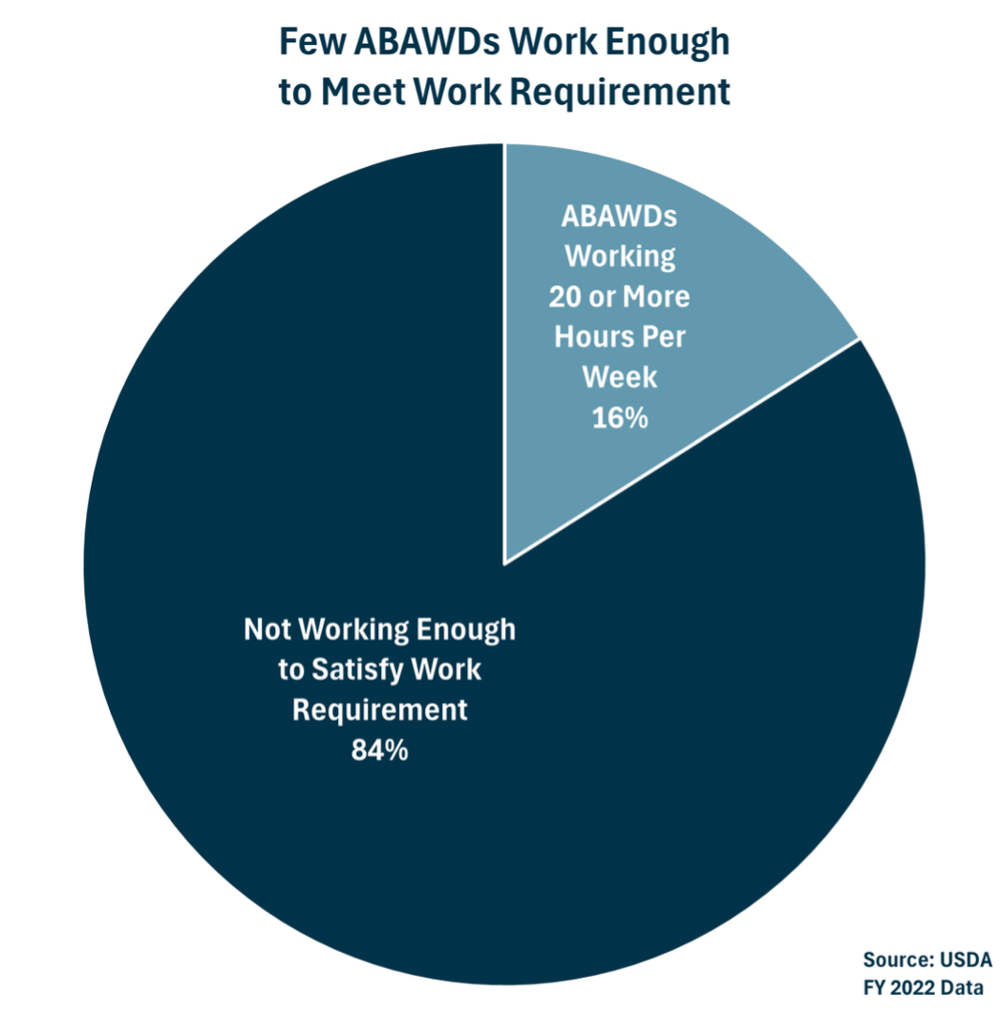
[2] Few Food Stamp recipients work, and those who do work do not work very much. In 2022, 84 percent of those who are supposed to be subject to the work requirement did not work the 20 hours per week needed to satisfy the work requirement through employment.
[3]
Work Requirements Work
The Dignity of Work
Work is an essential American value. It is a positive good for individuals, families, communities, and our nation.
It can instill ethics of integrity, honesty, respect, empathy, and accountability. Work requires effort that is essential to earned success. It increases and amplifies peoples’ engagement with their communities, strengthening local bonds and trust. Collaborative work provides an avenue for innovation to solve problems, encouraging growth and development to improve quality of life for all. As it benefits the larger society, work gives individuals a sense of purpose, allowing them to utilize their unique gifts and talents and achieve their full potential.
There is an inherent dignity in honest work. Work is not a punishment but instead provides an important source of meaning for people. As Arthur Brooks, a Harvard professor focusing on happiness and former President of the American Enterprise Institute, has written:
“Work gives people something welfare never can. It’s a sense of self-worth and mastery, the feeling that we are in control of our lives. This is a sense of abiding joy.”
[4]
It is demeaning to believe that many Americans are simply unable to be successful and should be relegated to a life of dependence on perpetual government subsidization of their basic needs. Trapping people in cycles of dependency is a symptom of a deficit mindset about low-income people.
We should not define success for government anti-poverty programs by inputs like how much they spend, how many people are enrolled, or by allowing people to stay on the rolls forever. Instead, we should enact policies that empower people to earn success based on the belief that poverty and dependency can be temporary conditions. The best welfare benefit is one that gets a person off of welfare and into a job.
Work Requirements are Common Sense
It is only right that government policy helps people escape from poverty and reach their full potential.
Offering a hand up and not just a handout would ensure better results for everyone: recipients who are put on a path towards self-sufficiency, the truly needy for whom a safety net is safeguarded, and the taxpayers whose funds are used more efficiently and effectively.
Welfare programs without work requirements for able-bodied adults encourage dependence and reduce employment. Policies that expect work or work preparation activities as a condition of receipt of welfare benefits for able-bodied adults have a positive impact.
[5]
Those who work full time are virtually guaranteed not to be in poverty. According to the Bureau of Labor Statistics (BLS), “Full-time workers remained much less likely to be among the working poor than part-time workers. Among people in the labor force for 27 weeks or more, 2.6 percent of those usually employed full time were classified as working poor, compared with 10.2 percent of part-time workers."
[6]
Work is also associated with positive mental and physical health outcomes. A study for the United Kingdom’s Department for Work and Pensions found:
“There is a strong evidence base showing that work is generally good for physical and mental health and well-being. Worklessness is associated with poorer physical and mental health and well-being. Work can be therapeutic and can reverse the adverse health effects of unemployment.”
[7]
A recent American Enterprise Institute study found that Food Stamp recipients who worked were 14 percentage points less likely to report feelings of hopelessness or worthlessness than recipients who did not work.
[8]
The One Big Beautiful Bill Strengthens Work Requirements and Promotes Opportunity
The House Agriculture Committee’s reconciliation recommendations in the One Big Beautiful Bill make important progress in strengthening work requirements for able-bodied adults on Food Stamps.
[9]
Restricting Waivers
Geographic waivers are a loophole that have gutted the existing work requirement, allowing millions of work-capable adults to receive Food Stamps without working.
[10]
States may request waivers of the work requirements for geographic “areas” deemed to lack a “sufficient number of jobs.” However, states and the U.S. Department of Agriculture (USDA) exploit these loosely defined terms and expansive regulations to gerrymander boundaries and use outdated data to exempt millions of able-bodied welfare recipients from work. Left-wing advocacy groups even provide mapping and consulting services for states to maximize waivers.
[11]
These loopholes have allowed four states to waive work requirements statewide and 25 others to implement partial waivers despite modest unemployment rates and 7.4 million job openings reported by the BLS in April.
[12] In many of the states with partial waivers, the work requirement is waived in most of the state.
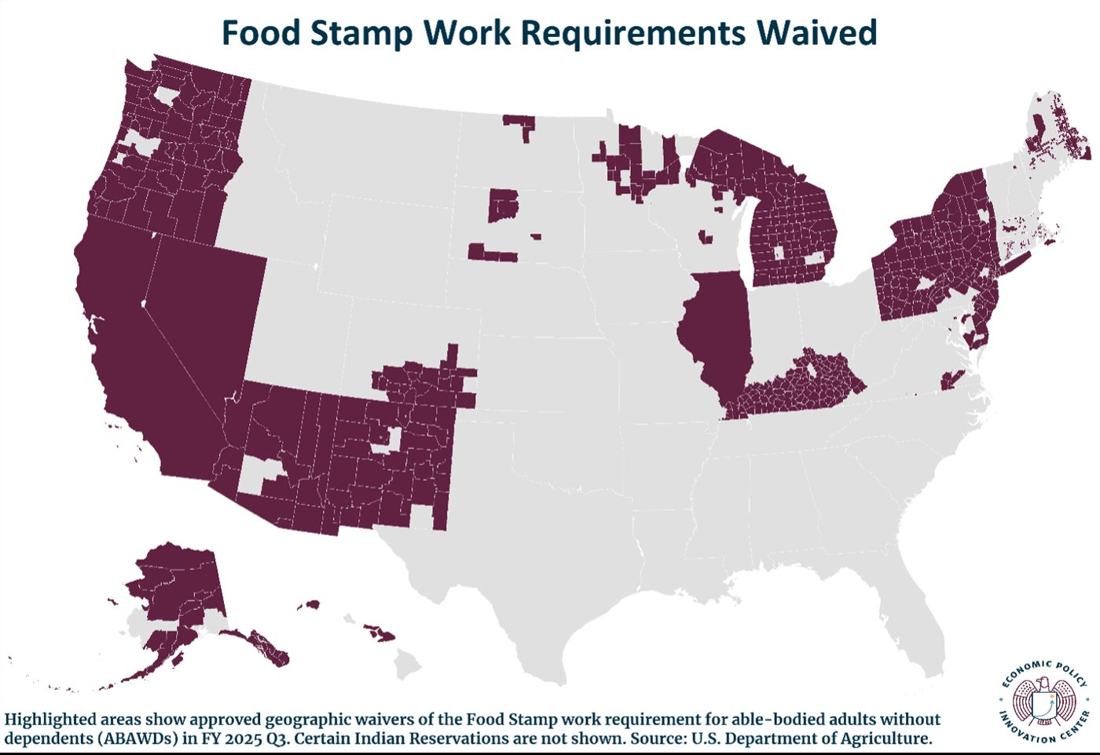
California is an example of an egregious work requirement waiver gimmick.
[13] The state has 5.5 million Food Stamp recipients. At the very end of the Biden Administration, California was granted a two-year statewide waiver of work requirements, lasting through January 2027, based on data from 2021 – more than five years earlier.
New York is another example of an egregious work requirement waiver gimmick.
[14] New York grouped 61 of its 62 counties into one massive “area” to gerrymander the data and exclude as many people as possible from the work requirement. Even in its submission to the USDA, New York admitted that only 11 counties would have qualified on their own.
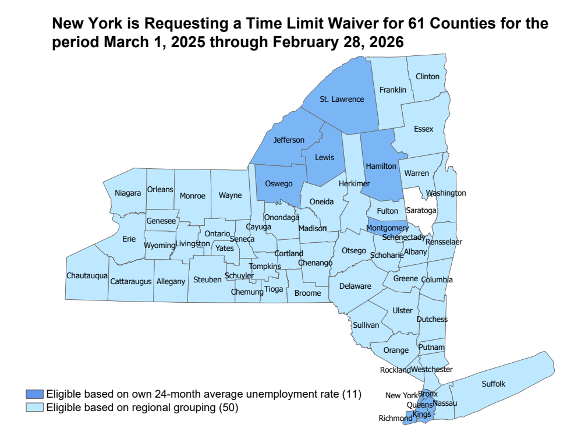
The One Big Beautiful Bill makes significant progress in closing these loopholes by eliminating the subjective lack of “sufficient number of jobs” criteria. Instead, states would only be able to request a geographic waiver for counties with an unemployment rate of over 10%.
Work is Pro-Family
Promoting work for parents is an important pro-family reform. Households with children should have at least one worker to provide for the family and set a positive example for the next generation. The best way to reduce child poverty is not through government handouts, but by helping parents get on an upwardly mobile trajectory.
As Pope John Paul II taught, “Work constitutes a foundation for the formation of family life, which is a natural right and something that man is called to… In a way, work is a condition for making it possible to found a family, since the family requires the means of subsistence which man normally gains through work.”
[15]
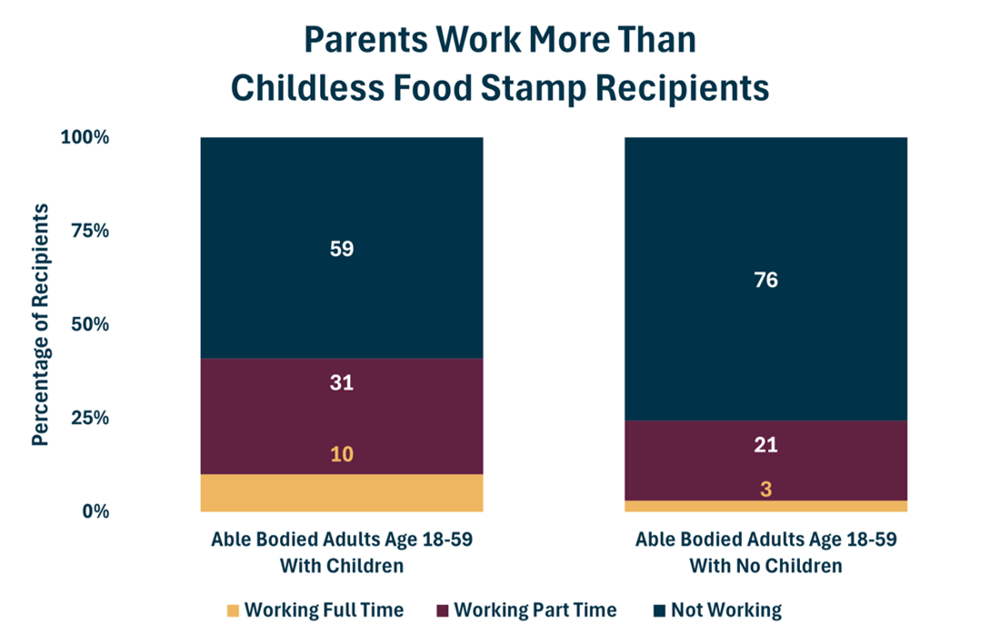
Although parents are currently excepted from the work requirements, they actually work more than the childless adults who are subject to the work requirement. Parents naturally want to work to provide a better future for their families rather than remain dependent solely on government welfare.
In 2022, 41 percent of able-bodied adults on Food Stamps with children worked, compared to just 24 percent of childless able-bodied adults. The difference in full-time employment is particularly stark, with more than three times the percentage of parents working full-time compared to non-parents.
The OBBB applies work requirements to parents of children aged 7 and older, with an exception for a married parent who lives with a child and a spouse who meets the work requirement.
Age of Applicability
The OBBB expands work requirements to certain able-bodied adults through age 64 – up from the current maximum age of 49 under permanent law.
The Food Stamp Program Suffers from Improper Payments
The Food Stamp program makes billions of improper payments each year. The USDA has reported more than $56 billion of improper payments between FY 2003 and FY 2023. The reported improper payment rate was 11.7 percent in 2023.
[16]
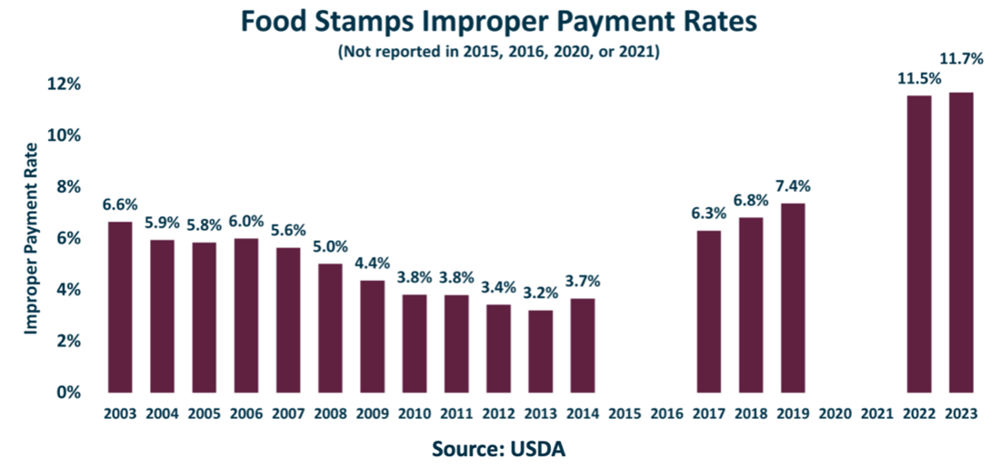
Virtually all Food Stamp improper payments are overpayments. In FY 2023, 10 percent of Food Stamp payments were overpayments while just 1.6 percent were underpayments.
Improper payments are likely significantly higher than the reported amounts. In fact, the 2014 Farm Bill instructed USDA to ignore improper payments up to a “quality control tolerance threshold.” This threshold was set at $37 in 2014 and increases with inflation each year. In 2023, the “tolerance threshold” was $54. Thus, any improper payment up to $54 was intentionally not reported.
A State Cost-Share Would Help
Because states are administering a program that is completely funded by the federal government, they have little incentive to control overpayments. As a result, many states have astonishingly large overpayment rates.
Introducing a matching requirement, whereby state governments bear a portion of the program costs, would encourage states to take a more active role in eliminating the tens of billions of improper payments that plague the Food Stamp program each year.
[17]
A state cost-sharing requirement would not reduce or change total benefit spending on Food Stamps. It would promote better outcomes for beneficiaries, fairness, and fiscal federalism.
To fix this inequity and improve incentives, the House-passed bill included a state cost-sharing requirement. Each state would contribute 5% of program costs beginning in 2028. States with improper payment rates of 6% or higher would contribute more based on a sliding scale, with states that have a payment error rate of 10% or higher contributing 25% of program costs.
Close the Broad-Based Categorical Eligibility Loophole (BBCE)
One way that states avoid reporting improper payments is by ignoring the Food Stamp income and asset limit rules through a loophole called Broad-Based Categorical Eligibility (BBCE). Through BBCE, states may provide Food Stamps to households that receive benefits through Temporary Assistance for Needy Families (TANF), Social Security Income, and state-funded general assistance programs, even if the household does not meet the federal requirements. The “benefits” provided by TANF that confer Food Stamp eligibility can be as limited as being provided a brochure or a pamphlet.
An estimated five million Food Stamp recipients get benefits despite not actually qualifying under normal program rules.
[18] Without a state-cost sharing requirement, states have no incentive to limit a sweeping expansion of Food Stamps with federal dollars.
Important Progress in Promoting Work
The reforms included in the One Big Beautiful Bill represent important progress in addressing waste, fraud, and abuse. Eliminating these loopholes would restore Food Stamp program integrity while safeguarding assistance for the truly needy.
[1] Matthew Dickerson, "Food Stamps: A Culture of Dependency," Economic Policy Innovation Center, May 8, 2025,
../../social-programs/food-stamps-a-culture-of-dependency/.
[2] Matthew Dickerson, "Strengthen Food Stamp Work Requirements to Promote Opportunity," Economic Policy Innovation Center, May 1, 2025,
../../social-programs/strengthen-food-stamp-work-requirements-to-promote-opportunity/.
[3] United States Department of Agriculture, “Characteristics of Supplemental Nutrition Assistance Program
Households: Fiscal Year 2022,” Table A.26. Work status of participants by age and household composition, June 2024,
https://www.fns.usda.gov/research/snap/characteristics-fy22 (accessed April 21, 2025).
[4] Arthur C. Brooks,
The Conservative Heart, page 96, HarperCollins, New York, New York, 2015.
[5] For reviews of evidence on work requirements, see: Matthew Dickerson, "Strengthen Food Stamp Work Requirements to Promote Opportunity," Economic Policy Innovation Center, May 1, 2024,
../../social-programs/strengthen-food-stamp-work-requirements-to-promote-opportunity/; The Council of Economic Advisers, " Medicaid Community Engagement Requirements and the Value of Work," June 2025,
https://www.whitehouse.gov/wp-content/uploads/2025/03/Medicaid-Community-Engagement-Requirements-and-the-Value-of-Work.pdf (accessed June 22, 2025); and Council of Economic Advisers, " Expanding Work Requirements in Non-Cash Welfare Programs," July 2018,
https://trumpwhitehouse.archives.gov/wp-content/uploads/2018/07/Expanding-Work-Requirements-in-Non-Cash-Welfare-Programs.pdf (accessed June 22, 2025).
[6] Bureau of Labor Statistics, “A profile of the working poor, 2020,” September 2022,
https://www.bls.gov/opub/reports/working-poor/2020/home.htm (accessed February 13, 2024).
[7] Gordon Wadell and A. Kim Burton, “Is work good for your health and well-being? An independent review,” U.K. Department for Work and Pensions, January 1, 2006,
https://www.gov.uk/government/publications/is-work-good-for-your-health-and-well-being (accessed March 10, 2024).
[8] Angela Rachidi and Thomas O’Rourke, “Work Improves Mental Health,” American Enterprise Institute, June 8, 2023,
https://www.aei.org/opportunity-social-mobility/work-improves-mental-health/ (accessed March 10, 2024).
[9] Matthew Dickerson, "Progress In Strengthening Food Stamp Work Requirements," Economic Policy Innovation Center, May 13, 2025,
../../social-programs/progress-in-strengthening-food-stamp-work-requirements/.
[10] Matthew Dickerson, "Work Requirements, Not Workarounds: Ending Food Stamp Waiver Abuse," Economic Policy Innovation Center, April 28, 2025,
../../federal-budget/work-requirements-not-workarounds-ending-food-stamp-waiver-abuse/.
[11] See for example, Tennessee Department of Labor & Workforce Development, “SNAP Employment and Training State Plan,” Appendix C, Federal Fiscal Year 2016,
https://web.archive.org/web/20170222160158/https://www.tn.gov/assets/entities/labor/attachments/TN_SNAP_ET_State_Plan_FFY_2016.pdf(accessed April 21, 2025).
[12] United States Bureau of Labor Statistics, “Job Openings and Labor Turnover Summary,” June 3, 2025,
https://www.bls.gov/news.release/pdf/jolts.pdf (accessed June 20, 2025).
[13] Catrina L. Kamau to Alexis Fernández Garcia, “RE: Supplemental Nutrition Assistance Program (SNAP) – California Request to Waive Able-bodied Adults Without Dependents Time Limit – Initial – Approval,” U.S. Department of Agriculture, January 15, 2025,
https://fns-prod.azureedge.us/sites/default/files/resource-files/ca-abawd-response-fy2025-b.pdf (accessed April 21, 2025).
[14] Catrina L. Kamau to Valerie T. Figueroa, “RE: Supplemental Nutrition Assistance Program (SNAP) – New York Request to Waive Able-Bodied Adults Without Dependents Time Limit – Initial – Approval,” U.S. Department of Agriculture, October 2, 2024,
https://fns-prod.azureedge.us/sites/default/files/resource-files/ny-abawd-response-fy2025.pdf (accessed April 21, 2025).
[15] John Paul II, “Laborem Exercens,” The Holy See, 1981,
https://www.vatican.va/content/john-paul-ii/en/encyclicals/documents/hf_jp-ii_enc_14091981_laborem-exercens.html (accessed February 13, 2024).
[16] USDA reported data quality issues in FY 2015 and 2016 that prevented it from providing improper payment rates. In FY 2020 and 2021, USDA suspended state error data reporting requirements during the COVID-19 pandemic. PaymentAccuracy.gov, “Annual Improper Payments Datasets,” 2024 Dataset, November 2024,
https://www.paymentaccuracy.gov/payment-accuracy-the-numbers (accessed April 17, 2025); and U.S. Department of Agriculture, “SNAP Payment Error Rates,” July 9, 2024,
https://www.fns.usda.gov/snap/qc/per (accessed April 17, 2025). The USDA did not report improper payment rate data for FY 2015, 2016, 2020, or 2021.
[17] Matthew Dickerson, "Food Stamp State Cost Sharing Can Improve Outcomes and Sustainability Without Changing Total Benefit Spending," Economic Policy Innovation Center, April 28, 2025,
../../federal-budget/food-stamp-state-cost-sharing-can-improve-outcomes-and-sustainability-without-changing-total-benefit-spending/.
[18] Paige Terryberry, “How Congress Can Protect the Truly Needy and Restore Program Integrity to Food Stamps by Ending Broad-Based Categorical Eligibility,” Foundation for Government Accountability, August 14, 2023,
https://thefga.org/research/how-congress-can-protect-needy-by-ending-bbce/ (accessed April 23, 2025).